

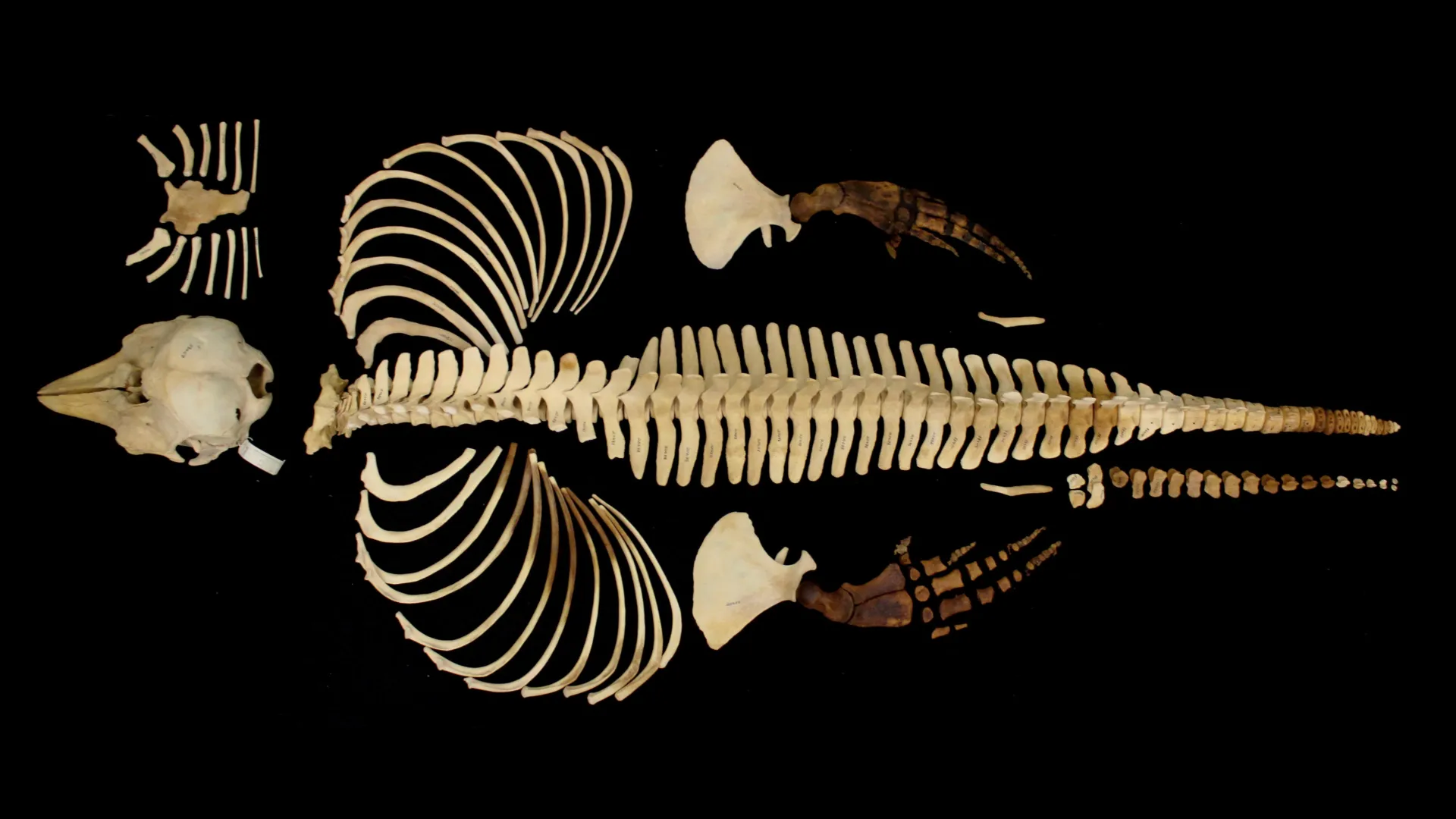
The vaquita (Phocoena sinus), a small porpoise found only in the shallow waters of Mexico’s northern Gulf of California, is among the most endangered marine mammals on the planet. At roughly 5 feet long, it is the smallest member of the cetacean group, which includes whales, dolphins and porpoises. Recognizable by the dark markings around its eyes and mouth, the vaquita was unknown to science until the second half of the 20th century. Today, it has become a powerful symbol of the biodiversity crisis affecting oceans around the world.
Only an estimated handful of vaquitas remain in the wild, leaving the species dangerously close to extinction. The population collapse has been caused primarily by accidental entanglement in gillnets, especially those used to illegally catch totoaba. This large fish is targeted because its swim bladder commands high prices on international black markets. Although fishing for totoaba was banned decades ago, illegal harvesting continues due to wildlife trafficking networks and persistent overseas demand.
Despite years of conservation efforts, the future of the vaquita remains uncertain. Experts say its survival depends on swift international cooperation to eliminate gillnet fishing within its habitat and prevent the disappearance of one of the ocean’s most critically endangered species.
Advanced Imaging Creates a Digital Vaquita Archive
In an effort to preserve knowledge of the species, researchers from Florida Atlantic University worked with the San Diego Natural History Museum, SeaWorld California, and NOAA Fisheries to digitally document a complete female vaquita skeleton. The specimen was donated to the museum in 1966 and has now become the basis for an exceptionally detailed digital record of the rare porpoise.
The research, published in Marine Mammal Science, combined medical CT scans, micro-CT imaging, and digital photography to produce one of the most comprehensive digital anatomical records of a vaquita ever created. The approach allowed scientists to capture tiny skeletal features and transform them into interactive three-dimensional models.
“By combining advanced imaging technologies with open-access data sharing, the effort not only safeguards a valuable record of one of the planet’s most endangered marine mammals, but also makes that information accessible to anyone,” said Jamie Knaub, first author, imaging lab assistant in the Berlin Family Bioimaging Lab at FAU Laboratory Schools Marcus Research and Innovation Center, and a Ph.D. candidate in the FAU Department of Biology within the Charles E. Schmidt College of Science. “The project will enable the production of scientifically accurate replicas for museums, classrooms and educational programs, helping to raise awareness and support conservation efforts for a species now teetering on the edge of extinction.”
Knaub collaborated with co-authors Brittany Aja Dolan, formerly with SeaWorld California and the leader of the project; Philip Unitt, curator of birds and mammals at the San Diego Natural History Museum; and Robert L. Brownell Jr., Ph.D., a biologist with Southwest Fisheries Science Center, Marine Mammal and Turtle Division, NOAA Fisheries, who collected the specimen during the 1960s while he was a graduate student.
CT and Micro-CT Scans Reveal Microscopic Details
To build the digital archive, the team used several imaging techniques that documented the skeleton at multiple levels of detail. Researchers first scanned the specimen using medical computed tomography (CT), which uses X-rays to generate cross-sectional images. They then photographed individual bones and skeletal components before performing high-resolution micro-computed tomography, or micro-CT, scans.
Unlike standard CT scanners, micro-CT systems can capture extremely small anatomical structures measured in microns — smaller than the width of a human hair.
“This project required an unusually intricate imaging workflow to capture the vaquita skeleton at multiple scales, from whole-bone structure down to microscopic internal detail,” said Marianne E. Porter, Ph.D., senior author and a professor, FAU Department of Biological Sciences. “By integrating medical CT, micro-CT and high-resolution photography, we were able to reconstruct both the external morphology and internal architecture of each bone in a way that preserves anatomical fidelity while remaining fully interactive in digital form. The result is not just a model, but a layered dataset that reflects the true complexity of the specimen.”
The scanning process generated thousands of cross-sectional images. Using specialized three-dimensional imaging software, researchers digitally separated each bone and reconstructed them into highly detailed 3D models. The resulting replicas can be rotated, enlarged, and viewed from any angle, allowing scientists to study the specimen without risking damage to the original skeleton.
Open Access 3D Models for Research and Education
Because the original vaquita skeleton is both fragile and extremely rare, opportunities for direct study and public display are limited. To make the information more widely available, the team has uploaded the 3D models to the online repository MorphoSource, where they can be freely accessed.
“The success of this project was made possible by the advanced imaging capabilities available at the Berlin Family Bioimaging Lab,” said Tricia L. Meredith, Ph.D., co-author and director of research for FAU’s on-site lab schools, A.D. Henderson University School and FAU High School, and an assistant research professor in FAU’s College of Education. “Having access to high-resolution micro-CT systems, alongside the expertise to process and reconstruct large, complex datasets, was essential to transforming raw scan data into usable 3D models. This kind of integrated technological environment is what allows specimens like the vaquita to be preserved and shared at a level of detail that simply wasn’t possible until recently.”
The research was supported by FAU’s School of Environmental, Coastal, and Ocean Sustainability (ECOS), the Joshua M. Berlin Research Gift, FAU Laboratory Schools, and SeaWorld California.