

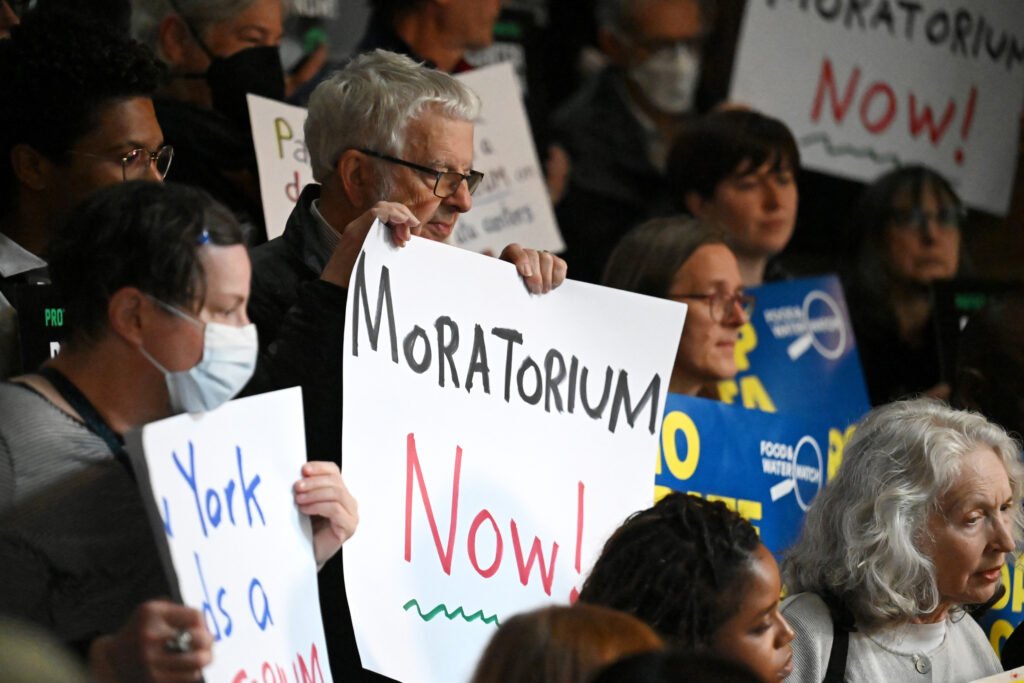
The New York Legislature passed a one-year moratorium Thursday night on data center permits, the latest sign of pushback amid a nationwide rush to build the power-hungry facilities.
New York would become the first state in the nation to enact such a freeze if Gov. Kathy Hochul signs the bill into law. But Hochul, who is up for re-election this year, has said that she believes it should be left up to municipalities, Politico’s E&E News reported last week. Maine’s governor vetoed a moratorium there in April.
The bill, named the Responsible Data Center Development Act, would also require a local public hearing before such facilities are constructed and a statewide data center environmental impact report within a year and a half after the bill becomes law. The moratorium would apply to any data center with a peak energy use above 20 megawatts.
“We need to make sure that we have the appropriate infrastructure and processes in place to protect communities from rising utility bills, protect our environmental resources and actually have a positive vision for what our energy future as a state should look like,” state Sen. Kristen Gonzalez, a Democrat who introduced the bill, told Inside Climate News.
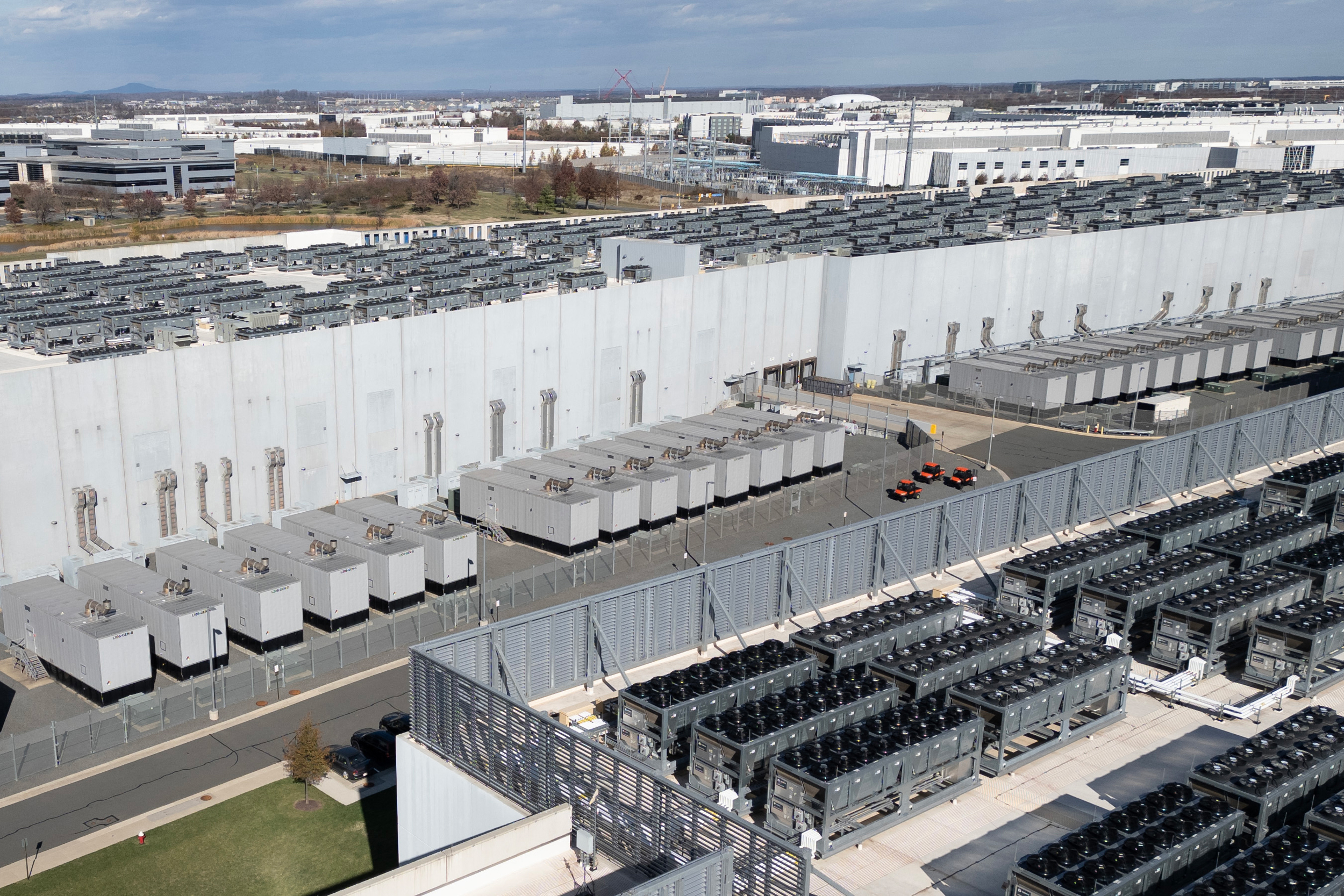
Large data centers that support artificial intelligence suck up an enormous amount of energy to power their computers. They also need water to cool them.
In New York, data centers have been proposed across upstate communities, from Niagara and Erie counties along the border with Canada to the town of East Fishkill in the southeast. Local opposition to these projects, which are often proposed in rural areas, is growing.
“The burden of rigorous analysis and defense against billionaires and their white-shoe law firms should not be put on volunteer planning board appointees,” said Gay Nicholson of Sustainable Finger Lakes, a nonprofit opposed to a large data center in the upstate town of Lansing.
“We need state-level intervention,” she said at a recent press conference.
The bill is not without its detractors. Khara Boender, the director of state policy at the Data Center Coalition, an industry group, told local station Spectrum News that “a statewide moratorium on data centers would discourage further investment, undermine New York’s economy, and send a signal that the state is closed for business.”
Ken Pokalsky, the vice president of the Business Council of New York State, said in a memo that the “expansive and unworkable mandates proposed in this bill would result in significant adverse economic development impacts.”
Multiple data center developers working in the state declined or did not respond to requests for comment.
Ed Nadeau, the president of the New York State Pipe Trades Association, told Inside Climate News that he was concerned about the loss of construction jobs during the 12-month moratorium, but did not oppose any other aspects of the bill. Workers in his union have been training to build and maintain these types of facilities for years, he said.
“It doesn’t make any sense,” Nadeau said of the freeze. “We want these jobs.”
This story is funded by readers like you.
Our nonprofit newsroom provides award-winning climate coverage free of charge and advertising. We rely on donations from readers like you to keep going. Please donate now to support our work.
In response to questions about job reductions, Gonzalez said that the capital expended to build and operate a data center is very high compared to the jobs created. New York Focus, a state news outlet, recently reported that a $77 million subsidy for a data center near the state’s border with New Jersey had led to the creation of only a single permanent job.
“We want to make sure our building trades have as many opportunities to build as possible,” Gonzalez said. “That’s why we invest deeply in housing, but as part of this bill, we’re also identifying new ways the [electricity] grid has to be improved, and those will be jobs moving forward.”
Local Opposition to Data Centers
The town of Oneonta in central New York is among the localities nationwide enacting their own moratoriums.
William Rivera, now the town supervisor, said he became aware of a proposed data center there last year at a town hall meeting. Eco-Yotta Inc., a technology company, wanted to rezone over 150 acres of what Rivera called “pristine farmland” for the data center.
Last month, his administration successfully passed a 12-month moratorium on data center development.
“Gone are the days where these mega-corporations can come in and sneak in harmful applications on the backs of working people,” said Rivera, who drafted the Oneonta moratorium policy.
But, he said, many local governments and residents struggle to get access to all the information concerning data centers and their impacts. Historically, data center developers have been extremely reluctant to share information about their energy and water use with the public, to the point of getting local officials to sign non-disclosure agreements concerning the details of a project.
The newly passed state legislation would force developers to be more transparent about their use of local resources, and includes a requirement to make efforts toward “energy efficiency goals” like recycling waste heat.
New York’s electricity grid operator has stated that data center projects will put pressure on the grid and complicate efforts to retire aging gas-fired power plants.
U.S. data centers often rely on highly polluting diesel generators for backup power. Some operate their own gas-fired power plants to keep the computers running. The new bill would require existing data centers to disclose greenhouse gas emissions data for the environmental impact report. It would also require them to use increasing amounts of renewable energy to power their data centers, starting at a third of their energy consumption in 2030.
“Modern hyperscale data centers are a new and unregulated industrial sector,” said Bridge Rauch, an environmental justice organizer with the Clean Air Coalition of Western New York, a region where multiple data centers have been proposed. “Our communities and our state need time to develop and pass local and state regulations.”
About This Story
Perhaps you noticed: This story, like all the news we publish, is free to read. That’s because Inside Climate News is a 501c3 nonprofit organization. We do not charge a subscription fee, lock our news behind a paywall, or clutter our website with ads. We make our news on climate and the environment freely available to you and anyone who wants it.
That’s not all. We also share our news for free with scores of other media organizations around the country. Many of them can’t afford to do environmental journalism of their own. We’ve built bureaus from coast to coast to report local stories, collaborate with local newsrooms and co-publish articles so that this vital work is shared as widely as possible.
Two of us launched ICN in 2007. Six years later we earned a Pulitzer Prize for National Reporting, and now we run the oldest and largest dedicated climate newsroom in the nation. We tell the story in all its complexity. We hold polluters accountable. We expose environmental injustice. We debunk misinformation. We scrutinize solutions and inspire action.
Donations from readers like you fund every aspect of what we do. If you don’t already, will you support our ongoing work, our reporting on the biggest crisis facing our planet, and help us reach even more readers in more places?
Please take a moment to make a tax-deductible donation. Every one of them makes a difference.
Thank you,

Reporter, New York City
Lauren Dalban is a New York City-based reporter with a background in local journalism. A former ICN fellow, she now covers environmental issues in all five boroughs. Originally from London, she earned a B.A. in History and English from the University of Virginia, and an M.S. from Columbia Graduate School of Journalism.