

According to the United Nations, 2.2 billion people still do not have access to safely managed drinking water. To help meet growing demand, many regions, from California to parts of the Middle East, rely on desalination plants that convert seawater into fresh water.
Traditional desalination methods such as reverse osmosis and thermal distillation can be expensive and energy intensive. They often require chemical treatments before and after processing the water and generate large volumes of concentrated saltwater known as brine. When discharged back into the ocean, brine can damage marine ecosystems by increasing salinity and reducing oxygen levels.
Researchers at the University of Rochester have developed a new approach that could address several of these challenges. Their solar powered desalination system produces fresh water efficiently, operates without chemical pretreatment, and avoids creating brine waste. The research was led by Chunlei Guo, a professor of optics and physics and a senior scientist at the University’s Laboratory for Laser Energetics. The team described the technology in the journal Light: Science & Applications.
Laser-Treated Solar Panels Drive the Process
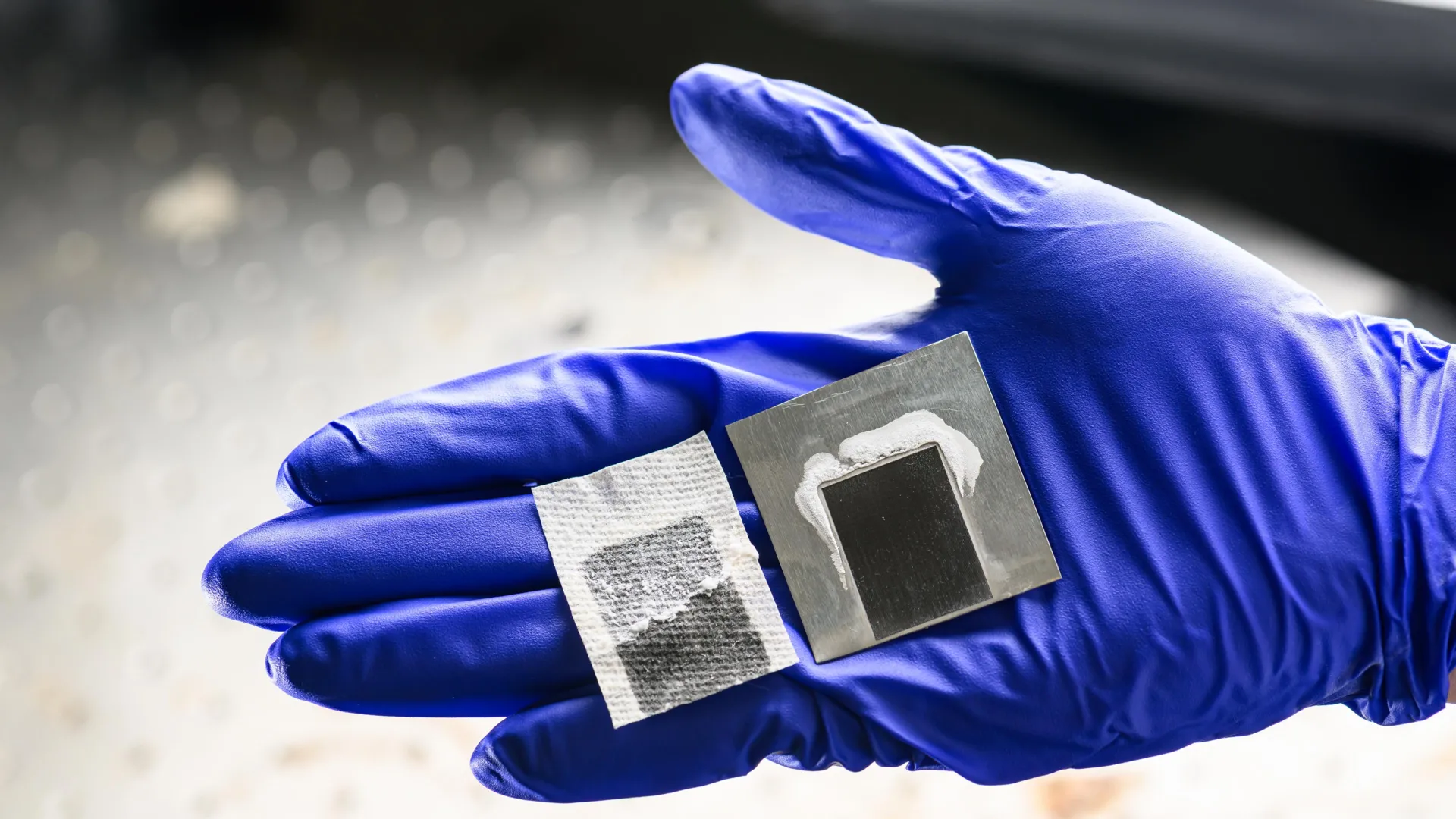
The system relies on specially engineered solar panels made from black metal that has been textured with femtosecond lasers. This treatment gives the surface two important properties. It absorbs nearly all incoming sunlight and strongly attracts water, a characteristic known as superwicking.
A laser patterned active region draws a thin layer of seawater across the panel. As sunlight is absorbed, the water evaporates and is distilled into fresh water. At the same time, dissolved salts and minerals are guided away from the active area and deposited onto untreated sections of the panel called passive regions.
By moving the salts away from the evaporation zone, the design prevents buildup that could otherwise interfere with continuous operation.
Using the Coffee Ring Effect to Prevent Clogging
Guo notes that several solar thermal desalination technologies have shown promising results in laboratory studies using simplified seawater composed only of water and sodium chloride.
In those experiments, sodium chloride crystals form in a loose, porous structure as water evaporates. Water can continue flowing through these crystals, dissolving them and making the systems relatively easy to clean.
Real seawater is far more complicated.
In addition to sodium chloride, oceans contain many other dissolved minerals. Materials containing magnesium and calcium often form hard, dense crusts when they crystallize. These deposits can block water flow and eventually shut down the desalination process.
The problem is similar to mineral scale building up inside a tea kettle or clogging a shower head over time, except seawater contains far higher concentrations of dissolved salts.
To overcome this challenge, the Rochester team carefully designed microscopic grooves on the black metal surface. The pattern encourages salts and minerals to move away from the active region before they can accumulate.
The researchers also took advantage of a familiar physical phenomenon known as the coffee ring effect.
“If you drop coffee on a surface, eventually the water evaporates and there’s a ring left at the outer edge that is the concentrated coffee particles,” says Guo. “We use that same principle to advance the salts to the passive region.”
When the team tested the technology using water samples collected from the Pacific, Atlantic, and Indian Oceans, the surface effectively cleaned itself. Fresh water was continuously extracted while salts were directed toward the passive regions, where they could later be collected without reducing performance.
Recovering Valuable Minerals Instead of Creating Waste
One of the most significant advantages of the system is what happens to the leftover salt.
Conventional desalination produces liquid brine that must be treated, disposed of, or discharged into the environment. The new process instead recovers nearly all dissolved salts in solid form.
Those recovered materials could become valuable resources. In addition to producing table salt, the process could help extract important minerals such as lithium, a key ingredient in lithium ion batteries used in electric vehicles and many consumer electronics.
In a related study published in the Journal of Materials Chemistry A, Guo and colleagues demonstrated that the same superwicking solar panels can also separate lithium from other salts.
To accomplish this, the researchers embedded hydrogen titanate nanoparticles into the microscopic grooves of the black metal surface. These particles selectively isolate lithium from other dissolved minerals.
“Mining lithium from the Earth has proven to be very taxing from an energy and environmental standpoint, so pulling lithium directly from saltwater could be a very important future route,” says Guo.
Using water from Utah’s Great Salt Lake, the team successfully recovered about 50 percent of the lithium contained in the salts remaining after desalination.
Potential for Large Scale Fresh Water Production
Although the technology has so far been demonstrated only in proof of concept devices, Guo believes the approach can be scaled up significantly.
If successfully expanded, the system could help increase access to clean drinking water while also creating more sustainable sources of critical minerals.
The research was supported by the National Science Foundation, the Bill & Melinda Gates Foundation, and the Worldwide Universities Network. Additional contributors from the Institute of Optics included Senior Scientist Subash Singh, alumnus Ran Wei ’24 (PhD), PhD students Luheng Tang and Tainshu Xu, and Mingjiang Ma.