

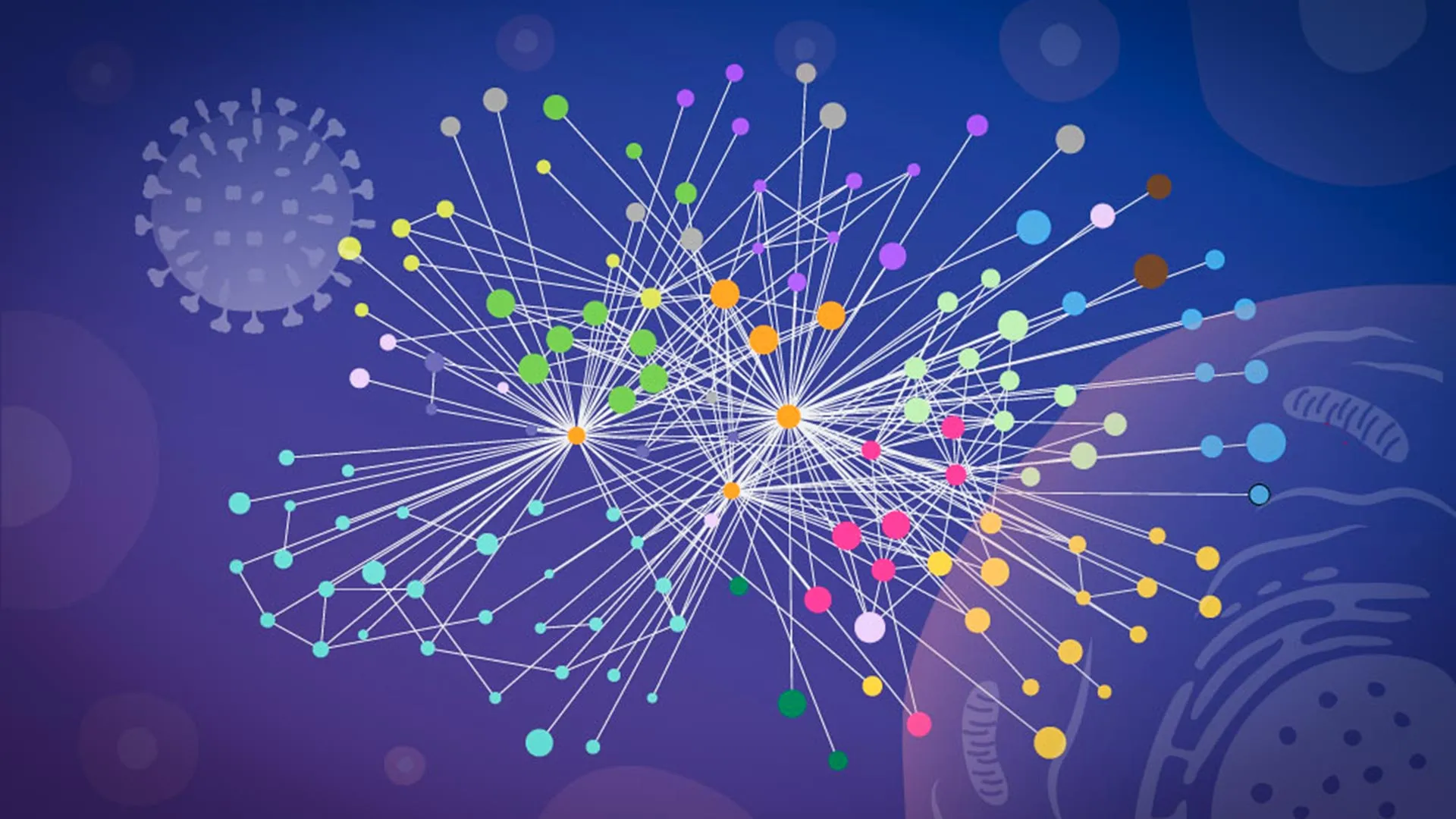
Researchers at EMBL Hamburg, working with scientists at the Leibniz Research Institute for Molecular Pharmacology (FMP), have produced an unusually detailed map of how influenza A reshapes infected human cells. Their customized workflow allowed them to observe protein interactions directly inside intact cells rather than relying only on samples that had been broken apart.
Seasonal influenza causes 3-5 million cases of severe illness worldwide each year and is linked to as many as 650,000 deaths. Influenza A has also driven multiple pandemics, including the 1918 Spanish Flu pandemic.
After entering a cell, the virus releases RNA containing the instructions for making a small set of viral proteins. Those proteins spread through the host cell and redirect its molecular systems, turning the cell into a production site for new virus particles.
Mapping the Flu Virus Inside Intact Cells
A clearer view of this takeover could help scientists develop more effective flu vaccines and antiviral drugs. To reach that goal, researchers need to know which viral proteins interact with human proteins, where those contacts occur, and how the virus uses them to support its own replication.
The new study is the first to map direct contacts between influenza proteins and human proteins on a large scale inside intact infected cells. The structural detail was also precise enough for researchers to model how the interacting proteins may fit together.
“Our work provides a new way to study flu-host interactions in their native context and with structural insight,” said Jan Kosinski, Group Leader at EMBL Hamburg and Centre for Structural Systems Biology (CSSB). “The current results are a snapshot of a moment during infection, and it opens the door to studying flu-host interactions across the entire infection cycle.”
Overcoming a Major Experimental Problem
Tracking protein-protein interactions during an active infection is extremely difficult. Many earlier studies depended on biochemical techniques that required scientists to break cells open before measuring protein contacts.
That process can distort what was happening inside the living cell. Once internal compartments are destroyed, proteins that were originally separated may come into contact in the laboratory. At the same time, weak, temporary, or location-specific interactions can disappear. As a result, researchers may struggle to determine which connections truly existed during infection.
“This is when we learned that our collaborators, Boris Bogdanow and Fan Liu, at FMP Berlin had developed a specialized version of cross-linking mass spectrometry (XL-MS), a long-established technique for mapping protein contacts, tailored specifically to virus-infected cells,” said Kosinski.
The specialized method provided the breakthrough the team needed. It made it possible to capture interactions that occur only briefly or within particular regions of an infected cell.
“XL-MS allows us to capture protein-protein interactions directly in infected intact cells, while also providing structural information about how these interactions are happening,” explained Bogdanow, who is now a Junior Research Group Leader at the Institute of Virology, Charité — Universitätsmedizin Berlin. “This gives us insight into the interface between the virus and the human cell and may, through structural modeling, help identify actionable targets for future pharmaceutical interventions.”
Combining Experimental Data With AlphaFold
The researchers paired their XL-MS results with computational structural modeling. This allowed them to identify viral and human proteins that interact and estimate how those proteins are positioned when they connect.
To build these structural models, the team used a modified version of AlphaFold, the Nobel prize-winning protein structure prediction algorithm.
“The key advantage of the modified AlphaFold approach is that it allowed us to feed our experimental cross-linking data directly into the structural modeling,” explained Kosinski. “This tells the model which parts of the viral and host proteins are close to each other inside infected cells. This was especially useful for virus-host complexes, which are often difficult to predict reliably.”
Two Ways Influenza Hijacks Human Cells
The findings, published in Nature Microbiology, revealed two notable strategies that influenza A appears to use when taking control of a cell.
The first centers on hemagglutinin, a protein found on the virus’s surface. Influenza uses hemagglutinin to attach to and enter host cells. The researchers followed this protein as it traveled through the cell’s internal transport and processing network.
This network consists of compartments that fold, modify, and prepare proteins before sending them to their final locations. The analysis showed that several human proteins helped fold and modify hemagglutinin correctly during infection. Some of those host proteins previously had poorly understood functions.
Influenza Dissolves Structures in the Nucleus
The second discovery involved paraspeckles, small droplet-like compartments located inside the cell nucleus. The team found that influenza A infection caused these structures to dissolve.
When paraspeckles broke apart, they released RNA-binding proteins that had been held inside them. The virus may then use those proteins to support its own replication.
“What surprised us most was the paraspeckles,” said Iuliia Kotova, former predoctoral fellow at the Kosinski Group at EMBL Hamburg, currently at ETH Zurich and first author of the publication. “Watching these tiny organelles in the nucleus dissolve, consistently across every cell line and every flu strain we tested, told us this isn’t a side effect of infection — it might be a strategy,”
The disruption may provide influenza with more than one advantage.
“There may also be a second benefit for the virus: some evidence suggests paraspeckles contribute to cellular stress responses and antiviral gene regulation, so disrupting them could also weaken parts of the cell’s defense response,” added Kosinski.
A Collaborative Effort Across Three Institutions
The project depended on shared technology and expertise from three institutions. Researchers carried out the cross-linking mass spectrometry work at Charité in Berlin. Glycoproteomics analyses were completed at the EMBL Proteomics Core Facility.
The team performed AlphaFold modeling on the EMBL Compute Cluster, while microscopy imaging took place at CSSB’s Advanced Light and Fluorescence Microscopy (ALFM) Facility.
A New Way to Study Potential Pandemic Viruses
The findings demonstrate how studying molecular contacts inside intact infected cells can reveal both where and how a virus takes control of human cellular machinery. The researchers say this type of ‘mapping in context’ may also help explain how other viruses operate.
“While the exact host factors and mechanisms often differ from virus to virus, we think our overall approach — combining in-cell cross-linking, structural modeling, and targeted cell-biology follow-up to map native virus-host interactions at specific stages of infection — remains broadly applicable,” Kosinski said.
Although the study examined a laboratory-adapted strain of influenza, the researchers believe the same strategy could eventually be used to investigate viruses with greater pandemic potential.
Bogdanow agrees: “Although this study has focused on a lab-adapted strain, this study lays the groundwork to apply the methodology to viruses of potential pandemic relevance, such as H5N1, and for uncovering the interaction networks that support their multiplication in human cells.”