

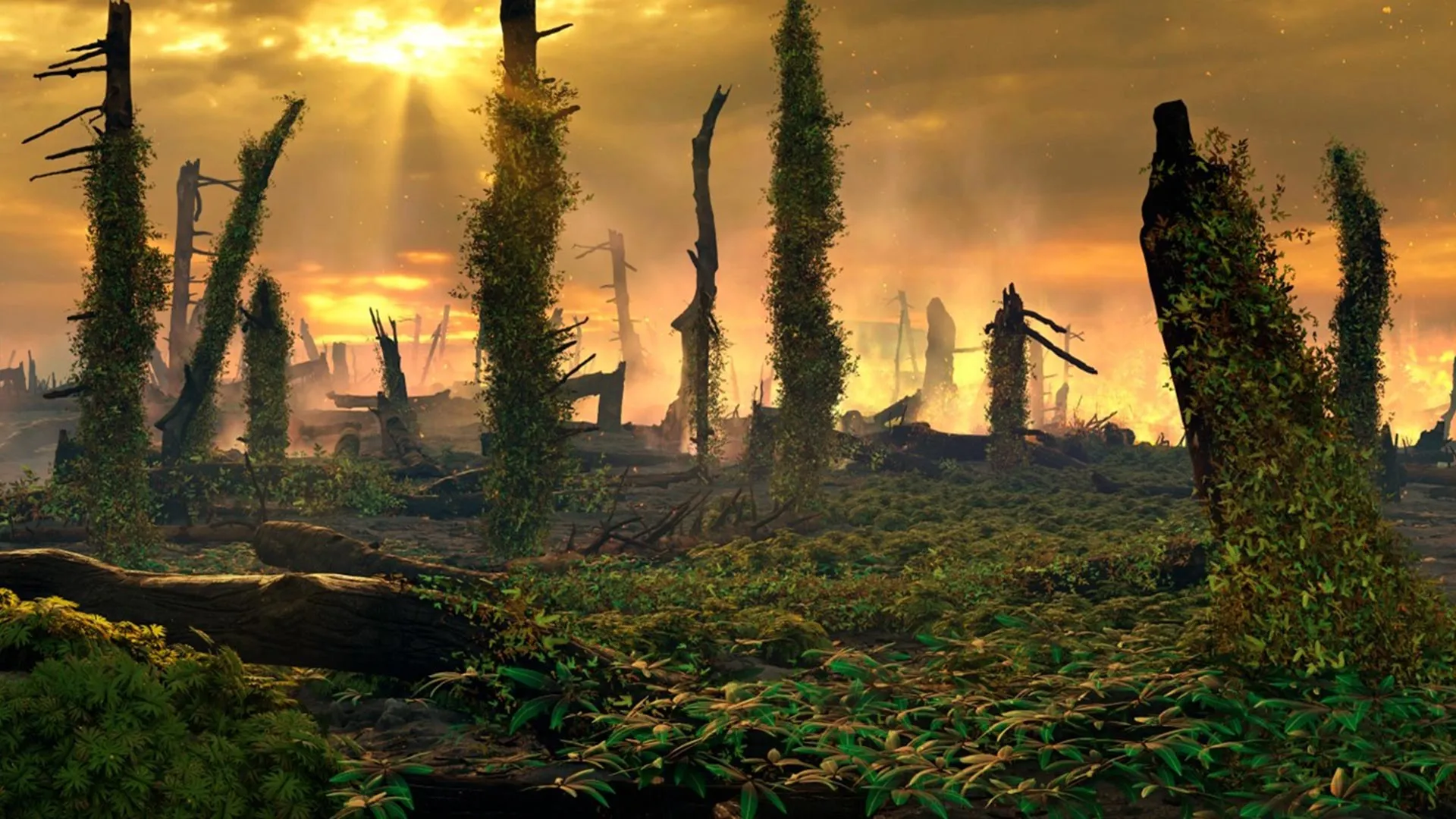
The end-Triassic mass extinction struck about 201 million years ago and has been tied to enormous volcanic eruptions associated with the break-up of Pangea. Those eruptions released vast quantities of CO2 into the atmosphere, driving global temperatures up by an estimated 5 to 10 degrees Celsius.
As the planet heated, forests dominated by trees collapsed. Ferns quickly moved into the damaged landscapes, spreading across large parts of what is now Northwest Europe and creating broad savannah-like environments. New research from an international team led by geologists at Utrecht University suggests that these fern-covered regions were highly vulnerable to fire. The ferns themselves may have supplied much of the fuel that kept the flames spreading.
The findings were published in Nature Geoscience on July 21, 2026.
Reconstructing Ancient Wildfires
To investigate wildfire activity from this distant period, the researchers studied exceptionally well-preserved sediment from 4 drill cores. One of them was a recently collected 640-meter-long core from the United Kingdom.
The team reconstructed ancient fire activity by measuring fossil charcoal and organic compounds produced in wildfire smoke, known as polycyclic aromatic hydrocarbons (PAHs).
When these results were combined with records of fossil pollen and spores, they pointed to a sharp increase in wildfire activity during the main phase of the extinction. This fiery interval also matched a dramatic expansion of ferns.
However, both traditional indicators have limitations. Large charcoal pieces can break apart into many smaller fragments, making the amount of fire appear greater than it actually was. PAHs can also travel far from the fire that produced them, and some of the molecules may not survive in the geological record. Because of these problems, the researchers developed another method for tracking fires in deep time.
“The novelty of this study came from the analysis of color changes of organic microfossils,” explains Dr. Bas van de Schootbrugge from Utrecht University, a senior author on the paper. “We used a simple and very low-cost technique that quantifies the ‘darkness’ of fossil pollen and spores, a so-called Palynomorph Darkness Index.”
A Strange Pattern in Fossil Color
Organic microfossils usually become darker after they are buried because rising pressure and temperature gradually alter the material. Sediments that sink deeper underground are exposed to more heat, causing the organic matter inside them to become increasingly cooked. In most cases, greater depth means darker fossils.
“But here we found a very different pattern,” Van de Schootbrugge says.
The oldest and deepest pollen and spores in the cores remained lightly colored. Yet fossils from the extinction interval became progressively darker, eventually reaching an extremely dark brown. Once the extinction period ended, the fossils returned to a pale yellow color.
“We were quite puzzled by this phenomenon as it occurs in all 4 cores at exactly the same time, so it could not have been related to burial of the sediments as the four basins experienced very different geological histories,” Van de Schootbrugge explains.
The Ancient Fire “Dark Zone”
The Palynomorph Darkness Index measures color using the RGB spectrum. A camera connected to a light microscope records the fossils, and the color information is converted into an average gray scale value. This allows scientists to compare samples from different layers within the same core, as well as samples taken from cores in separate locations.
The researchers completed 15,000 measurements of pollen and spores from plants that lived before, during, and after the extinction. They also compared tree pollen with fern spores to determine whether the darkening might have been caused by biological differences between plant groups.
“All plant groups show the same effect, which is a strong indication that it was the result of an outside force.”
When the team compared the fossil color changes with charcoal and PAH levels, the pattern became clear. The unusual “Dark Zone” appeared to record an extended period of severe wildfire activity during the fern spike.
“The darkening overlaps exactly with the fern spike, the main extinction interval, and elevated abundance of charcoal and PAHs.”
Ferns Spread Across a Warming World
The rapid rise of ferns during the main extinction interval was likely driven by several connected forces, including deforestation, soil erosion, intense greenhouse warming, and repeated wildfires.
Van de Schootbrugge: “Ferns are truly remarkable plants that have withstood many crises throughout Earth history, and some species can adapt to some of the most extreme environments. They can be considered to be true disaster species.”
Certain ferns can spread quickly across damaged ground, especially where other vegetation has been destroyed. Fire can accelerate this process. Although the visible parts of the ferns burn, the plants can rapidly regrow from root systems below the surface. This allows them to return faster than many competing plants and take over even more territory.
That ability may help explain why the fern spike lasted so long. Researchers estimate that the interval continued for at least 40,000 years and possibly as long as 300,000 years.
Ferns Became Fuel for Repeated Fires
“When the ferns dry out, the thick mats act as the ideal fuel to trigger massive wildfires,” Van de Schootbrugge explains.
Fast-spreading pioneer and weeding ferns created extensive fern savannahs. Some species may have acted as fire ladders, helping flames move through the landscape while also crowding out and smothering other vegetation.
“Ferns responded to and delivered the fuel that fanned the flames, triggering repeated massive wildfires. A truly hellish world.”
The result may have been a destructive feedback cycle. Climate warming and forest loss opened the landscape to ferns. The ferns then supplied abundant dry fuel for new fires, after which they rapidly grew back and spread again.
“The lesson we can learn from this, is that the combination of climate change, deforestation, and the spread of opportunistic species can provide all the ingredients for a perfect storm,” Van de Schootbrugge concludes.