

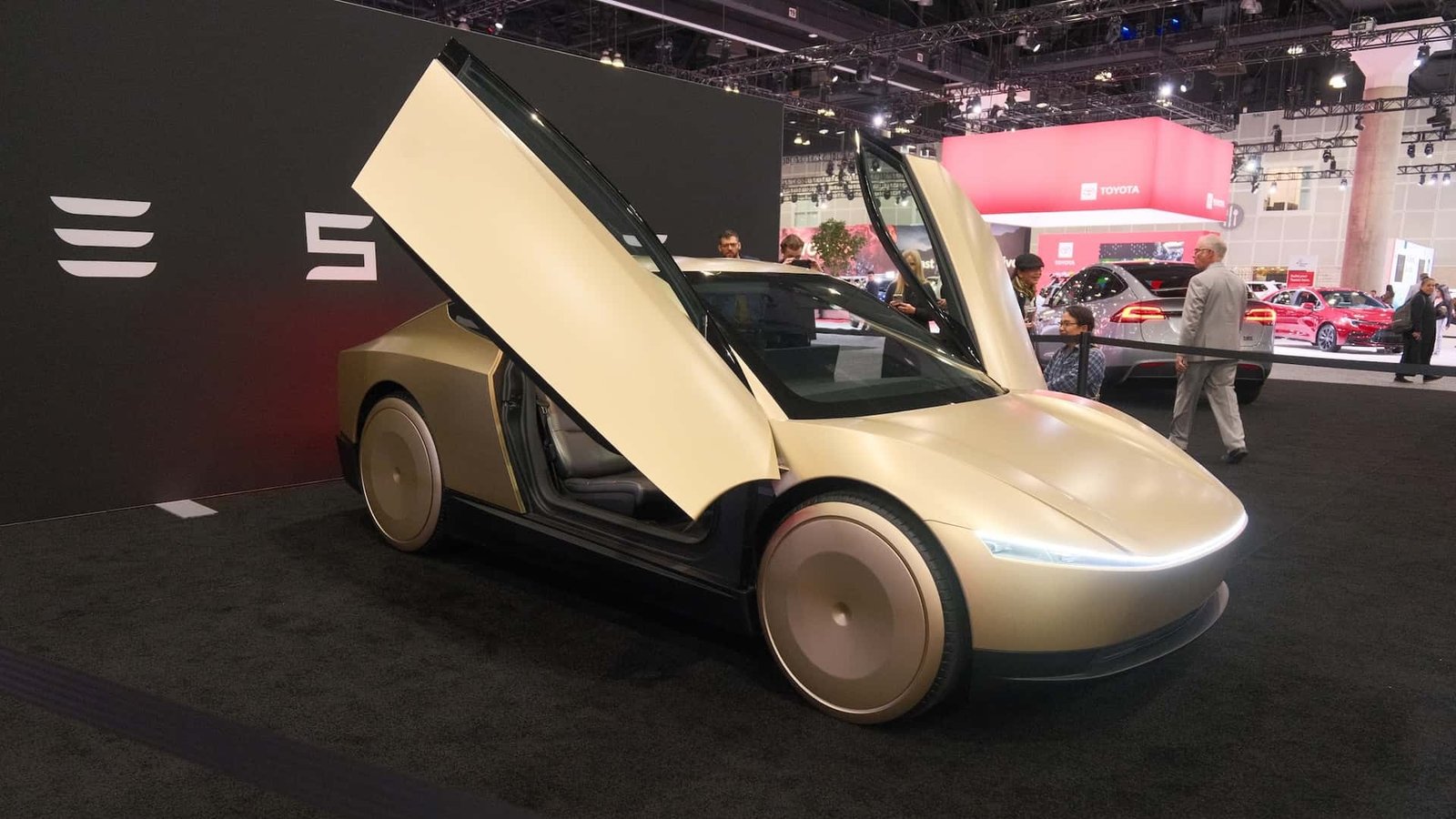
My home state of New Jersey might be putting its foot down and squashing Tesla’s Cybercab robotaxis before they even get there. As spotted by The Verge, a bill that’s currently under consideration in the state would prevent companies from operating fully autonomous vehicles unless they have camera-based technology and two additional forms of sensor tech, like lidar or radar. Elon Musk has been adamant over the years that Tesla’s camera-based system is enough, but it legally won’t be in Jersey if this bill becomes law.
One of New Jersey’s state lawmakers is also a physicist (the state doesn’t prevent senators from keeping their day jobs), and he insists that he likes the idea of autonomous cars but is worried about safety.
”This is not anti-Tesla,” Democratic state Sen. Andrew Zwicker, the bill’s primary sponsor, told The Verge. “I’m pro-New Jersey safety.”

Photo by: Tesla
After spending some time in a Waymo in Phoenix, Arizona, he’s into the idea of robotaxis but recognizes the limitations of a camera-only system.
”At this point, I don’t think the evidence is sufficient that a single sensor with software can handle situations that humans can,” Zwicker said.
New Jersey is far from the only state debating how to regulate autonomous vehicles. However, its proposed hardware demands are unusual. Some might argue that the bill’s language is vague, as it doesn’t label any specific hardware the robotaxi must have, but I’d argue that’s probably a good thing. As technologies advance, or new ones are developed, a rigid legal framework might slow progress down. And requiring redundancies could certainly keep people safer.
As it stands, the part of the bill in question says that a fully autonomous vehicle must “be equipped with crash-avoidance systems, including a camera system and two distinct sensing modalities that are capable of detecting and tracking obstacles in the event of failure of the camera system.”
Waymo Hyundai Ioniq 5 with Lidar
Photo by: Waymo
It isn’t just tech, though. The bill also has testing requirements. Companies would need specific state authorization to operate autonomous vehicles in New Jersey, and that authorization wouldn’t come until after at least 50,000 crash-free miles of supervised testing. The testing pilot program would last at least three years, too.
Musk feels that his AI-assisted camera-based system is enough, going so far as to not add any additional sensors to the steering wheel- and pedal-free Cybercab. After all, we drive around with nothing but vision and our own (sometimes questionable) intelligence. However, Philip Koopman, an autonomous vehicle safety expert at Carnegie Mellon, disagrees.
According to The Verge, Koopman says that “human brains are fundamentally more powerful than AI because we understand.” And I couldn’t agree more. Driving was created by humans, for humans. We fundamentally just get driving, have experience, understand how other humans behave or might want to do on the road, and have instincts far beyond what even an advanced AI can have. Plus, cameras can get covered in snow or mud or smushed insects, completely obscuring their view. Having backup sensors, even if the car’s main source of info is camera-based, is far safer.
Most companies developing and deploying autonomous vehicles, like Zoox, Waymo, and Nuro, agree and are going the multi-sensor route. Rivian and Lucid both decided to add lidar to their future vehicles to allow for higher levels of driving automation.
Plus, you don’t need to look too hard to find proof that self-driving vehicles with lots of sensors are superior today. Tesla argues that its cheaper, simpler sensing setup will give it a scaling advantage. Maybe that will be true someday, when its self-driving tech works better. But Waymo, whose cars are brimming with lidars, radars, cameras, and audio receivers, is way ahead of Tesla right now. The Alphabet-owned company is doing over 500,000 paid driverless trips per week across at least 10 cities, with more markets coming online regularly. It’s still early days for Tesla’s service, and growth has been far slower than Musk has promised.
The autonomous vehicle industry has been pitching unified federal guidelines for years, but that hasn’t materialized yet, and lots of self-driving regulation happens at the state and local level. If more places follow New Jersey’s lead—New York has similar legislation in the works—that could be another bump in the road for Tesla’s big self-driving dreams.
Photo by: Rivian