


UPPER MAKEFIELD TOWNSHIP, Pa.— As their children ran in circles at the street corner on a clear morning, parents of Mount Eyre Manor kept watch, especially mindful of the white pickup trucks that begin to roll into the neighborhood before the school bus.
Only after their 6-year-old daughter boarded the bus did Ryan Harper and Veronica Casina-Harper talk about the nightmare of the past year and a half.
From their front yard, they pointed to work crews finishing four new holes in their street, the latest of 44 wells drilled in Mount Eyre Manor. The driller is one of the nation’s largest and most politically connected oil and gas companies, Energy Transfer. The company is using the wells to determine how far and how deep an unknown quantity of petroleum fuel has spread into drinking water supplies from a rupture in its 68-year-old pipeline beneath this neighborhood just north of Philadelphia, a mile uphill from the Delaware River.
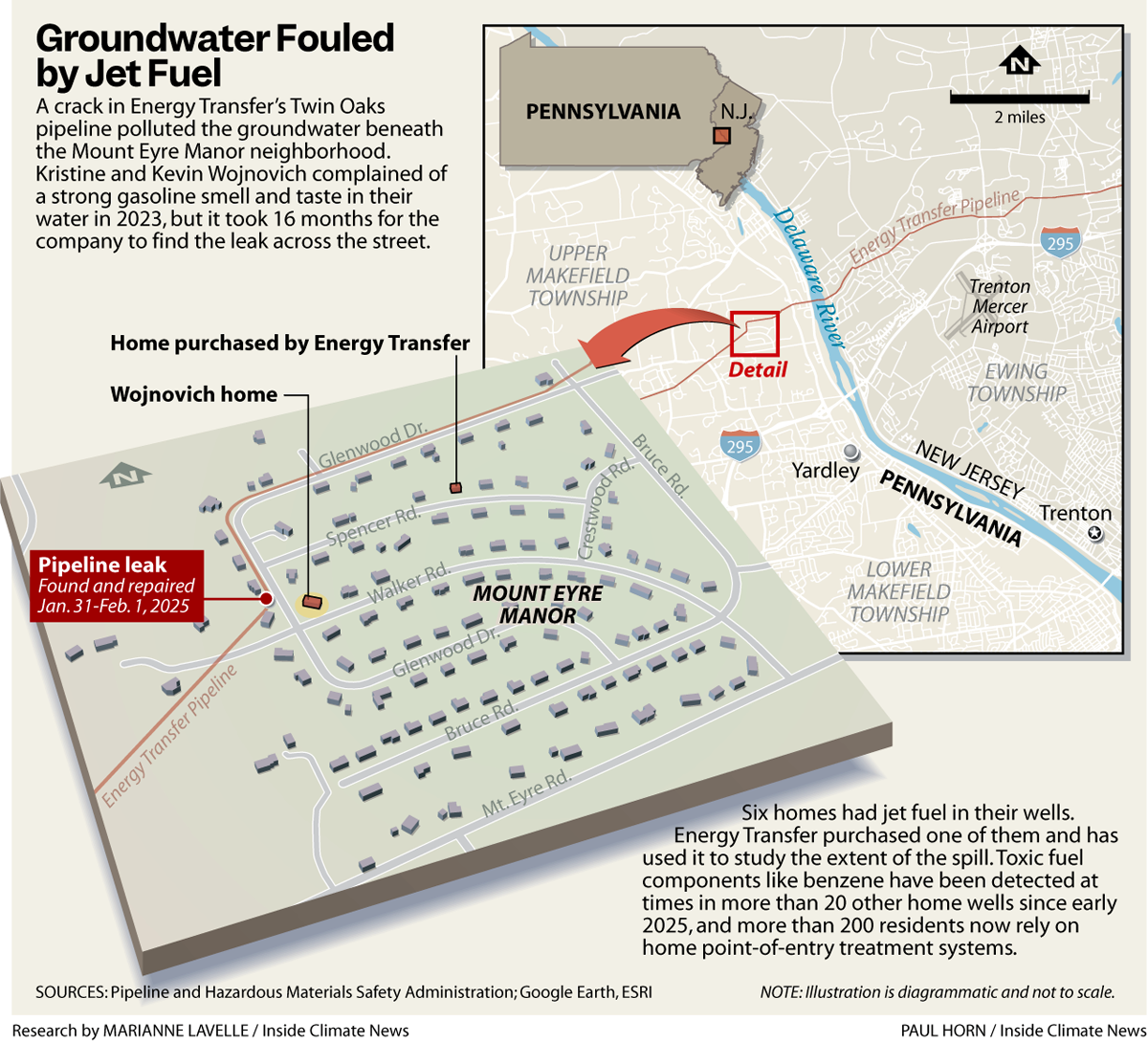
By the time Energy Transfer and its subsidiary Sunoco found the leak in its 105.5-mile pipeline in January 2025, 16 months after residents first complained of a gasoline smell and taste in their drinking water, jet fuel was floating in the wells of six Mount Eyre Manor homes. The company replaced the cracked segment and got the pipeline running again immediately, delivering fuel to a terminal near Newark Liberty International Airport. Residents were left with the aftermath.
Other wells, in 28 homes to date, have tested positive for toxic fuel components like benzene and xylenes since the crisis began. And now, thousands of gallons of fuel—how much is hotly contested—remain in the groundwater that the neighborhood relies on.
“We don’t know where it is, that’s the scary part,” Casina-Harper said. “Is it just slowly seeping through and eventually going to get to us?”
Energy Transfer unveiled its cleanup plan this summer—a vacuum extraction system—but it arrived far later than residents hoped and delivers less than the permanent clean-water solution they are seeking. The Pennsylvania Department of Environmental Protection is providing oversight, using its limited authority under state law. But missing from the scene almost entirely are federal regulators.

The U.S. Environmental Protection Agency has declined to step in, even after a Republican congressman implored the agency to do so. The Pipeline and Hazardous Materials Safety Administration (PHMSA), which falls under the Department of Transportation, provided what residents thought was a strong initial response, but since has been “completely absent,” in the words of one local lawmaker. PHMSA has kept residents in the dark about key information the company turned over on the pipeline, and it has shown little sign of holding Energy Transfer accountable, even for probable violations of the law the agency identified.
One week after PHMSA’s first notice to the company over the spill, Energy Transfer and its executive chairman gave a combined $25 million to Trump-aligned MAGA Inc.—at the time the largest contributions to the political action committee established after the 2024 election to support the president’s agenda.
President Donald Trump made clear that agenda for companies like Energy Transfer on the first day of his second term in office when he signed an “Unleashing American Energy” executive order to dramatically roll back regulation of the industry. The fuel spill in Upper Makefield Township, discovered 11 days later, is one of the first case studies of that policy in action during an environmental disaster.
The community’s plight has laid bare many long-standing gaps in environmental protection law at both the state and federal level—especially for those who rely on private drinking water wells, which are not covered by the Safe Drinking Water Act.
But on top of existing weaknesses in the law, the Trump administration has layered policies favoring the fossil fuel industry. Among them:
- The EPA is explicitly excluding groundwater from its responsibilities under the Clean Water Act. This marks a change from policy in the Biden administration, which interpreted the EPA’s authority as extending to some groundwater pollution that threatens rivers.
- Enforcement on the nation’s interstate oil and gas pipelines fell to a record low last year as staffing fell at PHMSA.
- PHMSA last year adopted a new enforcement policy it says is designed to increase “due process” rights for pipeline operators accused of violations, a change that the agency made in part to address issues in a legal challenge from Energy Transfer.
Exposure to the chemicals in the spilled fuel can cause cancer and other ills, an omnipresent fear for Mount Eyre Manor residents. Energy Transfer faces a slew of lawsuits from neighbors, who want cleanup and compensation as well as long-term court-administered medical monitoring to catch diseases that could show up years later.

But federal regulators could move faster than the courts to limit the damage. Residents feel they are largely on their own.
“Who is our advocate?” asked Joe Babiasz, another neighborhood parent. “You know, we’re going to these meetings, and I guess we expected some entity to be more, like, representing us.”
The EPA Limits its Regulatory Reach
This isn’t the first environmental disaster in Pennsylvania for Energy Transfer. Gov. Josh Shapiro led a sprawling investigation of the company when he was attorney general. The company pleaded no contest to criminal charges over spills, sinkholes and drinking water well contamination at 22 sites along the route of one pipeline from 2017 to 2020, and a 2018 explosion at another pipeline. Energy Transfer, based in Dallas, had been mainly a natural gas firm until its 2012 purchase of Sunoco of Philadelphia. Overnight, the company became a diversified giant with a petroleum liquids portfolio.
Among the Sunoco assets Energy Transfer inherited was a 14-inch diameter pipeline built in the 1950s to propel fuel from the company’s Twin Oaks terminal southwest of Philadelphia International Airport to the Newark airport in northern New Jersey, through a dense suburban landscape.
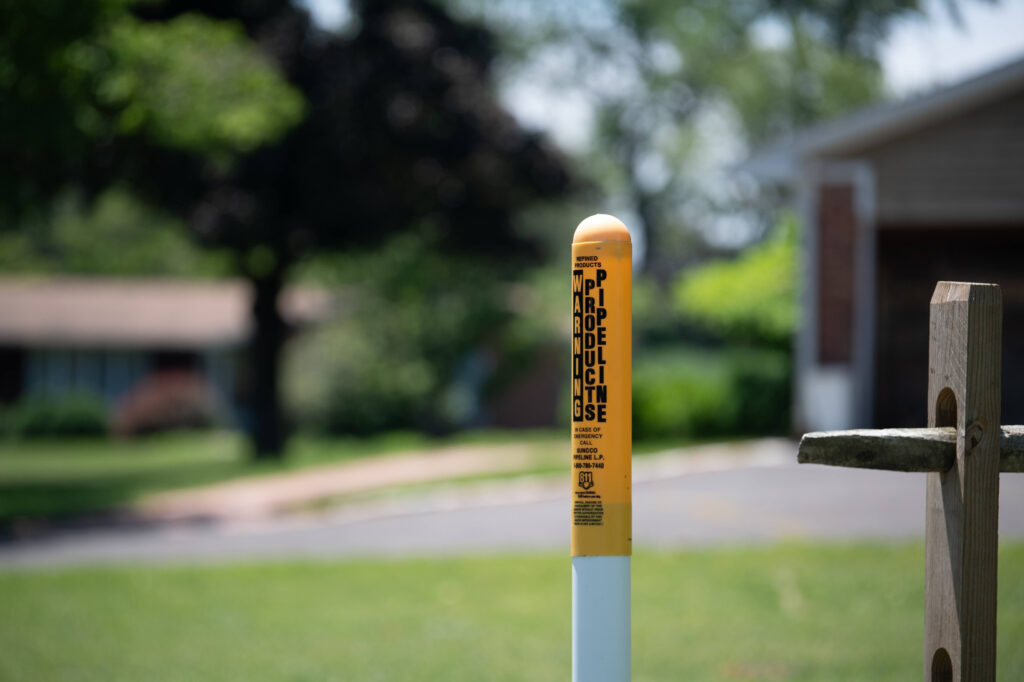
Mount Eyre Manor residents say they weren’t told about the pipeline when they bought their homes. The Harpers, here for eight years, saw yellow warning posts installed along the perimeter of the neighborhood, but thought it might be a pipeline bringing natural gas to homes.
“You don’t think about it when you move into places,” Casina-Harper said. “You just assume that those things are getting taken care of.”
The Alphabet Soup of Pipeline Pollution
Here are some of the acronyms that have become a part of daily life for residents of Mount Eyre Manor:
LNAPL: “Light Non-Aqueous Phase Liquid” is the fuel that escaped the pipeline. No longer destined for energy, it has to be cleaned up. Engineers describe it by its key physical characteristic: It floats on the groundwater.
BTEX: A quartet of “volatile organic compounds” (VOCs) found in petroleum fuels. They dissolve out of the LNAPL into the groundwater. Benzene is a known carcinogen, especially associated with leukemia. Toluene can cause headaches, dizziness and confusion, with potential long-lasting effects for children of those exposed during pregnancy. Ethylbenzene is a possible carcinogen; irreversible hearing damage has been seen in animals exposed to relatively low concentrations. Xylenes can make breathing difficult.
Energy Transfer is regularly testing the groundwater for BTEX and a handful of other substances found on Pennsylvania’s so-called “short list” of petroleum product pollution indicators. Of these substances, residents have been especially surprised to see two former fuel additives turn up in wells: methyl tert-butyl ether (MTBE) was phased out after 2005, and lead was banned for sale in gasoline in 1996. Lead is still used in fuel for some small aircraft. But the Pennsylvania Department of Health told residents in a handout that lead comes from many natural and manmade sources, and officials don’t know the source of the lead in their water.
Energy Transfer’s goal is to remediate the groundwater to a level that meets statewide standards for aquifers used for residential drinking water. It likely will require years of testing.
Now, Casina-Harper can show on her phone the government website where she can look up the map of the pipeline passing near Council Rock High School North, her alma mater, where she and her husband dream of sending their daughter one day.
“No homeowner should ever have to become an expert in pipeline safety,” said U.S. Rep. Brian Fitzpatrick, the Republican who represents the area in Congress. At a July 15 news conference on Capitol Hill, surrounded by Mount Eyre Manor residents, he said, “They became experts because the system had left them with no other choice.”
Fitzpatrick wrote to EPA Administrator Lee Zeldin last year, urging the agency to get involved. “I believe it is imperative that the U.S. Environmental Protection Agency provide additional support and guidance to PADEP to help ensure that all remediation and oversight efforts are as comprehensive, timely, and transparent as possible,” he wrote.
But in a letter last year that neither the EPA nor the congressman has released publicly, the agency told Fitzpatrick that it did not see the spill as falling within its jurisdiction.
“Broadly, EPA confirmed it was aware of the incident and had been coordinating with PADEP, which remains the lead authority,” Fitzpatrick’s communications director, Casey-Lee Waldron, said in an email to Inside Climate News. “EPA also indicated that, based on the circumstances outlined in its response, its federal response authority was not triggered.”
In response to Inside Climate News’ query on the exchange, an EPA spokesperson stressed PHMSA’s leading role. “EPA and PHMSA work together to address pipeline spills and protect our nation’s waterways,” the spokesperson said. “EPA’s authority to respond and take enforcement actions is based on whether an oil spill impacts, or there is a substantial threat that it might impact, navigable waters of the United States under the Clean Water Act.”
Environmentalists argue that such waters are at risk—the nearby Delaware River, toward which groundwater in the area flows, according to Energy Transfer’s own remedial action plan. “They do know there is a plume, and they know the direction of the groundwater is toward the Delaware River,” said Tracy Carluccio, deputy director of the nonprofit Delaware Riverkeeper Network.

But the Trump administration is explicitly excluding groundwater from its definition of “waters of the United States” in new proposed rules the White House is now reviewing before finalizing. Oil and gas industry groups have praised the groundwater exclusion, saying it was a provision they sought.
Both they and the Trump administration state that groundwater has never been federally regulated under the Clean Water Act. An EPA spokesperson reiterated that point in emailed responses to Inside Climate News, saying the explicit groundwater exclusion was for “clarity.” The spokesperson added that the Trump administration’s new rule was “not relevant” to the Energy Transfer spill in Pennsylvania because the rule was not yet final.
In fact, although the Biden administration’s 2023 regulations defining EPA’s Clean Water Act authority agreed that groundwater did not fall under the definition of “waters of the United States,” those rules noted that sometimes pollution in groundwater was within the agency’s regulatory reach. The Biden rule said case-by-case analysis was the correct approach, citing a 2020 Supreme Court ruling that set out a test based on such factors as distance from the body of water, transit time and geology. An EPA spokesperson maintained that the 2020 ruling was strictly about another aspect of the agency’s work, permitting.
It’s not clear if the Biden approach would have given EPA authority over the Energy Transfer spill in Pennsylvania. But the Trump administration made clear it had a narrower view in a March 2025 guidance memo, prior to its formal regulatory proposal. The administration said it would look for a “continuous surface connection” to navigable waters when assessing its regulatory authority over nearby waters, under its reading of a 2023 Supreme Court ruling.
For now, Pennsylvania DEP spokeswoman Robyn Briggs said testing by both the state and Energy Transfer have identified no jet fuel impacts to the Delaware River from the spill.
EPA’s default position is to leave incidents like this one to the states. “If state and local response organizations have sufficient resources and capabilities to address the discharge or if the responsible party is taking appropriate cleanup actions, there may not be a need for EPA response or oversight,” the agency spokesperson told Inside Climate News.
But William Muno, who directed the EPA’s Superfund and oil spill response across six Midwestern states before retiring in 2004 after 31 years at the agency, said the EPA’s job is to step in if a spill is too big or complex. The EPA has a key authority that Pennsylvania lacks: It can take over the response and recover the costs from the company under the nation’s 1990 oil pollution law.
Muno, a volunteer with the Environmental Protection Network, an alliance of former EPA employees, said he was surprised to learn Energy Transfer was only now, a year and a half after finding the leak, planning to test an extraction system. (Last October, Energy Transfer told residents “site conditions” did not warrant such a system, but now company contractors say they have reached the limits of their cleanup ability without one.)
“The longer you wait, the larger the plume is,” Muno said. “The company didn’t act as quickly as I think I would have done if I was asked to address the same situation.”
A Smaller Pipeline Watchdog With Less Bite
With the EPA out of the picture, Mount Eyre Manor residents have placed their hope for federal action on a much smaller agency, PHMSA.
PHMSA’s initial notice to Energy Transfer, dated Feb. 13, 2025, revealed the 2.5-inch pipeline crack occurred near a dent the company, then Sunoco, tried to repair in 1995 with a metal sleeve. PHMSA said the pipeline had 44 more so-called “Type A” sleeves installed around the same time.
The agency put out a safety advisory early this year, citing Energy Transfer’s Pennsylvania leak and warning of risks in Type A sleeves because they are not welded to the pipelines.
But the agency did not restrict their use or put in place any new safeguards.
“When properly installed, Type A sleeves are a viable repair method,” a PHMSA spokesperson said in an email to Inside Climate News. “When improperly installed, they can lead to integrity concerns.”
Were the Sunoco sleeves improperly installed? It’s just one of the questions Mount Eyre Manor residents have. Under a consent agreement negotiated last year, Energy Transfer was to report to PHMSA on the state of its Type A sleeves and the steps it is taking to ensure their safety. But PHMSA has not made public that report or a slew of other information Energy Transfer turned over to the agency, despite at least 11 Freedom of Information Act requests, including from Inside Climate News.
“Since the investigation into the Twin Oaks failure remains ongoing, PHMSA is limited in the amount of information it can release at this time,” the agency spokesperson said, adding that such requests are evaluated for the potential that public release could affect an enforcement case outcome.
Florent Moise, one of several engineers who live in Mount Eyre Manor and have prodded the company with technical questions, dismissed that concern as “ridiculous,” since all the information that FOIA requesters are seeking came directly from the company.
“Both Energy Transfer and PHMSA have access to this information,” Moise said in an email. “Only the residents do not.”
State Sen. Steve Santarsiero, a Democrat who represents Upper Makefield Township, expressed frustration at a community meeting last month with the company.
“PHMSA has been completely absent from our conversation now for the better part of the last 18 months,” Santarsiero said, “and I’m not confident here today that the continued operation of this pipeline doesn’t pose a risk not just to these residents but other residents throughout the region.”

At a community meeting in early February 2025, Bryan Lethcoe, the PHMSA regional director with oversight for Energy Transfer, had a short answer to whether he was confident of the company’s ability to detect a spill on its pipeline. “No,” he said, shaking his head.
But by April 2025, two months after the company’s $25 million in donations to MAGA Inc., Energy Transfer had negotiated its consent agreement with PHMSA that placed fewer burdens on the company than the agency originally proposed. Gone was a requirement that the company submit a leak detection plan with a schedule for improving hardware, software, surveillance and staffing. Instead, the company would evaluate and implement any changes that would “demonstrably” improve its spill detection ability. The company was freed from a number of other proposed reporting requirements.
Energy Transfer had made its extraordinary move certain to curry favor at the highest echelon of the Trump administration just as the company was sitting down to negotiate that agreement with PHMSA. On Feb. 20, 2025, one day after the company asked the agency for consultations, Energy Transfer’s co-founder and executive chairman, Kelcy Warren, gave the largest single political donation of his career—$12.5 million to MAGA Inc. The following day, another $12.5 million went to MAGA Inc. from Energy Transfer itself. The contributions stand out as the largest from the fossil fuel industry to what is now Trump’s $400 million war chest. (Energy Transfer had no comment on the donations.)
Trump made clear at a pre-election fundraiser for oil and gas executives that Warren co-hosted and in his Inauguration Day executive order that his plan was to “unleash” the industry from what he termed burdensome regulation.
PHMSA has become a diminished agency in Trump’s second term. By the end of May 2026, the agency had lost 17 percent of its staff, according to an Inside Climate News analysis—greater than the 12 percent across the entire federal government. Lethcoe, who led the initial investigation of Energy Transfer in Pennsylvania, retired in April. The pipeline agency is left with about 550 employees to oversee 3.3 million miles of interstate pipeline and regulate one of the nation’s biggest industries. EPA, meanwhile, has seen even bigger losses, having shed more than a quarter of its staff by the end of May.66
A PHMSA spokesperson said staff cuts had no impact on the Energy Transfer case, noting that the agency never conducted layoffs and pipeline inspectors and accident investigators were exempt from voluntary departure programs. “Investigations take time,” the spokesperson said, “and the status of this case is not related to any staff changes.”
PHMSA did, however, lose a disproportionate share of its managers—24 percent, according to federal workforce data. And in 2025, PHMSA initiated 112 enforcement actions, the fewest in the 21 years since the agency was established and 47 percent below average.
PHMSA decided to take no enforcement action against Energy Transfer, even though the agency determined the company was in probable violation of the law when it refused to turn over records to field inspectors checking its compliance with the Upper Makefield consent agreement in August 2025. PHMSA sent a warning letter telling the company it could have been subject to $2.7 million in penalties.
PHMSA’s spokesperson defended the agency’s approach on enforcement, noting that earlier this year PHMSA had ramped up corrective action orders significantly and had proposed the largest civil penalty in its history, $9.6 million, over a 2023 spill off the Gulf coast. “PHMSA will continue to use its data-driven enforcement approach to focus on issues that keep Americans safe,” the spokesperson said.
But PHMSA itself said it was seeking to ease the burden of what it described as the Biden administration’s “environmental agenda” when it announced enforcement policy changes last year to “protect due process” rights of the companies subject to its investigations. The Trump administration told a federal court in Texas in April 2025 that PHMSA’s new policy would address concerns raised by Energy Transfer, which at that time was pursuing an unusual lawsuit seeking to have PHMSA’s enforcement process declared unconstitutional. The company dropped its suit soon after the changes were made.
The PHMSA spokesperson said those changes were “critical reforms to its enforcement policies” required by law.
In July, PHMSA’s top lawyers met with Mount Eyre Manor residents.
PHMSA’s spokesperson shared an email from the residents thanking agency officials, but the note made clear they wanted more action and transparency.
“As the investigation moves forward, we remain hopeful that it will result in meaningful accountability, a clear understanding of what occurred, and important improvements to pipeline safety,” they wrote. “We also hope the findings and lessons will be shared openly with the public so that communities across the country can benefit from this experience.”
Proposing Stronger Laws Amid a Deregulatory Tide
Inside Climate News emailed questions to Energy Transfer, including why the cleanup was taking so long, what made the spill difficult to detect and the risk of the pollution reaching the Delaware River. The company replied that it did not have information to add beyond what it had said in public documents and public meetings.
“I can tell you that we remain committed to the cleanup and restoration of the Mt. Eyre neighborhood,” wrote Vicki Granado, a vice president for corporate communications. “Our work is progressing under the oversight of the Pennsylvania Department of Environmental Protection in accordance with the Act 2 regulations, which we will continue to meet and exceed where possible as part of our ongoing efforts.”
This story is funded by readers like you.
Our nonprofit newsroom provides award-winning climate coverage free of charge and advertising. We rely on donations from readers like you to keep going. Please donate now to support our work.
“Act 2” is Pennsylvania’s 1995 land recycling law. But Act 2’s standards are voluntary, meant to spur re-development of polluted industrial and commercial land and free developers from liability concerns. Energy Transfer has said that under Act 2, the company is not required to definitively determine the volume of fuel leaked—a big concern for residents, who think cleanup cannot be ensured without knowing the spill’s size. Santarsiero, the state senator, said the law was not designed to ensure safe drinking water in a residential neighborhood.
He said that if the pipeline had failed just across the Delaware River, New Jersey officials would have had the authority to take over the cleanup and recover costs from Energy Transfer. New Jersey’s 1976 “Spill Act” was the model for the federal Superfund law and the Oil Pollution Act of 1990, laws that give the EPA cost recovery authority that Pennsylvania lacks.
“I’m losing track of how many months it has been since Sunoco initially acknowledged a leak, and we are really no further along in understanding the extent of the problem and really getting at it,” Santarsiero said. “And that’s as much an indictment of our existing legal framework as it is of any of the regulatory agencies.”
Santarsiero and the area’s other representative in the state capital, Rep. Perry Warren, also a Democrat, have introduced legislation to give more authority to the Pennsylvania DEP. The bill has advanced out of committee in Pennsylvania’s Democrat-controlled House, but has not moved forward in the Republican-controlled Senate.
Neil Shader, a spokesman for the Pennsylvania DEP, said Shapiro’s administration is reviewing the legislation. He stressed that the DEP does have authority to take additional enforcement action if Energy Transfer does not meet its Act 2 goals, and the company has agreed to meet statewide standards protective of human health. Shader said the DEP will require changes to Energy Transfer’s cleanup plan if needed to ensure those standards are met.
“While DEP shares the community’s desire to see this work completed as quickly as possible, the cleanup must follow a step-by-step process based on science and technical data,” Shader said. “Because of the site’s complex geology and the number of nearby residential wells, this is not a cleanup that can be completed quickly.” Continued monitoring will be needed afterward, he added.
How to Comment on Energy Transfer’s Cleanup Plan
Energy Transfer is accepting public comments through Aug. 17 on its remedial action plan for the Upper Makefield Township pipeline spill site. Comments can be sent via email to [email protected], or mailed to Sunoco Pipeline LP at 525 Fritztown Road, Sinking Spring, PA 19608. The plan will be reviewed by the state Department of Environmental Protection before being finalized.
Energy Transfer’s Upper Makefield incident update webpage has a copy of the plan, a summary, a video and transcript of a community meeting held in July, among other resources.
Energy Transfer is taking general questions and comments on the incident at [email protected], by phone at (877) 397-3383 or at the company’s response trailer, located at 1798 Dolington Road, Yardley, PA 19067.
Meanwhile, Fitzpatrick, the area’s U.S. representative, has set his sights on reforming federal pipeline safety law. He introduced legislation that would use federal incentives to get municipalities to require disclosure of pipeline locations when homes are sold, and would create new testing and inspection requirements—especially for older pipelines where known faults have been repaired.
The last time the Twin Oaks pipeline was tested with inside-the-pipeline testing tools was 2022. Residents often note, including in one of the lawsuits against Energy Transfer, that the pipeline was never tested after devastating flash flooding and storms that ripped through the township in the summer of 2023, killing seven residents and tearing up roadways.
Only a few weeks after that tragedy, Mount Eyre Manor residents Kristine and Kevin Wojnovich first alerted Energy Transfer and state and local officials that there was an overwhelming smell and taste of gasoline in their drinking water. Company representatives conducted tests at the Wojnovich home and even excavated a pipeline section, but said they found nothing wrong and told the couple the smell was probably bacteria, according to a lawsuit the couple later filed. Sixteen months later, only after more resident complaints and the prodding of state and federal regulators, Energy Transfer found the pipeline crack across from the Wojnovich home and measured more than 12 feet of jet fuel—about 16 gallons—floating at the top of their drinking water well, the company’s test results show.
Fitzpatrick has vowed not to vote for the PHMSA reauthorization bill now moving through Congress unless it includes the reforms in his bill, which he has called the “Wojnovich Pipeline Safety Act.”
It’s not clear how much leverage Fitzpatrick and his co-sponsor, Rep. Tom Suozzi (D-N.Y.), will have. If all House Democrats went along, Fitzpatrick would likely need two fellow Republican members to join them, as well as approval of the Republican-controlled Senate. And Fitzpatrick, one of just six GOP House members running for re-election in districts that voted for Democrat Kamala Harris in 2024, is one of the few in his party willing to break with Trump.
Opposition to environmental regulation has become doctrine for Trump and congressional Republicans, bolstered by an oil and gas industry that pumped nearly $250 million into the 2024 elections, 88 percent to the GOP and conservative, anti-regulation groups. Energy Transfer was among the top industry donors, with nearly all $19.3 million of the campaign spending by the company and its executives going to the GOP and conservative groups, according to OpenSecrets. Warren, Energy Transfer’s executive chairman, personally gave $16 million (including $6,600 to Fitzpatrick’s campaign).
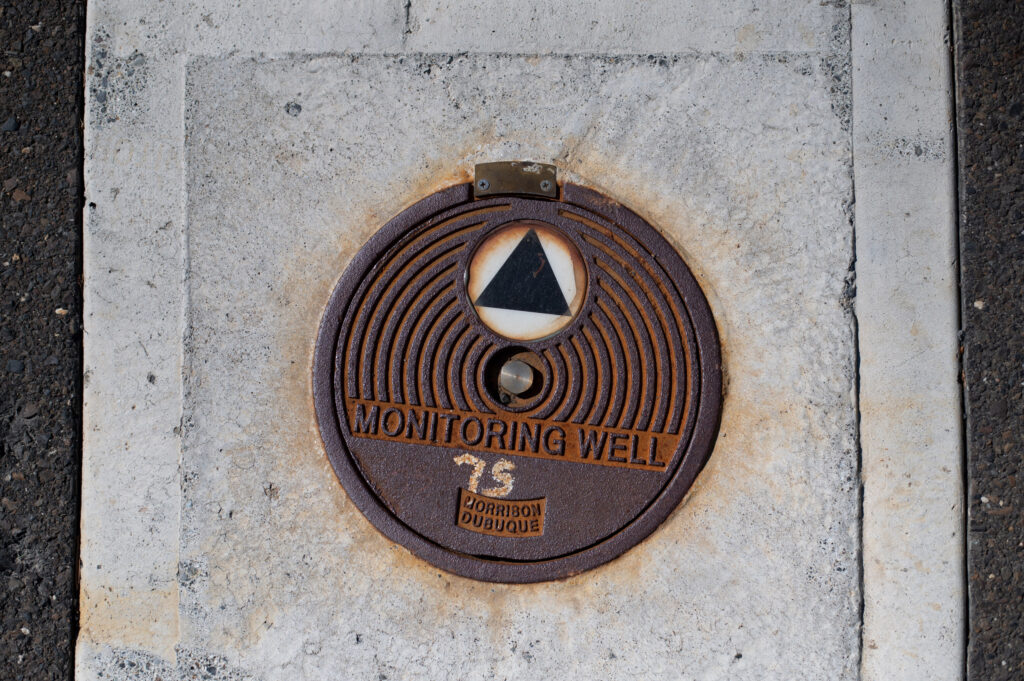
A water well and monitoring well sit in front of a home on Spencer Road, which was purchased by Energy Transfer soon after the company discovered the spill. Credit: Tracie Van Auken/Inside Climate News
At the July news conference on his proposal, Fitzpatrick directed sharp criticism at Energy Transfer, with a strong implication that weak government oversight has been part of the problem.
“My experience with them, with regard to Energy Transfer: no transparency and this aura of power that they have, that they can be unchecked,” Fitzpatrick said. “It doesn’t matter how much citizen uproar there is. It doesn’t matter how much a community is impacted. They feel insulated to kind of do things … on their timeline, their terms, the way they want.
“That’s a problem,” Fitzpatrick added. “They’re a corporation. They’re not a government.”
A Once-Safe Enclave Breached From Below
For now, more than 200 Upper Makefield residents rely on home point-of-entry treatment, or POET systems, to keep toxic pollutants out of their drinking water, with Energy Transfer picking up the tab. There have been problems, like filters that become saturated with black muck, and loss of water altogether if there’s a power outage. And then, there are 43 homes that want POET systems, which cost several thousand dollars each, and which Energy Transfer—a company that made $4.2 billion in profit last year—has declined to install. Residents say these homes are outside the zone the company has delineated as vulnerable to the spill effects.
At the community meeting last month, Ben Weldon, chairman of Upper Makefield’s board of supervisors, told Energy Transfer officials their remedial action plan was lacking what was most important to residents—a source of clean water.
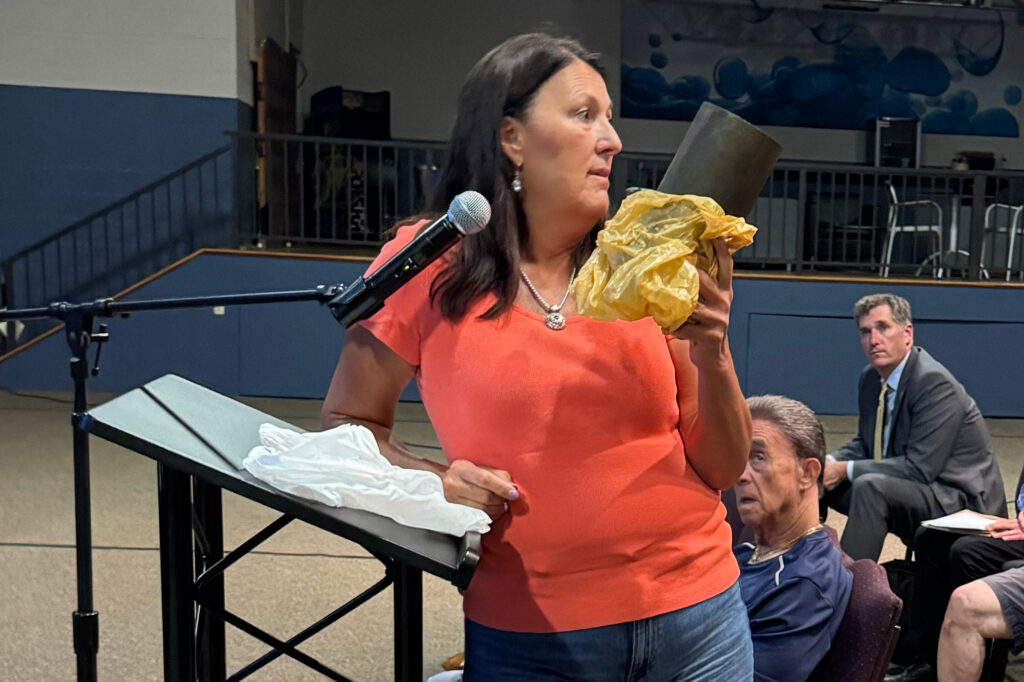
The POET systems “were never supposed to be the permanent clean-water solution,” Weldon said. “The fatal flaw of these systems is that we are still pulling water—even with these systems in place—from an aquifer that we know is contaminated with jet fuel.”
In an acknowledgement that a hook-up to a public water system may be the only solution, Fitzpatrick and Pennsylvania’s Democratic senator, John Fetterman, have proposed allocating $9 million to $11 million in federal clean water funding for Upper Makefield Township in the federal budget for the next fiscal year.
Meanwhile, Mount Eyre Manor residents watch the regular water test results from Energy Transfer. In March, fuel pollution showed up in a monitoring well where it had never appeared before, and in one home well. After several days of testing, water samples at both locations showed up clean.
The state DEP suspects that the readings were due to the spring thaw and rain increasing the movement of the pollution underground, agency spokeswoman Briggs said.
But news of the apparent fuel migration shook residents.
It prompted the Harpers to begin weighing their options, including the once-unthinkable prospect of leaving what they always saw as their forever home. They don’t want to move their daughter out of her elementary school and away from her friends. Home prices are astronomical in other neighborhoods within the school’s attendance zone. And most of all, they love it here.
Harper said the neighborhood was “amazing,” a throwback to a simpler time. “It’s a crazy 1950s thing, where you can go to the back door and scream, ‘Dinner’s ready!’ and the kids come home eventually,” he said. “Finding a neighborhood like that?”
“It’s tough,” said Casina-Harper.
“Almost impossible,” Harper said.
He pointed out that only one road leads into their neighborhood, which always gave it a protected feel.
It’s the road where Energy Transfer’s contractors in the white pickup trucks now enter their world each morning—to drill, to monitor and to decide the future of Mount Eyre Manor.
Inside Climate News’ Peter Aldhous contributed to this report.
About This Story
Perhaps you noticed: This story, like all the news we publish, is free to read. That’s because Inside Climate News is a 501c3 nonprofit organization. We do not charge a subscription fee, lock our news behind a paywall, or clutter our website with ads. We make our news on climate and the environment freely available to you and anyone who wants it.
That’s not all. We also share our news for free with scores of other media organizations around the country. Many of them can’t afford to do environmental journalism of their own. We’ve built bureaus from coast to coast to report local stories, collaborate with local newsrooms and co-publish articles so that this vital work is shared as widely as possible.
Two of us launched ICN in 2007. Six years later we earned a Pulitzer Prize for National Reporting, and now we run the oldest and largest dedicated climate newsroom in the nation. We tell the story in all its complexity. We hold polluters accountable. We expose environmental injustice. We debunk misinformation. We scrutinize solutions and inspire action.
Donations from readers like you fund every aspect of what we do. If you don’t already, will you support our ongoing work, our reporting on the biggest crisis facing our planet, and help us reach even more readers in more places?
Please take a moment to make a tax-deductible donation. Every one of them makes a difference.
Thank you,

Bureau Chief, Washington, D.C.
Marianne Lavelle is the Washington, D.C. bureau chief for Inside Climate News. She has covered environment, science, law, and business in Washington, D.C. for more than two decades. She has won the Polk Award, the Investigative Editors and Reporters Award, and numerous other honors. Lavelle spent four years as online energy news editor and writer at National Geographic. She spearheaded a project on climate lobbying for the nonprofit journalism organization, the Center for Public Integrity. She also has worked at U.S. News and World Report magazine and The National Law Journal. While there, she led the award-winning 1992 investigation, “Unequal Protection,” on the disparity in environmental law enforcement against polluters in minority and white communities. Lavelle received her master’s degree from Columbia University Graduate School of Journalism, and is a graduate of Villanova University.