

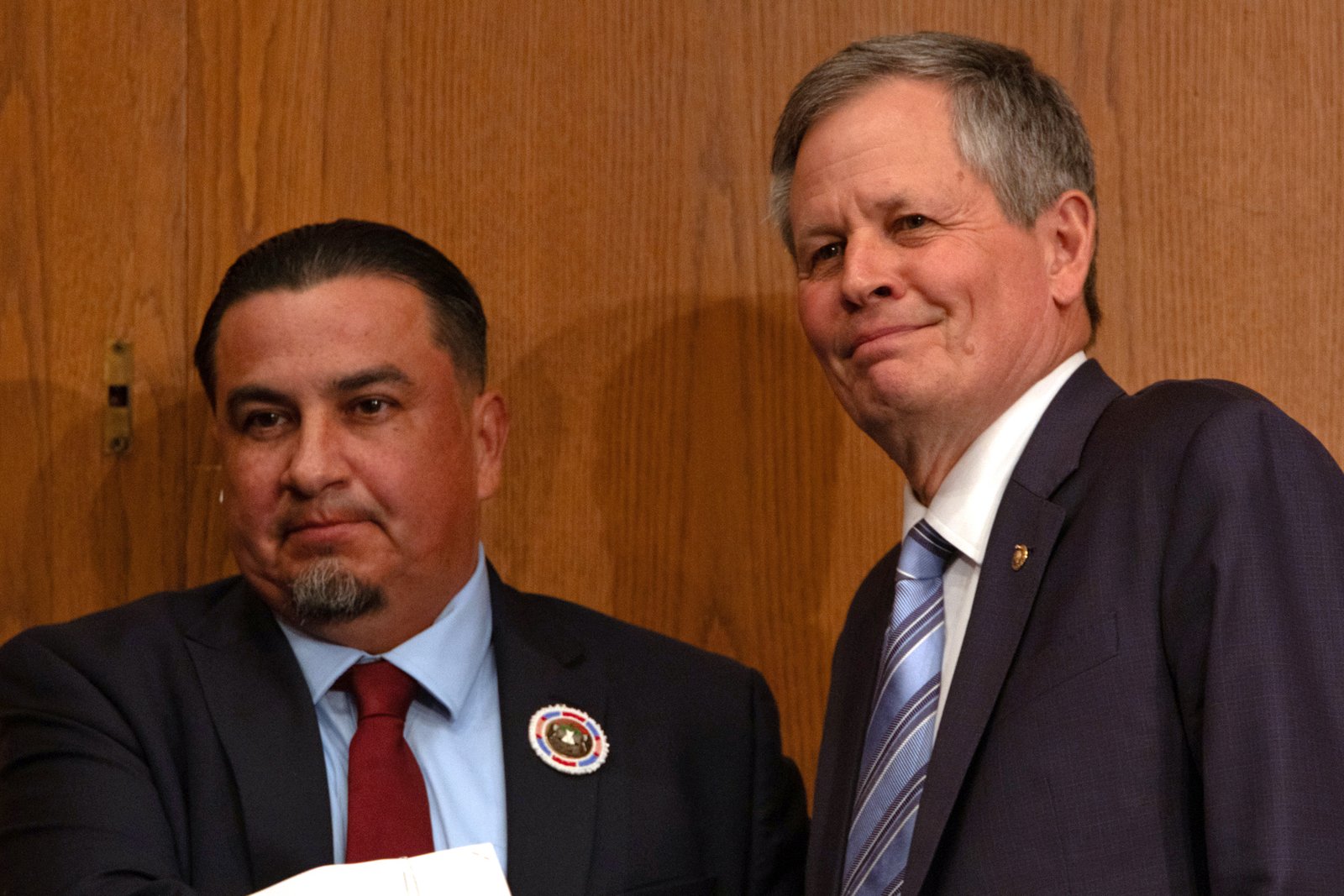
A U.S. Senate committee last week approved a complicated swap of underground coal resources supported by Montana’s Crow Tribe that would benefit Signal Peak Energy, a mining company that exports most of its coal to Japan and South Korea.
Democrats on the Indian Affairs Committee opposed the bill, citing concerns that it was intended to skirt environmental lawsuits and regulations.
The bill would give the Crow, a sovereign tribe in southern Montana, ownership of coal reserves beneath their land currently held by the Hope Family Trust; in exchange for relinquishing these rights, the Hope family would receive federal coal reserves in the Bull Mountains. The family is widely expected to lease that land to Signal Peak Energy, which operates Montana’s only longwall coal mine.
In the future, the Crow hope also to mine the coal reserves they would get in the swap.
“The Crow Tribe has decided to develop their coal … and so the rest of the world should not be in our way for that,” Conrad Stewart, energy director of the Crow Tribe, told Inside Climate News. “We’re trying to bring an economic benefit to our people.”
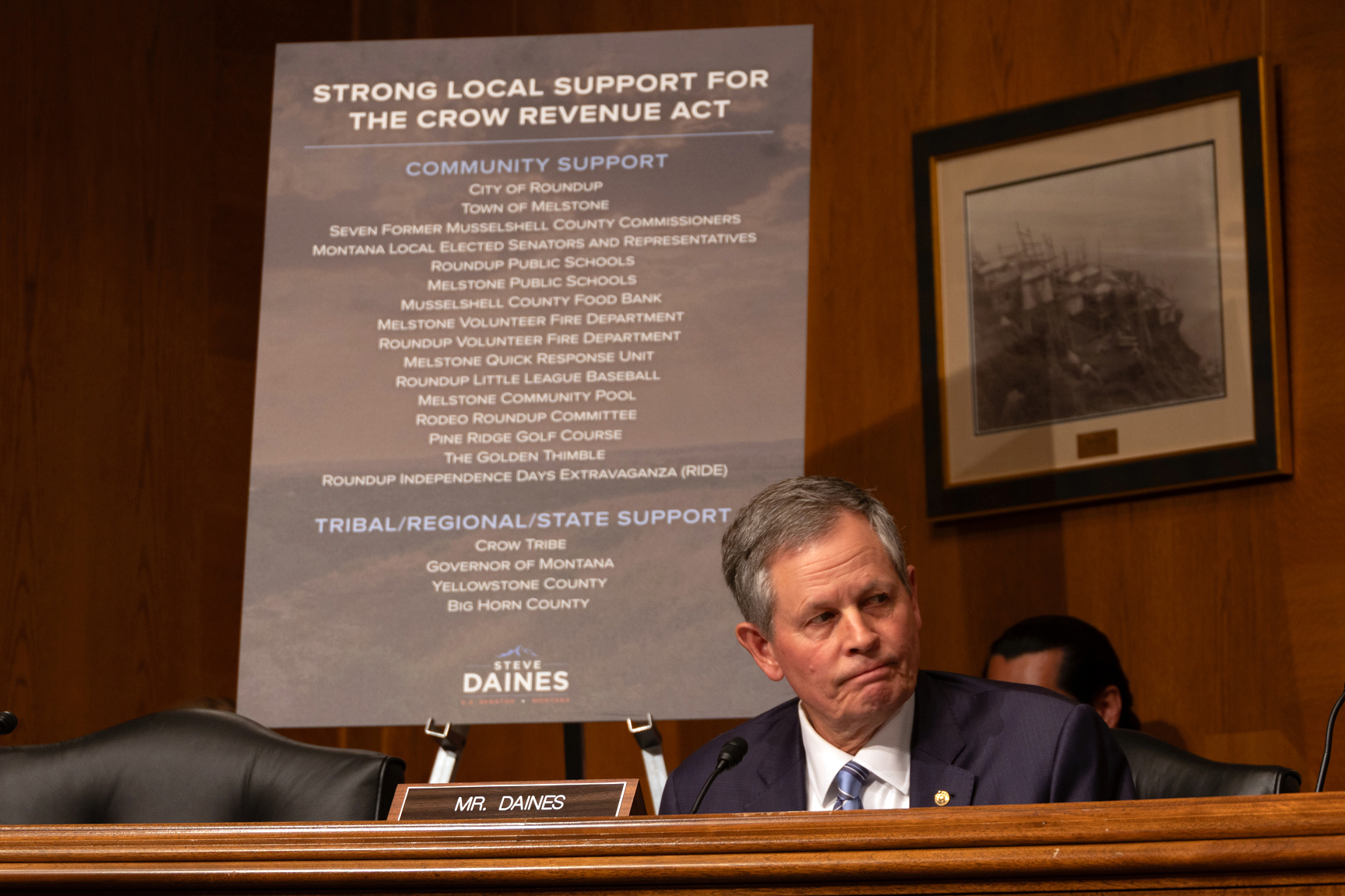
Sen. Steve Daines (R-Mont.) brokered the bill, saying it would benefit the tribe and the town of Roundup.
“The Crow Revenue Act is a huge win for the Crow Tribe, Roundup and the surrounding communities,” Daines said in a statement. “This bill helps the Tribe receive new revenue, supports our miners and keeps the Roundup community’s economy thriving.”
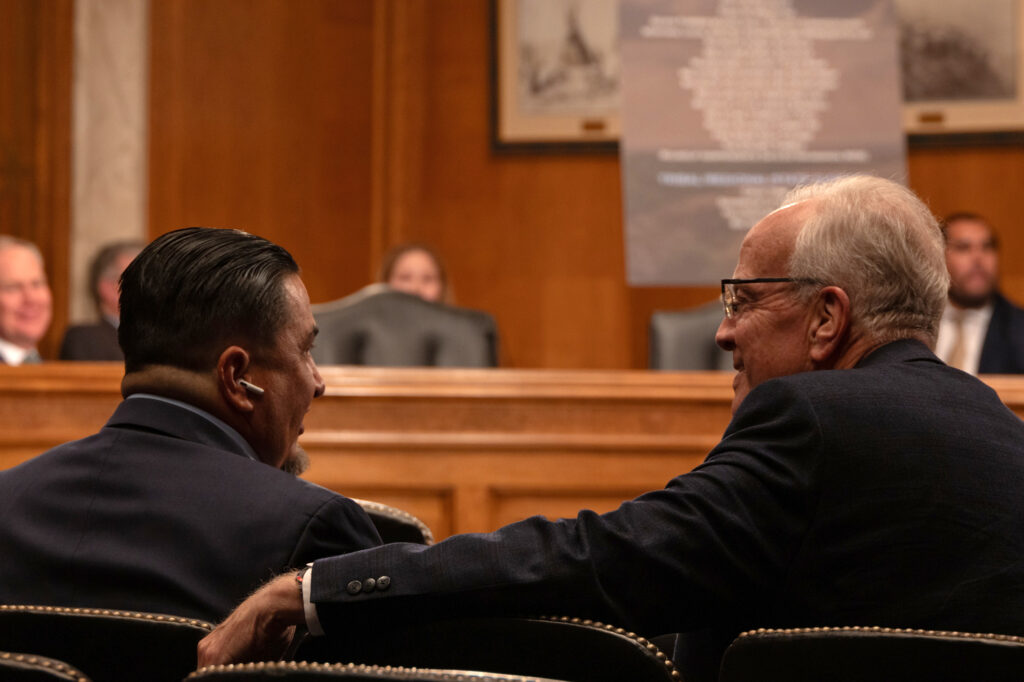
Sitting in front of Daines during the 6-5 party-line vote was Frank White Clay, chairman of the Crow Tribe, who has supported the bill since 2024. The House Committee on Natural Resources has already approved a similar legislation.
If passed by Congress, the Crow Revenue Act could allow Signal Peak to shield itself from a lawsuit the company said could force it to shut down.
Under the legislation, the federal government would relinquish 4,530 acres of federal subsurface interests and 940 acres of federal surface interests in Musselshell County currently within the boundaries of a coal mining permit held by Signal Peak. Once out of federal oversight, Signal Peak would not need to comply with the National Environmental Policy Act (NEPA).
The legislation is key to the coal mining company’s plan for its survival.
In March, Signal Peak became the target of a lawsuit by environmental groups. The suit came after the company sought approval for a separate 7,100-acre expansion that would allow it to pull 175 million tons of coal from beneath the Bull Mountains. Environmental groups said burning all that coal would release 240 million tons of greenhouse gas emissions over 11 years.
According to the litigants, the mining method used by the company resulted in the draining and dewatering of spring-fed intermittent and perennial streams and associated wetlands in the area. In the past, the company had repeatedly failed to conduct adequate evaluations of the environmental effects of its projects.
The U.S. Office of Surface Mining Reclamation and Enforcement approved the expansion, citing the “energy emergency” established in an executive order from President Donald Trump as the justification. The environmental groups challenged that reasoning, saying regulators had been aware for decades that underground coal mining would irrevocably damage the area’s water.
Derf Johnson, deputy director of the Montana Environmental Information Center, one of the groups involved in the lawsuit, said the Crow Revenue Act could prevent the Bull Mountain Mine from having to comply with NEPA, which requires the government to analyze environmental impacts of major projects.
“This legislation intends to circumvent a previous court ruling which prohibited the mining of federal coal unless and until the U.S. Office of Surface Mining Reclamation and Enforcement conducted an adequate NEPA analysis that fully considered the climate change impacts associated with the expansion,” Johnson said.
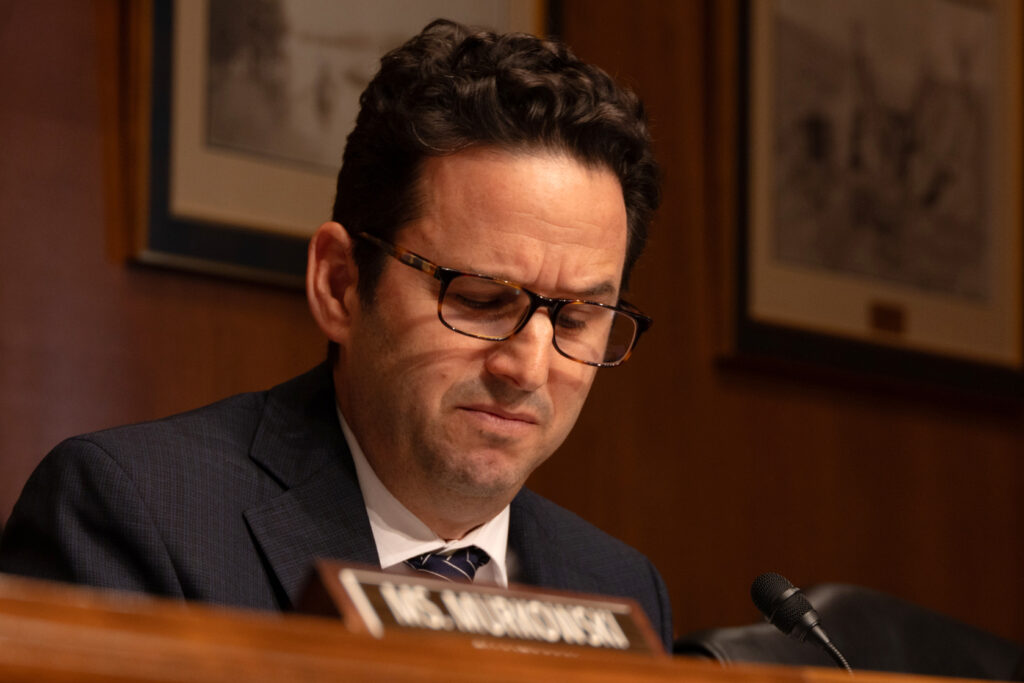
Sen. Brian Schatz (D-Hawaii), the committee’s vice chairman, said the agreement is being handled unusually, “with some companies that have been repeatedly in trouble with the federal government.” During the meeting, he proposed four amendments to the bill that would clarify the nature and value of the revenue-sharing agreement, define some of the wording on the bill and ensure that Signal Peak complied with NEPA standards within five years.
This story is funded by readers like you.
Our nonprofit newsroom provides award-winning climate coverage free of charge and advertising. We rely on donations from readers like you to keep going. Please donate now to support our work.
All four amendments were rejected along party lines.
“When we do land exchanges, we do have to make sure that we understand the architecture of the deal, and I just don’t,” Schatz said. “This is a tough one, because you can see the chairman of the tribe here, and he wants it. But I will tell you, I am not satisfied that the tribe is going to benefit and I am quite confident that the [Musselshell County] may lose a ton of revenue.”
Signal Peak Energy did not immediately respond to requests for comments on the lawsuits and for a statement on the revenue sharing agreements with the Crow Tribe.
A Crow Revenue Act
While the bill’s name suggests a revenue opportunity for the Crow Tribe, the only line that directly addresses compensation requires the Hope Family and the Tribe to “enter into a revenue sharing agreement for the development of any mineral interests in the Bull Mountains Tracts.”
“The Crow Revenue Act, evidenced by the first word, Crow, puts all the power in the Crow Tribe’s hands,” Daines said. “They get to negotiate a deal that they view as fair.”
Stewart, the tribe’s energy director, said the tribe has made a sovereign decision to support this legislation and that he is not concerned the agreement with Signal Peak Energy and the Hope family will fall short of their revenue expectations.
“It doesn’t matter if it passes in the Senate or the president signs it, if it turns out to be a deal where it’s not feasible for us, then we would probably step away from it,” Stewart said. “It doesn’t tie our hands.”
Although no one currently mines the coal the Hope Family holds rights to under the Crow reservation, Stewart said the revenue sharing agreement would bring economic benefits for at least 10 years to the tribe. Later on, the tribe could “start moving toward geothermal and maybe some oil development and some critical mineral development,” he said. He added that the Crow Tribe could earn $100 million in royalties through the revenue-sharing agreement with the Hope Family Trust.
“I’ve been a coal miner for 10 years,” Stewart said. “For me to hear people that have never been to a coal mine tell me how bad it is, it just doesn’t make sense.”
The federal government has not released an appraisal for the coal tracts that would be conveyed to the Hope Family Trust.
In May 2024, when the Crow Revenue Act was first introduced, Crow Chairman Frank White Clay wrote a letter to Daines, arguing that the legislation would restore to the tribe longstanding inholdings in their Reservation and provide “much needed revenue.”
Amanda Sowden, a legal consultant for the Crow Tribe, said the committee marked significant progress.
“We’re still Montanans and we still want the best for the state and [Signal Peak] and we want it to operate going forward the best it can,” Sowden said. “They’ve put a lot back in the community and they’ve worked hard at rebuilding relationships.”
Chéri Smith, founder, president and chief executive officer for the nonprofit Alliance for Tribal Clean Energy, said complex decisions, like balancing economic opportunity, energy development and environmental stewardship, should belong to the tribes. The nonprofit, which was not involved in the Crow Revenue Act negotiations, provides services ranging from technical assistance to project development support for tribes.
Smith said natural resource arrangements involving tribes should be structured to provide very clear, substantial and lasting benefits to them, while also granting access to complete information and third-party independent expertise.
“The mouse can’t be in charge of the cheese,” she said.
Derf Johnson thinks it is highly unlikely the coal within the Crow Tribe’s parcel of subsurface land “would ever be developed.” He said it is not located near existing infrastructure and that coal is essentially in permanent decline across the U.S.
Schatz said the Crow Revenue Act does not give any details on whether the Crow would actually benefit.
“We are being asked to approve something and we don’t even have the basic data, as if we’re buying a condominium. You can’t buy a condo without an appraisal,” Schatz said. “Yet we’re going to do a massive land transfer and evade the National Environmental Policy Act without even knowing the basic configuration of this deal.”
The companion bill in the U.S. House, introduced by Rep. Troy Downing (R-Mont.), cleared the House Natural Resources Committee with bipartisan support in late June. Reps. Adam Gray (D-Calif.) and Jared Golden (D-Maine) broke party lines to support it. The House bill is now eligible for consideration before the full House of Representatives.
Rep. Jared Huffman (D-Calif.), ranking member of the House committee, said the legislation would not guarantee revenue for the Crow Tribe. He said Signal Peak, which he called a “bad actor,” would first have to relinquish its lease with the federal government on the coal resources being turned over to the Crow.
“This legislation would essentially codify the Trump administration’s reckless and potentially illegal approval of the mine expansion,” Huffman said in a statement. “It would undermine federal environmental law and oversight by privatizing public land for the benefit of a criminal coal company.”
About This Story
Perhaps you noticed: This story, like all the news we publish, is free to read. That’s because Inside Climate News is a 501c3 nonprofit organization. We do not charge a subscription fee, lock our news behind a paywall, or clutter our website with ads. We make our news on climate and the environment freely available to you and anyone who wants it.
That’s not all. We also share our news for free with scores of other media organizations around the country. Many of them can’t afford to do environmental journalism of their own. We’ve built bureaus from coast to coast to report local stories, collaborate with local newsrooms and co-publish articles so that this vital work is shared as widely as possible.
Two of us launched ICN in 2007. Six years later we earned a Pulitzer Prize for National Reporting, and now we run the oldest and largest dedicated climate newsroom in the nation. We tell the story in all its complexity. We hold polluters accountable. We expose environmental injustice. We debunk misinformation. We scrutinize solutions and inspire action.
Donations from readers like you fund every aspect of what we do. If you don’t already, will you support our ongoing work, our reporting on the biggest crisis facing our planet, and help us reach even more readers in more places?
Please take a moment to make a tax-deductible donation. Every one of them makes a difference.
Thank you,

Fellow
Gabriel Matias Castilho is an Inside Climate News fellow reporting on the Washington, D.C. area. Previously, he worked for Capitol News Illinois, covering environmental policy, energy and utilities across the state. He is currently a master’s student at Northwestern University.