

Close Menu

    Subscribe to Updates

    Get the latest news information from worldwide businesses.

    What's Hot

    Juliette’s descent beneath the silo leads to a major finding

    July 24, 2026

    Solar generated more electricity than coal and wind in May – EIA data

    July 24, 2026

    17 Best Pools in Las Vegas to Beat the Desert Heat

    July 24, 2026
    Facebook Instagram YouTube LinkedIn X (Twitter)
    Trending
    • Juliette’s descent beneath the silo leads to a major finding
    • Solar generated more electricity than coal and wind in May – EIA data
    • 17 Best Pools in Las Vegas to Beat the Desert Heat
    • A new antiviral could stop measles before an outbreak takes off
    • Long COVID Hits Women’s Brain Health Harder Than Men’s
    • Tesla’s car door defect could lead to tougher rules for everyone
    • As US weighs response to Chinese AI, industry urges against broad open-weight restrictions
    • OpenAI pushes ChatGPT into patient health records
    Newspublicly
    • About Us
    • Advertise & Partner with us
    • Pitch Your Story
    • Contact Us
    Facebook Instagram LinkedIn X (Twitter)
    Subscribe
    • Home
    • World News
      • Asia
      • India
      • USA
      • UK & Europe
      • Middle East
    • Economy & Business
      • Global Economy
      • Corporate & Industry
      • Finance & Markets
      • Policy & Trade
    • Technology
      • Gadgets & Devices
      • Software & Apps
      • AI & Machine Learning
      • Robotics & Automation
    • Health & Medicine
      • Fitness & Nutrition
      • Research & Innovation
      • Disease & Treatment
      • Doctors, Clinics & Patient Care
    • Travel & Tourism
    • Automobile
      • Electric & Hybrid Vehicles
      • Auto Industry Insights
    • Sports
    • More
      • Education
      • Real Estate
      • Environment & Climate
      • Space & Astronomy
      • War & Conflicts
    Newspublicly
    Home»More»Space & Astronomy»NASA to launch rescue mission June 30 to save Swift space telescope from burning up in Earth’s atmosphere
    Space & Astronomy

    NASA to launch rescue mission June 30 to save Swift space telescope from burning up in Earth’s atmosphere

    AdminBy AdminJune 29, 2026No Comments4 Mins Read0 Views
    Share
    Facebook Twitter LinkedIn Copy Link WhatsApp


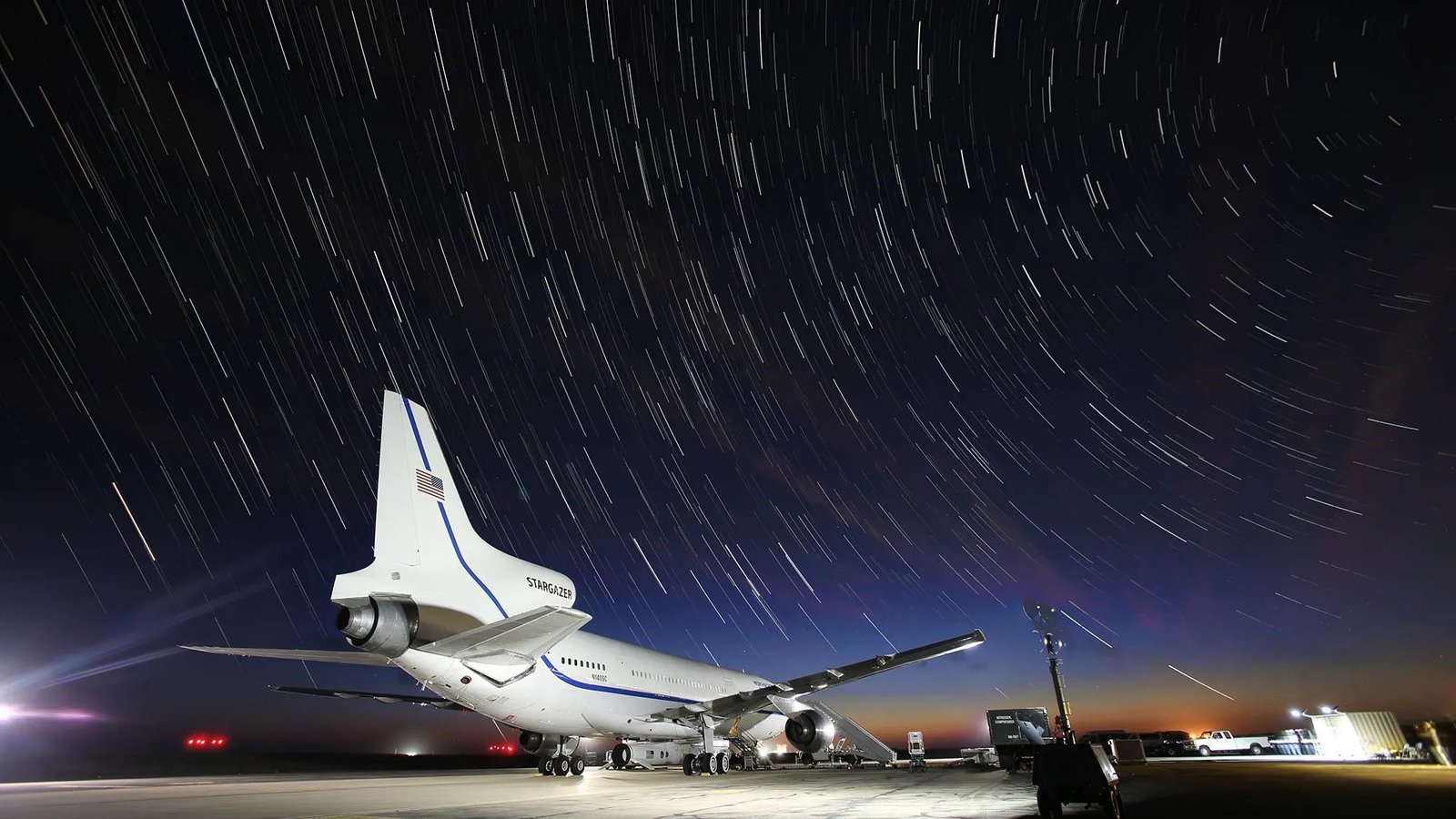
    An air-launched Northrop Grumman Pegasus XL rocket is scheduled to fly for the very last time early Tuesday morning (June 30), sending a private spacecraft on a rescue mission to save one of NASA’s most iconic space telescopes from falling back to Earth.

    The Swift Boost mission will send the LINK satellite, built by Arizona-based Katalyst Space Technologies, to grapple NASA’s Neil Gehrels Swift Observatory and tow it to a stable orbit, saving it from impending destruction as its trajectory dips farther into the atmosphere. LINK, aboard Pegasus, will take off from Bucholz Army Airfield at Kwajalein Atoll in the Marshall Islands, secured to Northrop Grumman’s L-1011 Stargazer jet.

    Liftoff is scheduled for 6:23 a.m. EDT (1023 GMT), Tuesday. Pegasus will be released by Stargazer once the aircraft reaches about 39,000 feet (12,000 meters), traveling at Mach 0.82. Five seconds later, the rocket will ignite its engine and ascend to orbit.

    Pegasus is a three-stage, solid rocket-propelled launch vehicle that measures 55 feet in length (16.9 meters), capable of delivering up to 1,000 pounds (454 kg) into low-earth orbit (LEO). Following its separation from the Stargazer, the rocket’s stages are ignited in sequence to reach its intended altitude in about 10 minutes.

    Pegasus debuted in 1990, and has since flown 45 missions. Its aerial deployment and flexibility to take off from different airfields allows the rocket to enter hard-to-reach orbital inclinations that are inaccessible from many major spaceports. That’s one of the reasons Pegasus is launching LINK, a robotic servicing satellite that can reach Swift’s low 20.6-degree inclination relative to Earth’s equator.


    You may like

    Another reason NASA chose the Pegasus rocket for this mission was time, which is running out for Swift. The $500 million Swift Observatory was launched in November 2004 to study gamma-ray bursts and other high-energy events across the universe. And, despite its more than 20 years of operation, Swift is still providing scientific value.

    Its orbit, though, has begun to dip dangerously low, where recent solar activity has increased atmospheric drag at higher LEO altitudes and will soon overcome the spacecraft, dragging it to its ultimate demise. Swift, unfortunately, was not designed to be serviced, and wasn’t built with the thrusters it needs to raise its own orbit.

    Space

    Enter LINK.

    After its release from Pegasus’ payload bay and initial systems checkouts, the Katalyst spacecraft will begin its long course to rendezvous with Swift. Before beginning its final approach, LINK will spend two to three weeks performing observations of Swift to assess optimal grapple points on the observatory.
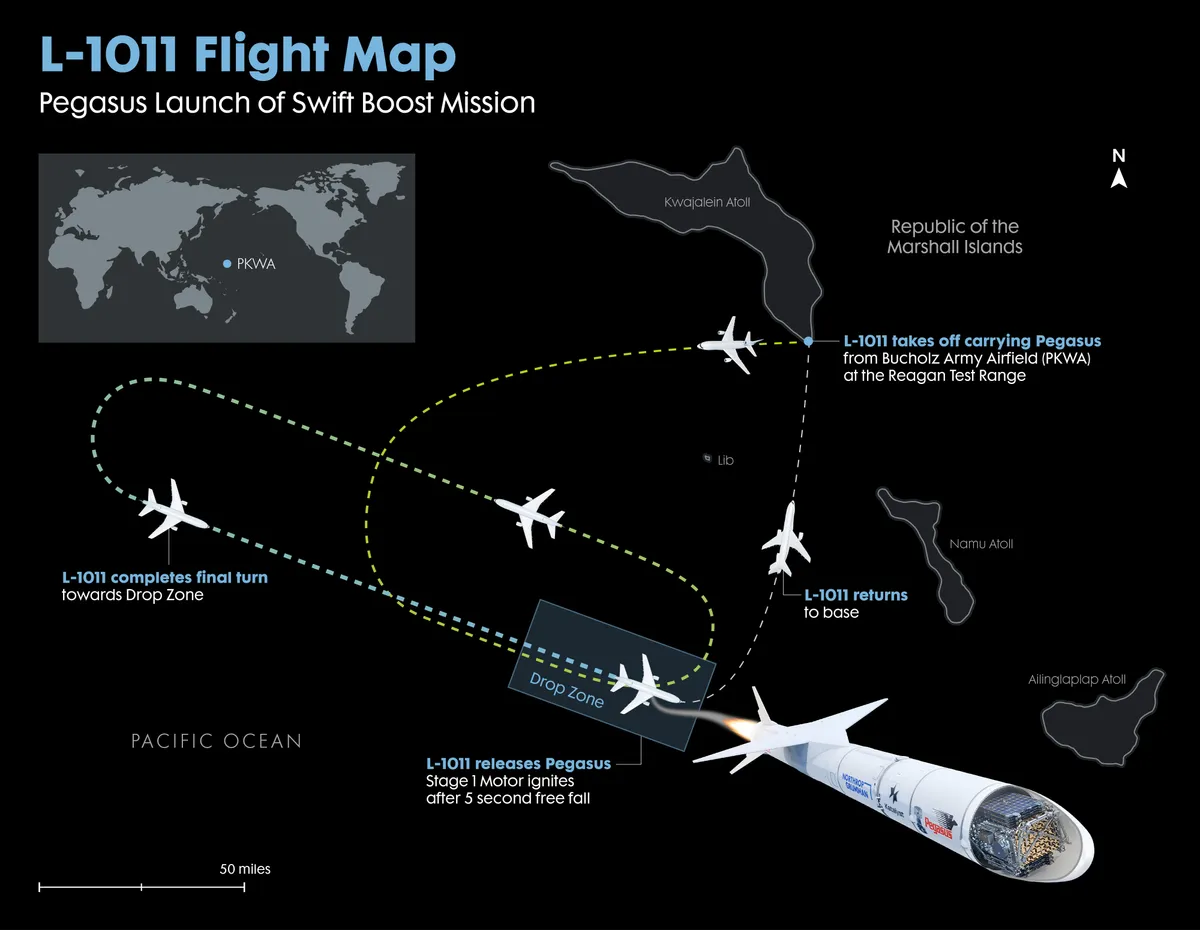
    the flight path of a plane is shown around an airland, landing strip, and a small white rocket on the bottom right.

    Stargazer flight path prior to Pegasus XL deployment. (Image credit: Northrop Grumman)

    LINK measures about 4.9 feet (1.5 m) tall, and is equipped with three robotic arms that will be used to capture Swift, which stretches about 12.7 feet (3.9 m). Once a grab-point is chosen and Swift secured, LINK will fire a set of gentle ion thrusters that will slowly raise the pair’s orbit over the next several months.

    LINK is poised to be the first private spacecraft to attempt to capture an uncrewed U.S. government satellite. NASA selected Katalyst for the task in September 2025, with less than a year to carry out LINK’s design, manufacture and testing. Despite its urgency and the relative short notice to get LINK in orbit, the entire Swift rescue mission and launch only cost NASA $30 million.

    “While NASA could have allowed Swift to re-enter the atmosphere, the situation presented an opportunity to demonstrate a key capability for the future of space exploration. This daring approach also extends Swift’s scientific lifetime and is more affordable than replacing the observatory’s unique capabilities,” NASA states on the Swift Boost mission page.

    The goal is to return Swift to its original altitude of about 373 miles (600 km), which will extend the observatory’s life expectancy by a number of years, provided its systems continue to operate as designed.


    Source link

    Author

    • Admin

      NewsPublicly.com is News & Articles Platform that creating SEO-focused articles on travel, lifestyle, and digital trends.

    Admin
    • Website

    NewsPublicly.com is News & Articles Platform that creating SEO-focused articles on travel, lifestyle, and digital trends.

    Related Posts

    Epic photo captures lightning striking a Chinese rocket during liftoff

    July 24, 2026

    Planet hunter gets the silent treatment photo of the day for July 24, 2026

    July 24, 2026

    The easiest way to learn the summer night sky starts with these 3 stars

    July 24, 2026
    Leave A Reply Cancel Reply

    Demo
    Top Posts

    The Blue Moon rises on May 30— Where and when to see the second full moon of the month

    May 30, 202640 Views

    New SOCOM rifle allows barrel swapping and cartridge changes

    June 1, 202633 Views

    “Inside Gemini Robotics 1.5: How Robots Learn to Reason & Act

    November 22, 202527 Views

    525 pounds of cocaine seized after Nebraska K9 alerts troopers on I-80

    May 28, 202624 Views
    Don't Miss

    Juliette’s descent beneath the silo leads to a major finding

    July 24, 20264 Mins Read0 Views

    The search for answers grows even more dangerous in Silo Season 3 Episode 4 as…

    Solar generated more electricity than coal and wind in May – EIA data

    July 24, 2026

    17 Best Pools in Las Vegas to Beat the Desert Heat

    July 24, 2026

    A new antiviral could stop measles before an outbreak takes off

    July 24, 2026
    Stay In Touch
    • Facebook
    • Twitter
    • Instagram
    • YouTube
    • LinkedIn
    • WhatsApp

    Subscribe to Updates

    Get the latest creative news from SmartMag about art & design.

    Demo
    NEWSPUBLICLY
    Facebook X (Twitter) Instagram LinkedIn

    Home

    • About Us
    • Leadership
    • Advertise & Partner With Us
    • Pitch Your Story
    • Media Kit & Pricing
    • Career
    • FAQs

    Guidelines

    • Editorial & Submission
    • Partnership
    • Advertising & Sponsor
    • Intellectual Property Policy
    • Community & Comment
    • Security & Data Protection
    • Send Your Opinion

    Quick Links

    • Cookie Policy
    • Payment & Billing Terms
    • Refund & Cancellation
    • Copyright Policy
    • Complaint & Support
    • Sitemap
    • Contact Us

    Subscribe Us

    Get the latest news and updates!

    Copyright © 2026 Newspublicly (DIGITALIX COMMUNICATION). All Rights Reserved.
    • Privacy Policy
    • Terms of Use
    • Disclaimer