

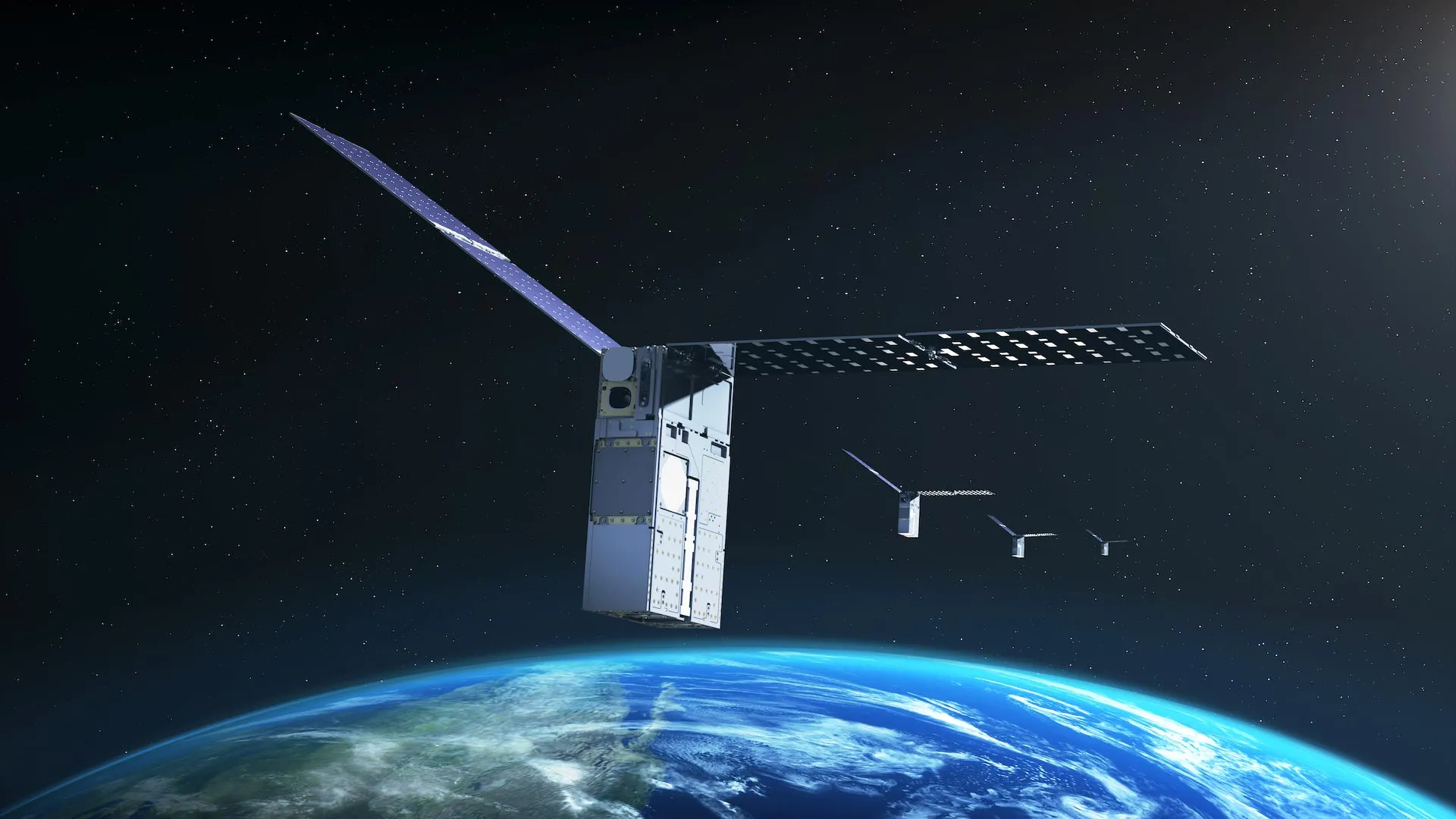
NASA’s Starling mission has reached another milestone in autonomous spaceflight by demonstrating a system that can determine a satellite’s orbital position using other objects in space as reference points rather than depending on an external navigation network.
The technology, called FALCON (Fast Autonomous Lost-in-space Catalog-based Optical Navigation), is designed to help spacecraft operate with greater independence. Such capabilities could become increasingly important as NASA pursues missions farther from Earth, including lunar satellite swarms, distributed science missions, and future human exploration.
Navigating Space Without GPS
Satellites near Earth commonly rely on GPS for navigation, but those signals may be weak, unreliable, or unavailable around the Moon and in deep space. FALCON offers an alternative by allowing spacecraft to determine where they are using what they can observe around them.
The FALCON payload is a joint flight experiment developed by NASA and EraDrive, a startup that emerged from Stanford University. The system combines EraDrive’s Era-Core flight software and embedded algorithms with Starling’s cameras and an onboard catalog of known satellites. Together, these tools enable GPS-independent navigation while also helping the spacecraft track activity and objects in its surroundings.
“FALCON is yet another success for the Starling demonstration mission. The results from FALCON can have far-reaching implications for on-orbit space-traffic monitoring, collision avoidance, and alternative navigation,” said Roger Hunter, program manager for NASA’s Small Spacecraft and Distributed Systems program at NASA’s Ames Research Center in California’s Silicon Valley. “The number of ‘firsts’ from Starling just keeps growing.”
Using Satellites and Debris as Reference Points
The FALCON demonstration evaluated two related capabilities using Starling’s onboard star tracker cameras. These cameras are standard spacecraft instruments that detect bright objects in space and help determine a spacecraft’s orientation and position.
During position, navigation, and timing experiments, FALCON identified objects seen by Starling’s cameras, including other spacecraft and orbital debris, and compared them with a publicly available catalog of known space objects maintained by the U.S. Department of War. Once the observed objects were identified and verified, FALCON used them as reference points to calculate Starling’s orbit.
A separate set of experiments tested whether the spacecraft could improve orbital estimates for the objects it observed. Mission controllers loaded a catalog containing approximately 20,000 space objects and their predicted orbits onto Starling.
FALCON then compared the catalog information with observations gathered by Starling’s cameras. Using those measurements, it calculated Starling’s position while also refining the estimated locations of other objects in space. The resulting estimates were even more precise than the existing catalog data.
Over a period of three days, FALCON improved the known orbits of more than 200 objects without any intervention from operators on the ground.
A First for Autonomous Optical Navigation
FALCON’s ability to determine its own orbit represents a first for a spacecraft navigating with optical cameras based on its position relative to other objects in space. In separate catalog updating tests, Starling also generated better onboard predictions of object positions than those supplied by ground stations.
These abilities could be especially valuable for future networks of satellites operating without GPS. Coordinated satellite systems may play an important role in supporting human activities on the surfaces of the Moon or Mars.
Precise spacecraft positioning is also essential for distributed science missions, where measurements collected from several locations in space must be accurately aligned. For space traffic management, autonomous navigation and onboard catalog updates could reduce dependence on ground-based tracking networks while improving collision avoidance.
From University Research to Commercial Technology
The FALCON experiment also demonstrates NASA’s role in helping university research develop into commercial technology. The work began as a University SmallSat Technology Partnerships project before developing into EraDrive, which is now commercializing its Era-Core software and related hardware for wider use.
Starling gave the technology an opportunity to be tested under real conditions in orbit, demonstrating how advanced flight software can allow satellites to function as increasingly autonomous navigators.
Later this year, Starling, which launched in 2023, will expand the FALCON experiment using Era-Core. The mission’s four spacecraft will share tracking information with one another and use those combined observations to refine their positions collectively.
NASA’s Ames Research Center in California’s Silicon Valley leads the Starling mission. NASA’s Small Spacecraft and Distributed Systems program, based at Ames and within the Research and Technology Mission Directorate, funds and manages the Starling mission.