

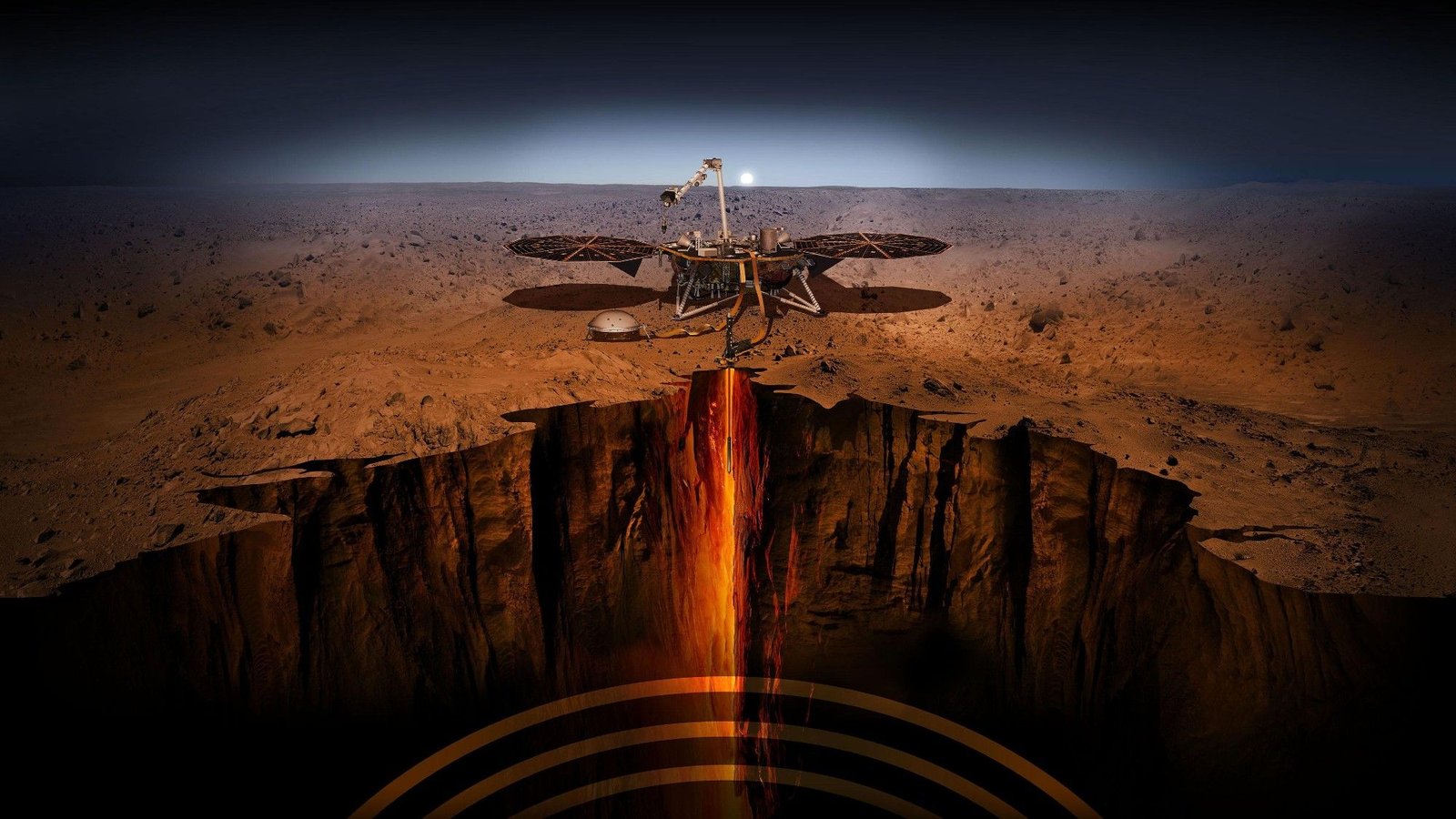
Deep oceans of magma once sloshed about inside the crust of Mars, seismic measurements taken by NASA’s InSight mission suggest.
The marsquakes detected by InSight show a boundary 15 miles (24 kilometers) deep between two different types of rock that were formed by enormous pools of magma. The presence of these magma pools could completely change what we thought we knew about the early development of Mars.
Already, scientists say the discovery could change what we know about the history of Mars. “One of the big questions in planetary science is whether Earth is unique,” said the University of Oxford’s Jon Wade in a statement. “If Mars could develop this kind of complex crust without plate tectonics, then maybe the conditions needed for habitability can emerge on more planets than we realized, including those previously dismissed based on size or their apparent lack of tectonic activity.”
Earth is shaped by plate tectonics, the shifting of giant slabs of the planet’s crust above our planet’s molten mantle in a motion that generates earthquakes and volcanoes, but which also creates new land and regulates atmospheric carbon by drawing it out of the atmosphere and re-releasing it though volcanic eruptions. This constant reprocessing results in a fairly complex crust with multiple layers.
However, no convincing evidence has been found that the Red Planet has ever had plate tectonics. Instead, it is what we call a ‘stagnant lid’ planet, where the entire crust is one unbroken layer. Beneath this solid lid, all the way down to the mantle 23.6 miles (38 km) below the Martian surface, was considered to be fairly homogenous.
But NASA’s InSight (Interior Exploration using Seismic Investigations, Geodesy and Heat Transport) mission, which operated on Mars’s surface between 2018 and 2022, put this to the test. InSight’s seismometer was designed to detect tremors from marsquakes triggered by meteorite impacts or shifts in the planet’s interior. These seismic tremors would reverberate through Mars, and InSight could learn about the interior structure of the Red Planet based on how they reached the lander.

Thanks to the way these tremors passed through Mars’s interior after traveling at different velocities through different kinds of rock, InSight discovered a boundary between two layers of crust, but its existence has not been explained until now.
Researchers at the University of Oxford tasked themselves with figuring it out. Using geothermal models and statistics, the Oxford team identified the two types of rock that best matched the seismic data. They conclude that above 15 miles (24 km) deep is a thick layer of mafic rock, which is rich in iron, magnesium and silica. Below this depth is denser, crystalline ultramafic rock, which contains iron and magnesium but is depleted in silica and which descends a further 8.7 miles (14 kilometers) to the boundary between the crust and the mantle.
It seems as though the rock has become differentiated – the denser material having settled out below the lighter mafic rock. This could only have happened in huge pools of magma that once resided in giant pockets within Mars’s crust. Like oil separating from water, the mafic and ultramafic rock separated over time, in a process called differentiation, before the magma cooled and froze the layers in place.
The pockets of magma could have extended for hundreds and possibly even thousands of kilometers around the planet, each pool linked to the others. Giant volcanic systems on Mars such as Olympus Mons and the Tharsis volcanoes would not have been isolated hotspots, but would have been interconnected beneath the surface.
This is something of a surprise – this kind of ‘transcrustal magmatism’ has only ever been found on Earth before. It’s evidence that even though Mars lacked plate tectonics, it could still have undergone a degree of geochemical evolution and deep, complex geology.
This geology could even have supported a habitable environment by regurgitating carbon back into the atmosphere to maintain a greenhouse effect. Because of its small size and therefore low gravity and lack of magnetic field, Mars’s atmosphere is notoriously leaky, and over its history, much of its atmosphere – including large quantities of its precious water – has escaped into space.
Large-scale volcanism, powered by interconnected chambers of magma, could have belched greenhouse gases back into the atmosphere, thickening the Martian atmosphere and maintaining warmer temperatures for longer.

But where did the magma come from? The Oxford team points the finger at upwelling from Mars’ deep mantle, and with that magma came waves of heat that partially melted the crust, creating more magma. Both these processes took place on Earth during the Archaean Eon, which spanned between 4 and 2.5 billion years ago. On Earth, these processes contributed to the formation of the continents, although Mars’ lack of plate tectonics and continents suggest that these processes were not as developed on the Red Planet.
Even so, some models suggest that mantle upwelling contributed to Mars’ north–south dichotomy where the north contains mostly lowlands, which could have facilitated a large ocean, and the south is dominated by highlands.
“We’ve traditionally assumed that volcanism on Mars was relatively simple compared to that on Earth, but this discovery suggests that the planet could sustain massive, long-lived magmatic systems capable of evolving and reprocessing molten rock throughout the crust,” said the study’s lead author, Tobermory Mackay-Champion, who was previously at Oxford during the research but is now at the University of Bristol.
Mackay–Champion also highlights how this reprocessing of Mars’s crust could have left metal deposits nearer the surface than had been thought.
“Mars may hold significantly more near-surface mineral wealth than previously recognized, boosting its potential for future mining, crewed missions and, eventually, permanent settlements,” said Mackay-Champion.
While undoubtedly useful for a future outpost on Mars, this does raise the specter of companies pillaging and exploiting the Red Planet for its resources.
The findings were published on June 26 in Nature Astronomy.