

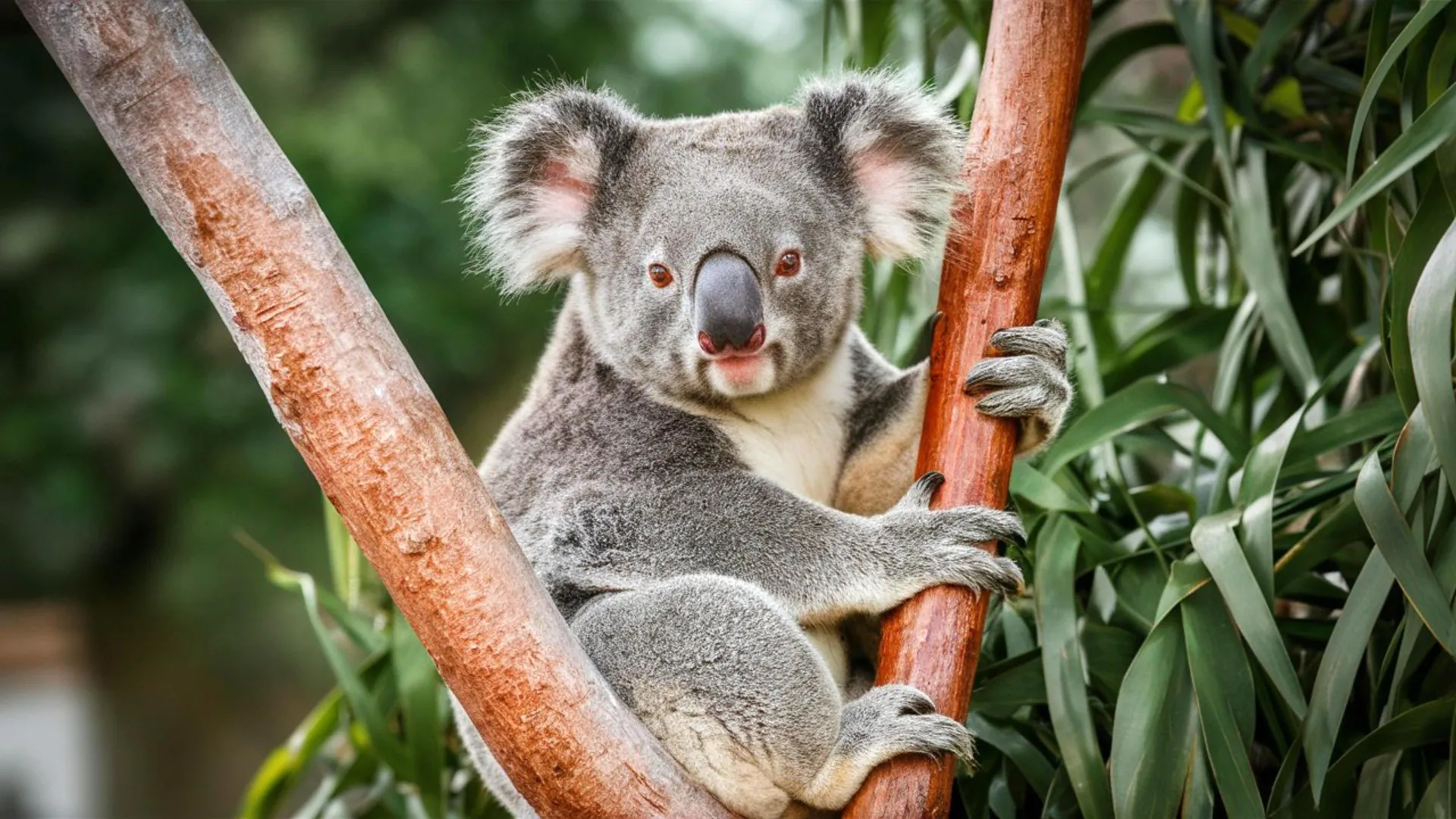
A major genomic analysis is changing scientists’ understanding of koala evolution. The research indicates that koalas (Phascolarctos cinereus) underwent a severe population decline about 100,000 years ago, well before humans reached Australia.
Every koala alive today appears to descend from a single ancestral population that endured dramatic environmental shifts, including intense glacial periods.
Modern koalas, however, are now confronting a different combination of dangers. These include hunting, widespread land clearing, bushfires, and disease.
Researchers from the University of Sydney and Texas A&M University led the study, which challenges earlier research suggesting that koala numbers collapsed only after humans arrived in Australia. The findings were announced in Molecular Biology and Evolution, published by Oxford University Press.
“The study rewrites the timeline for the koala’s genetic history in Australia,” says PhD student Toby Kovacs, who led the research.
“By calculating the mutation rate of modern koala populations, we can estimate and build the genetic timeline backwards all the way to 100,000 years ago to get a glimpse of genetic diversity and the sizes of ancient koala populations.”
Koala DNA Reveals a Hidden Population History
Fossil evidence is too limited to show precisely how many koalas lived in Australia 100,000 years ago, Mr. Kovacs said. Genomic data can help fill those gaps by preserving clues about earlier population sizes and changes in genetic diversity.
“Genomic analyses show that koalas have experienced major population declines in the past due to climate change and habitat loss. When environmental conditions improved, their populations recovered and expanded across much of eastern Australia.”
“It’s important to make clear many of the threats facing modern koala populations are caused by humans, which includes habitat loss and hunting.”
By examining how koalas responded to earlier population crashes and recoveries, scientists may be able to develop better conservation strategies for protecting the species today.
How Researchers Reconstructed Koala Evolution
To rebuild the koala’s genetic history, the scientists focused on the species’ mutation rate within its genome (an organism’s genetic information).
New mutations (genetic changes) naturally appear in the genome each time an organism reproduces. The mutation rate describes how many of these changes arise in each generation. Rates vary by species, with genetic changes accumulating more quickly in some animals than in others.
The team sequenced the genomes of four parent-offspring trios and counted the new mutations that appeared. This allowed them to calculate a precise mutation rate for koalas, which was about half the rate found in humans.
Researchers then applied the newly measured rate to 457 koala genomes. This gave them a more accurate way to trace how koala populations expanded, contracted and separated over thousands of years.
The work represents the first direct estimate of a mutation rate for koalas or for any member of the marsupial order Diprotodontia, which also includes wombats, kangaroos and possums.
Earlier studies had concluded that koala populations declined after modern humans arrived in Australia about 65,000 years ago. Those estimates, however, were based on mutation rates taken from distantly related mammals such as humans and mice.
Koalas Declined Before Humans Arrived
The new analysis suggests that a major koala population decline began around 100,000 years ago. Their numbers then reached a critical genetic bottleneck nearly 60,000 years ago.
This collapse coincided with a period of major environmental disruption during the most recent glacial period of the late Pleistocene age. The timing places the decline long before contact with humans.
The landmass that eventually became Australia was covered largely by wet forests during the Paleogene (23 — 66 million years ago). Conditions changed dramatically during the Miocene (5- 23 million years ago) as the Australian tectonic plate moved north.
During the Pleistocene (2.5 million to 11,700 years ago), Australia repeatedly shifted between glacial periods, characterized by cold and dry conditions, and interglacial periods, characterized by warmer and wetter conditions. These cycles steadily reshaped the continent, making its landscapes more arid and increasingly vulnerable to fire.
Around 70,000 years ago, the expanding Nullarbor Plain created a vast region of semi-arid shrubland. This reduced the amount of suitable koala habitat and separated populations in eastern and western Australia.
The western koala population eventually disappeared. A small population in the east managed to survive the most difficult glacial conditions.
A Small Population Rebuilt the Species
Conditions improved during the current interglacial period, allowing the surviving eastern population to expand. Between 16,500 and 6,000 years ago, it divided into five genetically distinct populations.
Those groups eventually gave rise to the koala populations now found along Australia’s east coast.
“Given these results, we’re now curious to see if other Australian species, including the closest relatives of extinct megafauna, also experienced population declines before humans arrived,” says Mr. Kovacs.
The newly calculated mutation rate does more than clarify the koala’s ancient past. Scientists can also use it to study recent changes in population size and improve modern conservation planning.
Estimates covering the most recent koala generations indicate that populations in Queensland and New South Wales have continued to decline. In contrast, populations in Victoria appear to be recovering.
Koalas have been officially listed as endangered in Queensland, New South Wales, and the Australian Capital Territory since 2022.
Genomic Research Could Guide Conservation
Mr. Kovacs says, “Understanding whether koala populations are shrinking helps conservationists act early, before populations lose genetic diversity and face increased risks from inbreeding.
“Koalas experienced large population retractions in the past, as the climate changed and suitable habitat disappeared. The surviving koalas are again experiencing a similar retraction, but this time due to human-driven land clearing, bushfires, hunting and disease.”
“Our team is generating enormous genomic resources for koalas, but to fully understand what these datasets can tell us, we also need to know how quickly new genetic changes arise in the species,” says Mr. Kovacs.
“Estimating the mutation rate improves our ability to reconstruct koala population history, understand their capacity to adapt, and make more informed conservation decisions for the future.”