

Close Menu

    Subscribe to Updates

    Get the latest news information from worldwide businesses.

    What's Hot

    You can’t ignore Google Zero anymore

    July 25, 2026

    Prentis, new AI lab co-founded by Reid Hoffman, Mark Pincus in talks to raise $100M

    July 25, 2026

    RJ Corp picks former Diageo maven Prathmesh Mishra to expand drinks play

    July 25, 2026
    Facebook Instagram YouTube LinkedIn X (Twitter)
    Trending
    • You can’t ignore Google Zero anymore
    • Prentis, new AI lab co-founded by Reid Hoffman, Mark Pincus in talks to raise $100M
    • RJ Corp picks former Diageo maven Prathmesh Mishra to expand drinks play
    • Romania says F-16 shot down drone over the country’s airspace
    • ‘What kind of arrogant government will not listen to kids?’: Actor Abhishek Banerjee joins protests in Goa | India News
    • Trump orders signs outside Smithsonian to promote accurate history
    • “Thirsty for a ring” – YouTuber FlightReacts Slams LeBron James For Joining 76ers After Jaylen Brown’s Infamous Bronny James Video Went Viral
    • Specialized just unveiled a new full-suspension e-bike, and here’s why it costs $13k
    Newspublicly
    • About Us
    • Advertise & Partner with us
    • Pitch Your Story
    • Contact Us
    Facebook Instagram LinkedIn X (Twitter)
    Subscribe
    • Home
    • World News
      • Asia
      • India
      • USA
      • UK & Europe
      • Middle East
    • Economy & Business
      • Global Economy
      • Corporate & Industry
      • Finance & Markets
      • Policy & Trade
    • Technology
      • Gadgets & Devices
      • Software & Apps
      • AI & Machine Learning
      • Robotics & Automation
    • Health & Medicine
      • Fitness & Nutrition
      • Research & Innovation
      • Disease & Treatment
      • Doctors, Clinics & Patient Care
    • Travel & Tourism
    • Automobile
      • Electric & Hybrid Vehicles
      • Auto Industry Insights
    • Sports
    • More
      • Education
      • Real Estate
      • Environment & Climate
      • Space & Astronomy
      • War & Conflicts
    Newspublicly
    Home»More»Space & Astronomy»James Webb Space Telescope discovers ‘galaxy-killing’ wind that may explain why some early galaxies lived fast and died young
    Space & Astronomy

    James Webb Space Telescope discovers ‘galaxy-killing’ wind that may explain why some early galaxies lived fast and died young

    AdminBy AdminJune 11, 2026No Comments3 Mins Read0 Views
    Share
    Facebook Twitter LinkedIn Copy Link WhatsApp


    Using the James Webb Space Telescope (JWST) and the Atacama Large Millimeter/submillimeter Array (ALMA), astronomers may have uncovered new clues about a longstanding mystery in galaxy evolution: why so many massive galaxies in the early universe appear to have died far sooner than expected.

    Galaxies are often considered “alive” when they are actively forming stars and “dead” when star formation has largely ceased. In today’s universe, dead galaxies are common. But astronomers have been surprised to find large numbers of them in the early universe, when galaxies were expected to be rapidly growing and churning out stars.

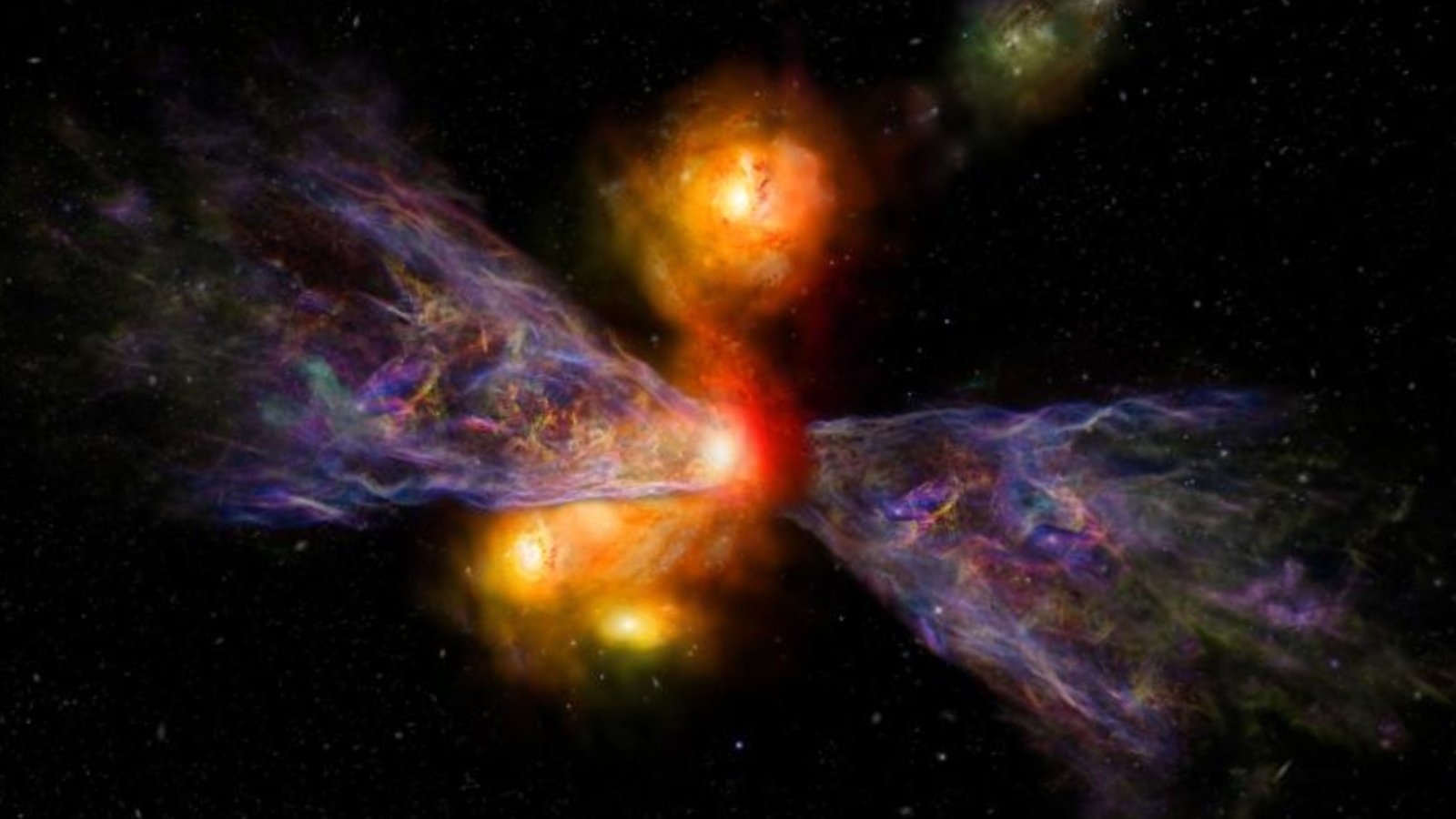
    Using ALMA and JWST observations of a distant galaxy, researchers have detected a “galaxy-killing” wind — an enormous, high-speed outflow of gas — that is powerful enough to strip a galaxy of the raw material needed to make new stars. The discovery could help explain the puzzling population of massive “dead” galaxies found throughout the young cosmos, according to a statement from the Royal Astronomical Society.

    “Dense regions of the universe are like very active cities,” Rebecca Davies, lead author of the study from Swinburne University of Technology in Melbourne, said in the statement. “Galaxies collide and undergo frenzied bursts of star formation. But when the biggest stars burn out, they explode as supernovas, launching powerful winds that blast away the very gas galaxies need to keep forming stars.”

    Davies and colleagues observed a galaxy called CRISTAL-02 as it appeared just one billion years after the Big Bang, catching it in the midst of a rapid growth spurt.

    The observations revealed that CRISTAL-02 is forming stars at roughly twice the rate of similar galaxies from the same era. At the same time, JWST and ALMA detected a vast plume of cold gas extending far from the galaxy — a telltale sign that material is being blown out into intergalactic space, according to the statement.

    “The galaxy has a powerful wind that is ejecting material twice as fast as the galaxy forms stars,” Davies added. “If this rapid blowout continues, the galaxy could be dead in less than 50 million years, explaining the origin of the mysterious massive dead galaxies in the early universe.”


    You may like

    The 18 galaxies from the ALPINE-CRISTAL-JWST survey

    The 18 galaxies from the ALPINE-CRISTAL-JWST survey including CRISTAL-02 (Image credit:  Andreas Faisst (Caltech) and the ALPINE-CRISTAL-JWST Survey team)

    The discovery is particularly intriguing because CRISTAL-02 is not a single galaxy. Instead, it consists of multiple galaxies in the final stages of a merger. During these cosmic collisions, gas is funneled toward galactic centers, triggering intense bursts of star formation, later followed by supernova explosions that drive powerful winds that prevent any new stars from being born.

    What’s more, observations suggest that nearly half of massive galaxies in the early universe were interacting with nearby companions, indicating that mergers and their galaxy-killing winds may have been widespread. In turn, many of the universe’s earliest giant galaxies may have effectively destroyed their own ability to form stars — helping explain why so many of these galaxies seem to have lived fast and died young.

    Space

    “If many early galaxies collide and experience rapid growth, then it may not be surprising that we see so many dead galaxies in the early universe,” Davies said in the statement. “CRISTAL-02 offers a natural solution to the mystery of why these massive galaxies live fast and die young.”

    The study was published June 10 in the journal Monthly Notices of the Royal Astronomical Society: Letters.


    Source link

    Author

    • Admin

      NewsPublicly.com is News & Articles Platform that creating SEO-focused articles on travel, lifestyle, and digital trends.

    Admin
    • Website

    NewsPublicly.com is News & Articles Platform that creating SEO-focused articles on travel, lifestyle, and digital trends.

    Related Posts

    The ZWO Seestar S30 Pro delivers beautiful astro in minutes.

    July 24, 2026

    We boldly chat to ‘Star Trek: Strange New Worlds’ showrunners about dinosaurs in space and Lovecraftian horrors for season 4 (interview)

    July 24, 2026

    What lurks beneath the volcanoes of Jupiter’s moon Io? NASA’s Juno probe just took a peek

    July 24, 2026
    Leave A Reply Cancel Reply

    Demo
    Top Posts

    The Blue Moon rises on May 30— Where and when to see the second full moon of the month

    May 30, 202640 Views

    New SOCOM rifle allows barrel swapping and cartridge changes

    June 1, 202633 Views

    “Inside Gemini Robotics 1.5: How Robots Learn to Reason & Act

    November 22, 202527 Views

    525 pounds of cocaine seized after Nebraska K9 alerts troopers on I-80

    May 28, 202624 Views
    Don't Miss

    You can’t ignore Google Zero anymore

    July 25, 20261 Min Read0 Views

    The web and Google once had a deal: Google collects data and indexes webpages and…

    Prentis, new AI lab co-founded by Reid Hoffman, Mark Pincus in talks to raise $100M

    July 25, 2026

    RJ Corp picks former Diageo maven Prathmesh Mishra to expand drinks play

    July 25, 2026

    Romania says F-16 shot down drone over the country’s airspace

    July 25, 2026
    Stay In Touch
    • Facebook
    • Twitter
    • Instagram
    • YouTube
    • LinkedIn
    • WhatsApp

    Subscribe to Updates

    Get the latest creative news from SmartMag about art & design.

    Demo
    NEWSPUBLICLY
    Facebook X (Twitter) Instagram LinkedIn

    Home

    • About Us
    • Leadership
    • Advertise & Partner With Us
    • Pitch Your Story
    • Media Kit & Pricing
    • Career
    • FAQs

    Guidelines

    • Editorial & Submission
    • Partnership
    • Advertising & Sponsor
    • Intellectual Property Policy
    • Community & Comment
    • Security & Data Protection
    • Send Your Opinion

    Quick Links

    • Cookie Policy
    • Payment & Billing Terms
    • Refund & Cancellation
    • Copyright Policy
    • Complaint & Support
    • Sitemap
    • Contact Us

    Subscribe Us

    Get the latest news and updates!

    Copyright © 2026 Newspublicly (DIGITALIX COMMUNICATION). All Rights Reserved.
    • Privacy Policy
    • Terms of Use
    • Disclaimer