

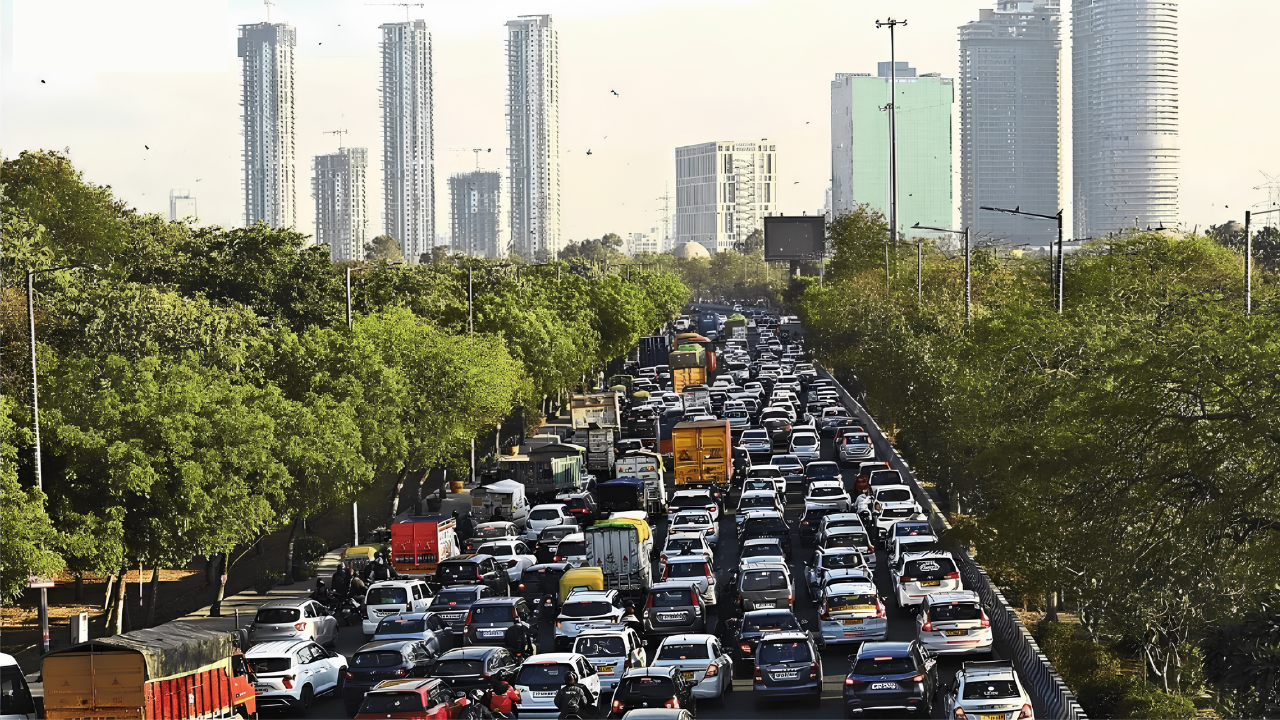
Jobs, exports, talent and investment increasingly depend on urban India. Three reforms can turn cities from growth constraints into productive assetsIndia’s economic destiny will be decided in its cities. This is a no brainer. They concentrate people, ideas, capital and markets in ways no other mode of human habitation can. India’s transition to a high-income Viksit Bharat will happen on the back of vibrant, well-functioning cities — as has happened everywhere else.For India, the stakes are higher than most. Unlike East Asia, whose rise was powered by manufacturing, India’s competitive edge lies in services. IT, BPO, financial services and over 2,000 global capability centres (GCC) currently employing 2.3 million professionals have driven exports and highvalue jobs for two decades. Services exports now rival merchandise exports. All these industries are urban. They live or die by whether cities can attract skilled talent and investors, provide reliable infrastructure and offer a quality of life that allows firms to compete globally.The liveability of Bengaluru or Gurgaon is not a municipal detail in an era where professionals are mobile. It is a national economic variable that shapes whether India’s brightest build their futures at home or in Singapore, Dubai or London.India has made real progress. Metro rail now operates approximately 1000km in about 20 cities (compared with 229km across less than five cities in 2013). Airports and highways have improved dramatically. Household tap water and sanitation coverage has expanded sharply and are now universal in urban areas with high public awareness. Digital governance has simplified access to civic services.But the gaps that remain are large enough to threaten the entire growth story.
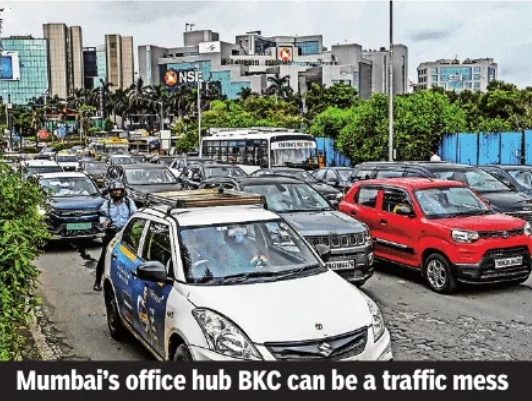
Mumbai
Start with how we plan our cities. If cities are to drive growth, there is almost no economic visioning or planning for them. Cities and their economies are left to architects and master plans which freeze their future based on a ground truth which is dynamic and fast changing. There is little attempt to identify the strengths of cities — current and potential — and plan to leverage those for rapid economic growth.
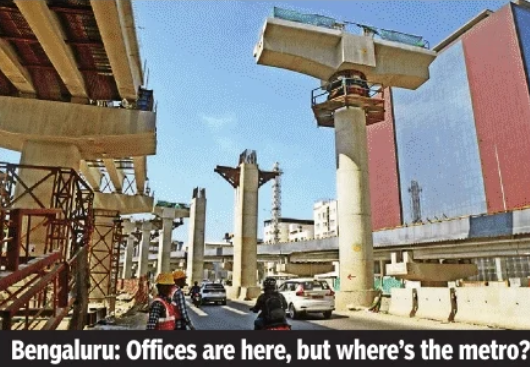
Bengaluru
Infrastructure, mobility, housing, services and quality of life need to be designed in line with this growth vision. Singapore, Dubai, and even New York and London have economic blueprints guiding their planning. These are city regions with trillion dollar economies. Hyderabad in the 1990s showed glimpses of such planning. India needs to do much more economic planning for cities for Viksit Bharat to become a reality.
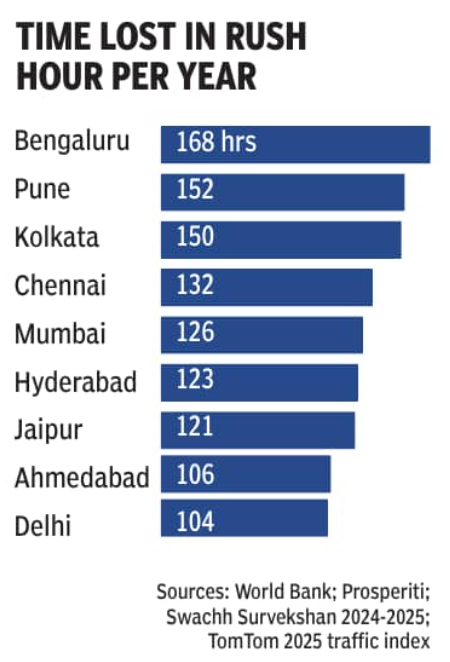
Time lost in rush hour.
Take air. Delhi is consistently ranked among the world’s most polluted capitals, with annual PM2. 5 concentrations 20 times WHO guidelines. Indian cities dominate global lists of the most polluted urban centres. This is not an unsolvable problem. Mexico City, once a byword for pollution, cut pollution through sustained, coordinated policy. India has yet to mount an effort of comparable seriousness.Basic services tell a similar story. Tap connections may have multiplied but almost no Indian city delivers water 24×7, forcing households to invest in tanks, pumps and purifiers — a private tax on public failure. Waste collection now exceeds 90% in many cities, without scientific processing, leaving mountains of legacy waste — Ghazipur in Delhi, Deonar in Mumbai — towering over neighbourhoods.
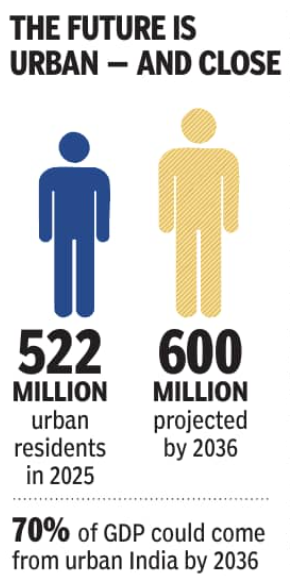
The future is urban-and close
Or consider the humble footpath. Indian cities are designed for vehicles, not people. In most cities, a majority of roads lack continuous, usable footpaths, even though walking accounts for a third or more of all trips. Cities in Europe and East Asia treat walkability as basic infrastructure; we treat it as an afterthought to be sacrificed whenever a road becomes congested. Behind all this lies a financing failure. India invests roughly 0.6-1.5% of GDP a year in urban infrastructure, against the 3-5% that rapidly urbanising economies have typically invested during their fastest growth phases.
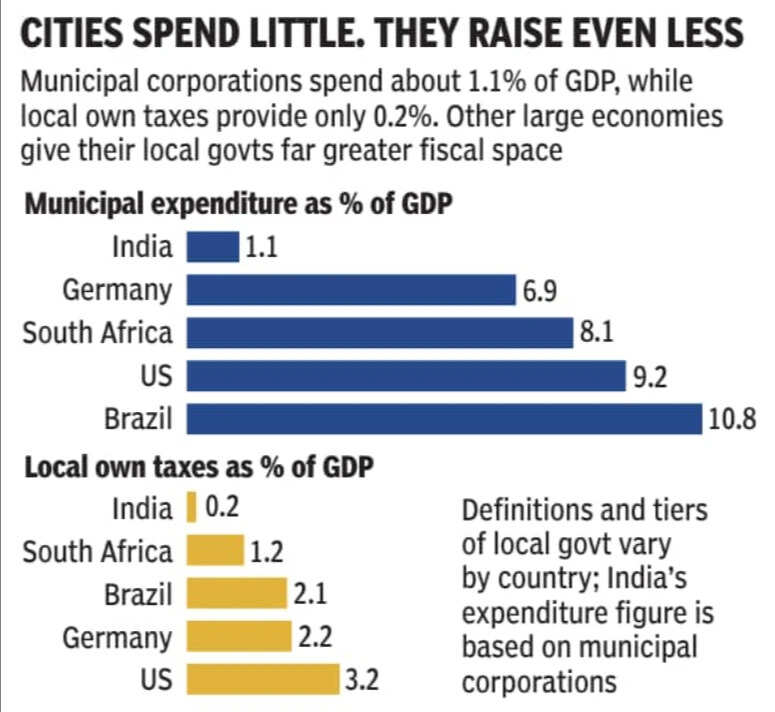
Cities spend little, they raise even less.
Municipal revenues have stagnated. The World Bank estimates India needs around $840 billion in urban investment over 15 years — about $55 billion a year. Interestingly, cities can finance themselves, given freedom and flexibility.
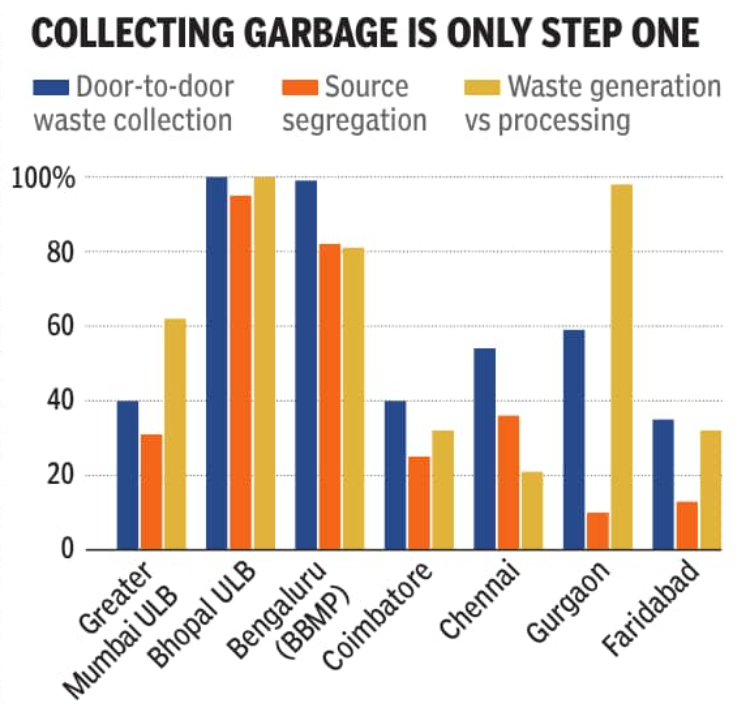
Waste collection by city
The good news: none of this is intractable. India does not lack entrepreneurial energy or private capital. It lacks a policy framework that lets cities grow.Three reforms matter most.1. Economic planningNot to be confused with more masterplanning. India mistakes detailed regulation for strategic foresight. No govt can predict where every colony or commercial district should stand 50 years hence. What it can predict are regional engines of growth: the Chennai-Bengaluru corridor, the Mumbai-Ahmedabad region, and emerging clusters around Hyderabad and Pune. Govt’s job is to think 50 years ahead — secure land, preserve transport corridors, and build trunk infrastructure early: rail, metro, water, sewage, power. Once those foundations exist, markets should decide the rest. Planning should enable growth, not micromanage it.2. RegulationRegulation that expands supply instead of strangling it. India’s housing affordability crisis is substantially self-inflicted. Low floor space index in cities should be relaxed for a premium, creating more floor space and generating revenue. Rigid FAR (floor-to-area ratio), archaic land-use conversion rules, and slow approvals make development costlier everywhere. The fixes are known: liberalise FAR wherever infrastructure permits, densify around metro stations, legalise mixed-use development, and digitise building approvals. Such reforms would unlock enormous private investment, expand housing supply and cut costs.3. Fix urban finance & governanceNo city can deliver world-class infrastructure on village-level finances and borrowed authority. Municipalities need stronger property tax systems, deeper municipal bond markets and predictable state transfers. But money without power will not suffice. Empower mayors and commissioners to plan, execute and be judged — and citizens will know exactly whom to hold responsible.By 2050, nearly 900 million Indians will live in urban areas — a number larger than the current population of the US and Western Europe combined. Cities already generate about 60% of India’s GDP, rising to 70% within a decade.The debate must therefore move beyond treating cities as administrative units needing periodic maintenance. Cities are productive assets — generators of jobs, innovation, exports and tax revenue. Investing in cities is not welfare; it is among the highestreturn investments.India’s rise to Viksit Bharat will be anchored in the quality of its cities. Get urbanisation right, and growth, tourism, talent and global standing follow. Get it wrong, and every one of those ambitions becomes harder — perhaps impossible — to achieve.The author is former CEO, NITI Aayog