

A social security agreement too has been operationalised from July 15.
“With the coming into force of the Comprehensive Economic and Trade Agreement and the Agreement on Social Security, our economic linkages are going to get even deeper,” Prime Minister Narendra Modi said in a social media post.
The CETA will give fresh momentum to Indian farmers, entrepreneurs and MSMEs. Several vibrant sectors will gain stronger access to the UK market, he said.

It will also deepen cooperation in technology, professional services and innovation, while supporting greater mobility for skilled Indian talent, he added.
The social security agreement will provide invaluable support to Indian professionals working temporarily in the UK and strengthen the competitiveness of Indian enterprises, the prime minister said.Flag-off ceremonies were held in different parts of the country, including Delhi, Coimbatore, Hyderabad and Jammu to mark the CETA coming into effect.
“The agreement, which opens new avenues for trade, investment and innovation, will create unique opportunities for our businesses while further accelerating PM @NarendraModi ji’s vision of Viksit Bharat 2047,” commerce and industry minister Piyush Goyal said in a social media post.
Terming the CETA as one of the “most aspirational” trade agreements by India to date, commerce secretary Rajesh Agarwal said: “More than 800 technical sessions were held over 14 formal rounds of negotiations…We have completed all pending issues in the last 30 days”.
He added that arriving at the agreement is only part of the work and that “every hour
of negotiation is complimented by three times the work outside”.
“It is a win-win agreement between the two countries which will have a shadow across economic relations,” Agrawal said.
Department of Commerce will work with export promotion councils to help industrial clusters understand how they can benefit from the agreement.
India and the UK aim to increase bilateral trade to $100 billion by 2030 from the current level of close to $60 billion in FY26, of which merchandise trade was worth $25.12 billion.
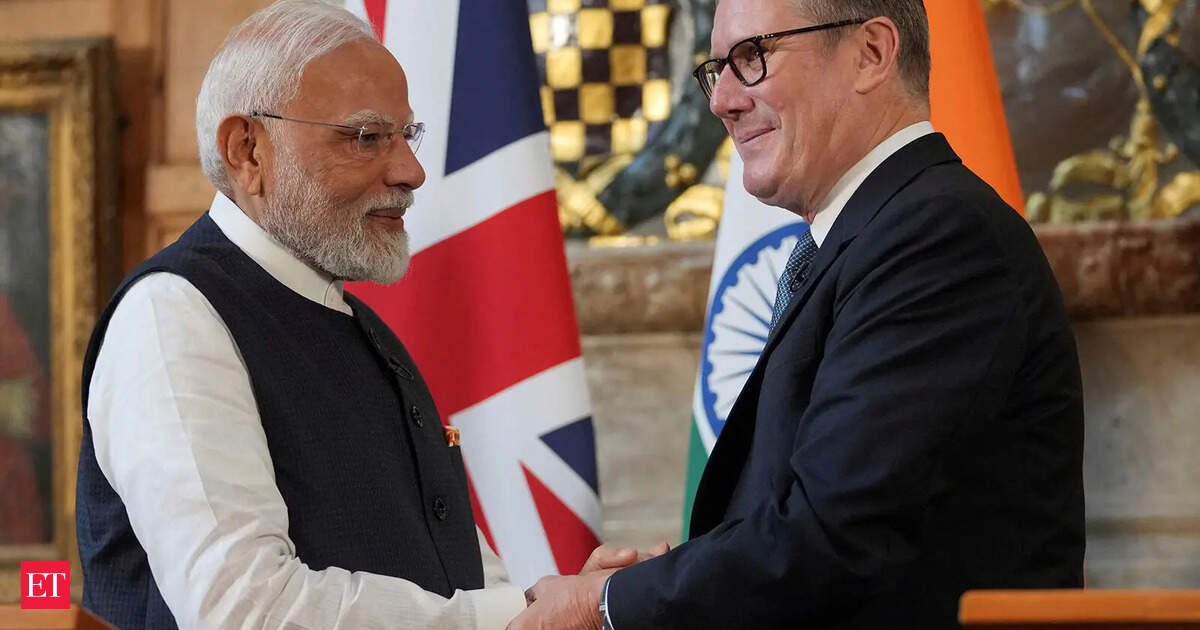
The CETA was signed in July 2025 by Prime Minister Narendra Modi and UK PM Keir Starmer following 14 rounds of negotiations.
“The deal turns ambition into action… and marks the next stage in bilateral trade,” said British High Commissioner to India Lindy Cameron, adding that UK-India trade is increasingly about services and knowledge, which are also supported through the trade deal.
Terming the agreement “the new gold standard of trade deals,” Cameron said it is the most ambitious free trade agreement either country has implemented to date.
She said that a British Airways flight arrived in Mumbai today with British goods eligible for tariff concessions under the CETA.
Agrawal said that India has gone beyond its FTA precedence in breadth and depth in the trade pact.
The deal, which spans 30 chapters, eliminates duties by the UK on 99% of Indian goods from Day One.
India has offered zero tariff on 64% of UK exports, which will gradually rise to 85% of goods.
It also includes a Double Contribution Convention Agreement that will help Indian professionals temporarily working in the UK by exempting them from social security contributions there.
Govt procurement, IPR, CBAM
Officials allayed concerns related to relaxation in compulsory licensing and opening up government procurement to the UK
The CETA includes a chapter on government procurement, which provides Indian suppliers legal access to the UK government procurement market worth around £90 billion ($122 billion).
India offers reciprocal opportunities of around $114 billion to the British market and there are four safeguards to protect the interests of domestic MSMEs.
UK suppliers receive treaty-backed access to certain central government procurement in India, and firms meeting a 20% UK-content threshold may qualify as Class 2 Local Suppliers but these commitments are not applicable at the state level.
“There are selected central government entities to which it is applicable,” said
Darpan Jain, additional secretary, commerce department, adding that British firms will not be allowed in strategic sectors.
The fourth safeguard is a minimum threshold under which UK firms can participate in government procurement contracts valued at more than Rs 5.5 crore.
For activities like construction contracts, the threshold is over Rs 60 crore.
On intellectual property rights, Jain said there is nothing in the agreement which says that the Indian government can’t use compulsory licensing.
Separately, India and the UK are engaged in discussions on the Carbon Border Adjustment Mechanism starting in 2027.
“Whenever UK takes a final view, if it affects our exports, then we would definitely seek an adjustment,” an official said.
The pact provides that if the UK imposes a carbon tax in the future and it adversely affects India’s exports, New Delhi may withdraw certain concessions.
Steel safeguarded
Indian exporters will be able to ship over 11 lakh tonnes of steel annually to the UK duty-free under the CETA through a combination of country-specific and residual quotas.
The UK’s March steel safeguard measures had become a major sticking point in implementing the pact.
Overall, 188 steel items accounting for $137 million worth of steel exports from India to Britain were covered by these safeguard measures. India’s total steel exports were $960 million in 2025.
The resolution of the issue has paved the way for the implementation of the agreement from July 15.
“As a result of these successful negotiations, India’s total country-specific quota (CSQ) under the new framework stands elevated at 1,68,029 tonnes, seamlessly complemented by the exclusive 9.45 lakh tonnes under the Authorised Use Scheme (AUS),” an official said.
To mitigate potential trade impacts and maintain equilibrium in the bilateral deal, the UK has expanded tariff-free access across critical product categories.
For non-alloy and other alloy hot-rolled sheets and strips, the country-specific quota for India has been nearly tripled to 33,456 tonnes from 12,405 tonnes.
In a major boost for Indian exporters, the UK has reserved an exclusive 40% of the quota under the AUS for India, translating to about 9.45 lakh tonnes of dedicated trade volume.
Similarly, under category 28 (non-alloy wire), the market access has been protected by removing nine commodity codes from the scope of the measure, ensuring that 95% of India’s exports in this category remain entirely free of restrictions.
Exporters benefit
India exported $4.7 billion of engineering goods to the UK in FY26 which could now rise to $8 billion by FY30 after the CETA.
“If we get some more benefits in steel, exports could go to $10 billion,” said EEPC chairman Pankaj Chadha.
Leather exporters said that $1 billion of exports of leather and footwear to the UK are doable in the next three years from around $420 million now.
India’s gem and jewelleryexports to the UK to increase from around $754 million to nearly $2.5 billion over the next three years, according to Sabyasachi Ray, Executive Director, GJEPC.
“Lower import duty on Scotch whisky will help Indian alcobev manufacturers to balance their input costs especially in the light of escalation of costs of dry goods, higher cost of logistics and production as well as rupee devaluation due to the US-Iran conflict,” said Confederation of Indian Alcoholic Beverage Companies Director General, Anant S Iyer.
Moreover, phased reduction in import duty over a period of 10 years will give ample time to the domestic industry to gear up to the challenges and dynamics of the evolving marketplace.
Federation of Indian Export Organisations president S C Ralhan said that the coming into force of the CETA opens a new chapter in economic partnership with one of India’s most important trading partners and provides Indian exporters with preferential market access, greater certainty, and enhanced competitiveness in the UK market by reducing tariff barriers, improving market access, simplifying trade procedures, and encouraging greater investments and technology partnerships between the two countries.
“This trade deal with UK ticks all important boxes from the Indian industry’s interest – UK is India’s long-standing export market for all labour-intensive exports, an important destination of services export and one of leading sources of Foreign Direct Investment. The UK is a major economic hub, which Indian companies can leverage to access wider European and other markets as UK is also a party to 39 Regional Trade Agreements which span nearly 100 countries across the world,” said Deep Kapuria, Chairman of the The Hi-Tech Group.
Mohit Singla, Chairman, Trade Promotion Council of India (TPCI) said that the CETA opens a new chapter of opportunity for Indian exporters by providing enhanced market access, greater predictability, and a level playing field in the UK market.
“For MSMEs in particular, this agreement presents an opportunity to integrate into global value chains, expand their international footprint, and build sustainable export capabilities,” Singla said.