

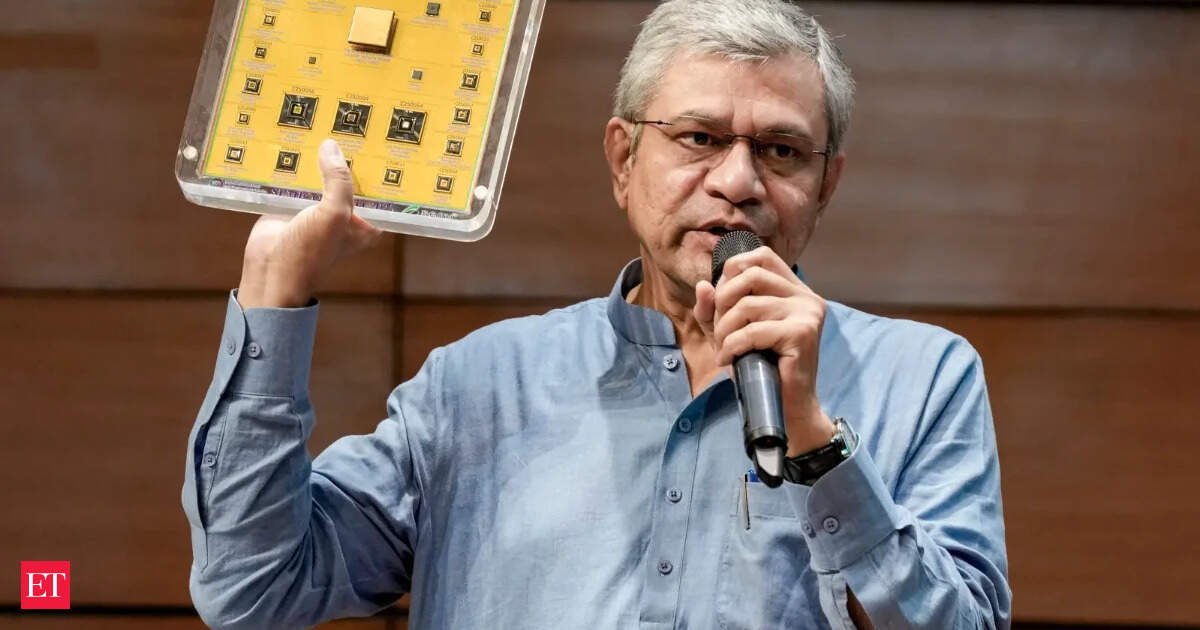
ISM 2.0 is expected to bring in investments of ₹4 lakh crore, generate production worth ₹2 lakh crore and exports of ₹1 lakh crore during its six-year tenure.
The scheme for mobile phones-billed as different from the production-linked programme that lapsed on March 31-will have a tenure of five years and disburse incentives based on domestic sourcing as well as design and R&D by Indian brands. The scheme will also offer incentives for export of smartphones.
Read More: Government may let statutory bodies to regulate members in multidisciplinary partnerships
Large semiconductor companies have shown interest in investments in India, Vaishnaw said.

Scheme Breakdown
The entire value chain for semiconductors-from sand, silicon ingot wafers to fabricated wafers, integrated circuits, electronic bare components and sub-assemblies-has now been covered under the ISM scheme, the minister said.
The second phase of the ISM has significantly slashed the incentives. In the first phase, the Centre was giving a 50% subsidy on investments in fab manufacturing and assembly, with states having an option to top it up to take the total incentive to nearly 75%. Under the second phase, the maximum incentives will be 40% of the investments for silicon fabs and 35% for other fabs. Like last time, incentives are on a pari-passu basis, or proportional to the capital investment made in a project.Officials reasoned that unlike last time (ISM 1.0), India has now proven that it has the capability to locally manufacture semiconductors, and the production volume of three existing OSATs has already been booked. “So, the scheme incentives have been modulated. They have been spread across a larger area to support more segments,” an official said.

Mobile Manufacturing Scheme
Extending the PLI scheme, announced in 2020, was a key demand from mobile-phone manufacturers such as Dixon Technologies, Foxconn and Tata Electronics.
The government will invite fresh applications for MPMS once the scheme is notified.
The scheme outlines incentives for eligible sales in the range of 2.25% to 5%. There is an additional incentive of 1.5% for domestic sourcing of key components and another 3% for building an Indian brand with its own design and R&D.
The government expects MPMS to help increase domestic value addition in smartphones to 40-45% by the end of the scheme from 24% now.
It projects cumulative mobile-phone production of Rs 39 lakh crore and exports of Rs15 lakh crore during the scheme period, creating an estimated 600,000 new direct jobs.
The previous PLI scheme helped production reach Rs 22 lakh crore and exports over Rs 7.5 lakh crore, creating 1.2 million jobs.
Read More: RBI pushes banks, NBFCs to own data risks across third parties
“The government’s conditionalities for incentives are aligned with the industry’s perspective which focuses on building scale, making India globally competitive, and owning intellectual property,” said Atul Lall, managing director at Dixon Technologies, a key beneficiary of the earlier PLI scheme.
While Dixon doesn’t harbour plans to have its own brand, the company is working on gaining design capabilities to help Indian brands launch their own smartphones, Lall said.
Vaishnaw said under the previous scheme, the government disbursed Rs 19,090 crore as incentives, and collected Rs 25,000 crore in direct tax and Rs 3 lakh crore in GST from the smartphone industry.
Investment under that scheme was Rs 20,587 crore, exceeding the target by three times. Smartphone production was Rs 11,61,581 crore during the tenure, exceeding the target by 142%. Exports at Rs 6,43,323 crore exceeded the target by 132%, Vaishnaw said.
Semiconductor Ecosystem Blueprint
While traditional silicon fabs focus on logic and memory chips, other fabs specialise in compound materials or microscopic mechanical structures tailored for distinct functions in modern electronics. With an eye on localising key parts of the semiconductor ecosystem, including materials, gasses, chemicals and semiconductor equipment, incentives of up to 30% will be given to new units.
Up to 30% incentive will also be given for strategic and commercial chips, Vaishnaw said. Offices of the principal scientific advisor and the national security advisor will select which chips will be considered as strategic. Commercial chips will be chosen based on market requirements.
ISM 2.0 will focus on chip design, machines and materials, setting up of fabrication units, and further strengthening of the nascent assembly, testing, marking and packaging in the country. Research and development as well as the development of a talent pipeline are among the other key focus areas.
Globally, there is a shortage of 1 million workers in the semiconductor industry. Existing government schemes have led to chips being designed by Indian college students across most states, the minister said.