

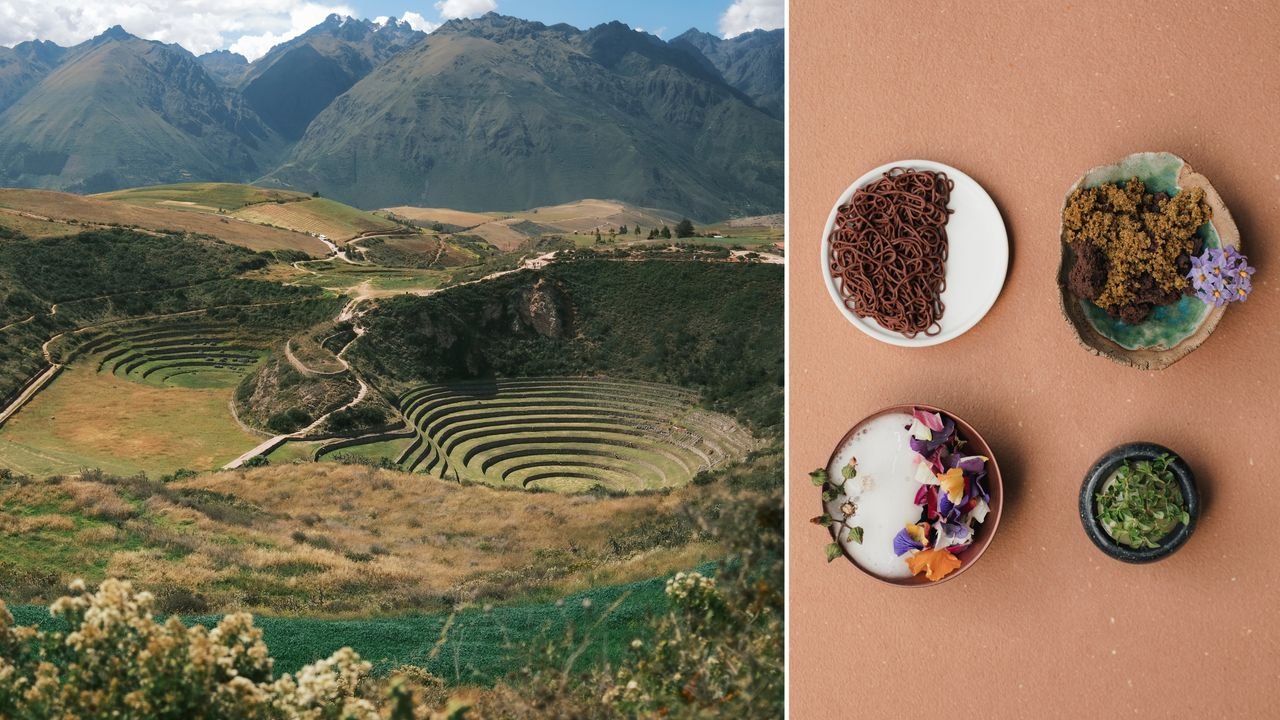
“The qollqa is a way to bring ancient technology into the present, to show that it can still be a tool to conserve food while relying on nothing more than wind to safeguard what matters most: the products that nourish us,” says Malena Martínez, Mater’s director. “It’s a construction that shifts our understanding of the past,” adds Virgilio.
To see this firsthand, Quispe and I walk to the new qollqa itself, making a 10-minute climb past fields that await harvest, and a small stream that, a couple of generations ago, carried saltwater but has since run sweet, elders say. There are fava beans drying in the sun, and piles of colorful tubers waiting for someone to collect them. And then, we reach Qollqa Mater—a conical, circular structure (15 x 52 feet) with walls made of adobe and stone. The entrance faces the apu Verónica, allowing cool breezes from the Amazon to flow in, and I can feel others coming off of nearby apu Chicón, whose chilly whispers sweep through the Sacred Valley every morning. Just as in ancient times, the structure’s orientation and location is no accident, but deliberately chosen to create an ideal microclimate inside. This qollqa, a new build, was designed by architect Juan Carlos Pareja in collaboration with archaeologist Rachel Schloss (UCLA), and built alongside families from the local community, led by Wilber Juárez Huamán, over the course of a year.
.jpg)
Following tradition, one must ask permission from the apus and Pachamama (Mother Earth) to enter the qollqa, by taking a few dry coca leaves in the hands, lifting them toward each of the main apus surrounding the building, and then burying them in the ground with an intention. Then, we may step inside.
The design has one key reinterpretation of the original Inca structures. “It brings three different storage buildings under one roof, with one for seeds, another for fresh food, and one for textiles,” says chef Pía León. There are more than 110 pounds of potatoes and mashuas (a flowering tuber) that have been there since December. They are free of the eyes (sprouts) that would have long emerged if these had been left in the average kitchen or pantry. Proof, perhaps, that the structure is working.