

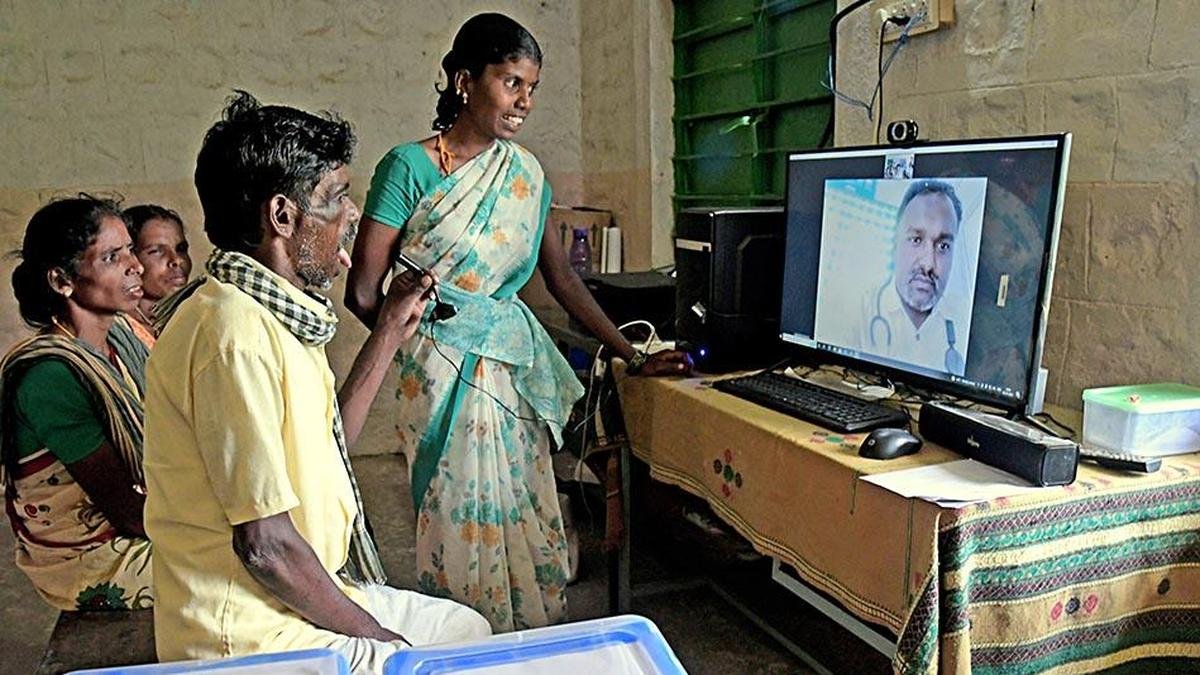

Telemedicine reaches more villages now, but direct access is limited: many individuals, especially rural women, need someone else to help them connect and log in. File photograph used for representational purposes only
| Photo Credit: The Hindu
After the pandemic, India began reshaping its healthcare system through eSanjeevani, a telemedicine service that has handled well over 470 million consultations across 1.3 lakh health centres nationwide. Instead of travelling long distances, patients receive care directly on their phone screens. The 80% specialist shortage in remote villages shrinks, when video calls replace commutes.
Still, counting consultations misses the real story. Digital care stays out of reach for countless rural women not because of technical or infrastructural constraints alone, but because of deep-rooted imbalances at home and inside medical institutions.

Understanding digital healthcare
Digital healthcare builds on one basic idea: that people can reach medical help through their mobile devices alone. In rural India, however, things are rarely that seamless. A 2025 National Statistics Office study shows 76.3% of rural women reported mobile use in the past three months, but device ownership remains below 50%. Getting online usually means borrowing a device managed by a male member at home. Control stays with whoever holds the phone: this could be a husband, brother, father, or someone else in charge.
Relying on shared devices brings problems that are not just about ownership. Privacy and confidentiality are vital for medically-sensitive conversations especially those around pregnancy choices, birth control, emotional struggles, or abuse. Not having their own devices could mean women are limited in the kind of healthcare services they can access. This is a reality in many parts of the country: a study in BMJ Global Health found that married women in rural Madhya Pradesh rarely decide how phones get used: usage is shaped more by tradition than by choice. If a woman speaks to a doctor using a family mobile device, she is watched, and probably listened to by others at home. Merely having internet connectivity does not make for a good consult.

The staff behind the devices
Most people in India still do not use telemedicine on their own. A look at the numbers shows why. In 2025, a report from Oxford Open Digital Health found that over 93% of consultations on eSanjeevani happened with the help of a health worker. Telemedicine reaches more villages now, but direct access is limited:. many individuals, especially rural women, need someone else to help them connect and log in.
Frontline health workers carry the bulk of the load in closing this divide. Our ASHAs, Auxiliary Nurse Midwives, and Community Health Officers now anchor how digital care reaches villages, guiding patients through mobile screens, handling data entries, and linking appointments. Still, these staff face their own hurdles such as low literacy levels, inadequate devices, weak signals, and heavy documentation burdens. Often, digital health efforts grow quicker than the support for the people rolling them out.
Blending physical and tele care
Despite its growth and reach, telemedicine cannot replace physical care. Maternal care video calls help address concerns, but abdominal scans, emergency deliveries, and blood tests demand physical presence. This is where India must navigate a careful path: relying heavily on mobile phones while letting health centres weaken may widen the healthcare gap instead of closing it.
The real issue here is not about expanding telemedicine further; it is about weaving it into a fairer health setup. Digital tools must back up strong local clinics, not replace them. Success cannot be measured in consultation numbers alone if fairness remains absent. Our measures of success should ask: who actually holds the phone during the consultation? Can the individual speak without constraint, wherever they are? Is a follow-up done, and the treatment truly completed after the call ends? Do women get the space to seek help on their own terms?
Telemedicine’s promise lies in going beyond simply linking patients and doctors through screens; it must ensure equity and its gains must reach everyone equally. Rural women need digital health literacy, smartphone access, personal control, privacy, and the freedom to use remote care before gaps in equitable treatment truly fade under technology.
(Shipra Agarwal is principal analyst, Health Disparities and Meta Evidence, ASIA Research at SGT University, Gurugram. shipra@advancedstudy.asia)
Published – June 10, 2026 04:44 pm IST