

From our collaborating partner “Living on Earth,” public radio’s environmental news magazine, an interview by host Steve Curwood and Jenni Doering with forest scientist Suzanne Simard.
You might remember the name Suzanne Simard from a few years back when she wrote the New York Times bestselling book “Finding the Mother Tree: Discovering the Wisdom of the Forest,” about her research showing that the biggest and oldest trees in the forest anchor networks of social connection among the trees, and indeed the whole forest ecosystem. It was a breakthrough and not without some controversy to regard trees as having some kind of collective consciousness.
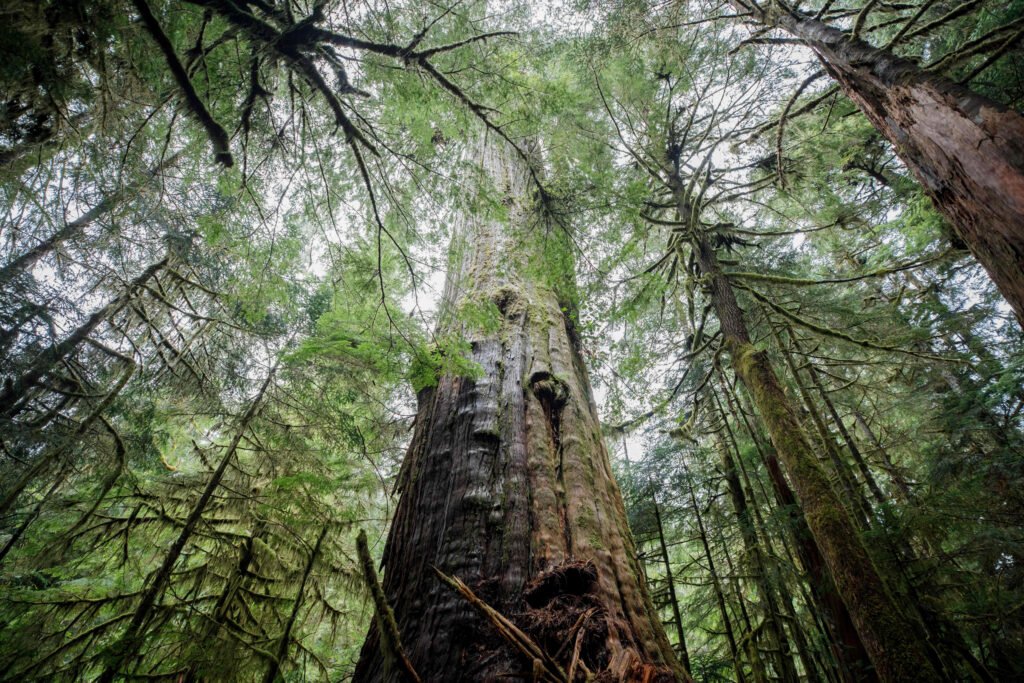
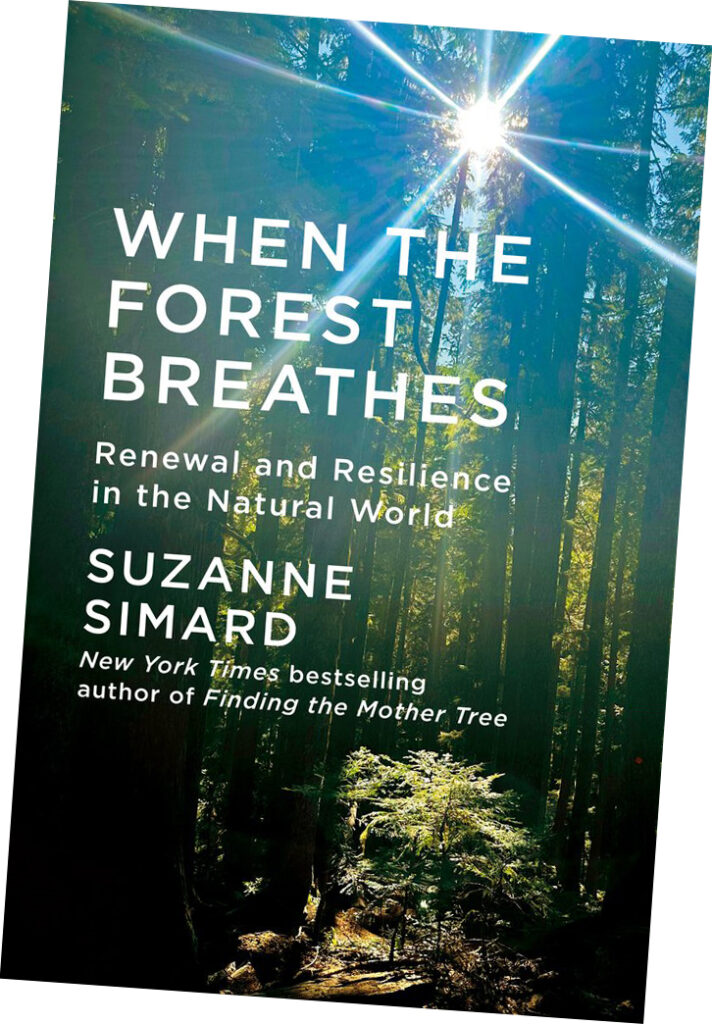
Now, Simard is back with her latest book, “When the Forest Breathes: Renewal and Resilience in the Natural World,” based in part on her latest research with colleagues including Indigenous communities, that further documents how older trees nurture younger saplings. Simard is a professor of forest ecology at the University of British Columbia and works in B.C.’s towering forests, where logging has taken all but 3 percent of the original old-growth trees.
She is intent on saving what’s left, and developing more sustainable logging methods to allow old “mother trees” to thrive in those forests, not only helping trees, but also the rest of us. This interview has been edited for length and clarity.
JENNI DOERING: What is a mother tree, and why did you give them that name?
SUZANNE SIMARD: What we did in this research, looking at connection in the forest, is we mapped what are called mycorrhizal networks. These are mycelial networks that live below ground. They’re formed by a mycorrhizal fungus, or many mycorrhizal fungi, which are a symbiotic obligate relationship with trees, and actually most plants in the world need these relationships. These fungi gather food from the trees. In exchange, in this symbiosis, they provide nutrients and water that they gather from the soil, and it turns out that some of these mycelium will connect trees together.
We mapped these mycelial or mycorrhizal networks—I use those things interchangeably—in the soil. What emerged from the map was that the biggest trees were the most highly connected. Then we started doing a lot of experiments around these old trees and found out that the mycelial network was essential in the regeneration of the trees that were coming up in these old-growth forests, that the young seedlings were tapping into these networks and benefiting from it by getting food and water and nutrients from the big trees. Because of the size, age and regenerative process of these old trees, we started calling them mother trees.
STEVE CURWOOD: What drew you to study forests and mother trees?
SIMARD: It came naturally because I grew up in these old forests. When I was a kid, I just followed my grandfather and grandmother and uncles and aunts through the forest. They were horse loggers, actually, so they made their living from the forest, selectively harvesting small trees from these old-growth forests, so that’s all I knew.
Then I became a forester, eventually, because as a girl you can’t really be a logger yourself, at least you couldn’t in the 1960s, so I had to find another way in. I became a forester, and I had to unlearn what my grandparents had told me. I made it my life’s work to try to demonstrate what I understood as a visceral ancestral person, that these forests are really connected places, and that’s why the work I did is to demonstrate connection.
CURWOOD: You said “unlearn.”
SIMARD: In forestry school, as in a lot of resource-management schools, the training in the colleges and universities, most of the people who did that were from Europe, and not that there’s anything wrong with Europeans, but they didn’t understand forests and ecosystems very well. They came over and colonized North America, and then taught from their perspective of what they’d done in Europe, and that didn’t match up with the natural ecosystems of Canada or Western Canada, where I was from.
What I learned from them was that you need to get rid of the old-growth forests and convert them to what they called normal forests. A normal forest means that it follows a bell-shaped curve, a normal distribution, which means it’s very predictable, follows a mean, an average tree size, average tree species. There’s not a lot of diversity. Precise, and yet too simple.
CURWOOD: And they cut down all their trees, by the way.
SIMARD: That’s true. And now they’ve spent a long time trying to get the trees back. And here we are in North America, we’re doing the same thing, but we don’t have to, right? We don’t have to go there, and that is part of the issue here, is to protect what we have left.
DOERING: This gets at the heart of the research that you talk about in this book. I think you had six or seven different logging treatments. You had outright clear cutting all the way down to taking just a small percent of trees, and you had a control group as well, with no logging, and I think you had a gradient of different climates, dry to wet, across British Columbia.
SIMARD: Clear cutting is the standard practice in Canada. I don’t know about the United States, but probably, in fact most forests around the world, it is the standard practice now, because basically the economists are running the forest, and that means that they’re trying to make it predictable and profitable, and the profit-driven way is to clear cut, which is to take everything. That’s not really good for the ecosystem, it turns out.
That design that you described, of leaving mother trees in different densities and configurations, was to try to find alternatives to that clear-cutting way. What we’re finding out is that you actually need these old trees left behind in order to protect the ecosystem. The old trees, it turns out, do provide seed for regeneration. They do provide shelter for the new ones coming up. They do provide mycorrhizal networks that the little ones can tap into to get sustenance from Mother Earth. They do provide homes for bears and birds. What we’re finding is that when we leave these old trees behind, and the more we leave behind, the more we’re able to protect the integrity of those ecosystems.
DOERING: When you presented these findings to foresters, I think they were shocked by what had happened to the forest floor. You saw something like a 60 percent loss in carbon in the forest floor in these clear cuts. What is going on there? Why is there so much of this carbon being lost, and so much that even the foresters themselves were like, “Oh no, there’s something wrong here.”?
SIMARD: I’ll set the stage for how important this is for a second. We’ve got this climate that’s not very stable right now, and part of the reason is because there’s too much carbon dioxide and other greenhouse gases in the atmosphere. Those gases come from fossil fuel burning, cement production and also land use change. Climate scientists figured that about 20 percent of greenhouse gases come from land use change.
My research suggests that’s an underestimation of the contribution of what land use changes. What is that? That means the conversion of the prairie to agriculture, it means clear-cut logging and also conversion of wetlands and other uses of land. It’s probably quite a bit more, so this research you just explained is part of that picture.
In a temperate forest, what we’re finding, at least in the Western temperate forests, is 50 percent of the carbon in a forest is in the ground, and 50 percent is what you see above ground. Being a carbon sink for CO2, forests are really important for balancing climate, balancing greenhouse gases. When you cut down a forest and clear cut it, that whole 50 percent that was above ground is basically emitted to the atmosphere.
The shocking thing is that with clear cutting we are also losing 60 percent of what’s in the forest floor, which is where half of the below ground carbon is. That means that we’re actually emitting, when you add it all up, about 70 percent of carbon in an ecosystem into the atmosphere.
Now, some will argue, well, some of it goes into long-term storage products like furniture and so on, but it’s only a small percentage. When you clear cut a forest, only 25 percent of it ends up in a forest product, and most of that is paper and cardboard, so most of it evaporates within the year of harvesting. So this is a really big deal. That forest floor took 10,000 years, in the case of Canada, to develop, and we’re erasing it in an instant. This was shocking. It’s even shocking to foresters. But there is a good news part to the story, which we can get into maybe a little bit down the road.
This story is funded by readers like you.
Our nonprofit newsroom provides award-winning climate coverage free of charge and advertising. We rely on donations from readers like you to keep going. Please donate now to support our work.
CURWOOD: So an old-growth tree is 300 or 400 years old, but the forest floor, you’re saying that’s a 10,000 year process, really, since the last Ice Age, that’s been building up. When we clear cut, we are putting that into the carbon flux. We’re putting that into climate disruption.
SIMARD: It’s shocking, isn’t it? And we don’t have to, that’s the thing. If you leave the trees, and if you don’t put big machines on the ground—the machines that go in and cut a forest down, they’re huge, they’re as big as a whale. They move the forest floor around. And the industrial method of clear cutting, you pull that whole tree out of the forest into a pile, cut off the limbs and put it on a logging truck. But the vast majority ends up in these piles that are as tall as the ceiling, and they get burned, and so they’re emitted to the atmosphere, so you’re losing that forest floor to this process of whole-tree logging. We need to do better than that, right? Because it’s squandering what life has given us on this Earth.
CURWOOD: I’m waiting for the good news.
SIMARD: There’s always some good news.
I have this big crew of students in the Mother Tree Project; there’s probably a couple dozen that come out every year, and we measure everything. We went back three years after this logging to figure out what had happened to the forest floor. My hypothesis was that if we clear cut and get rid of all the plants that it will continue to dwindle away. It will erode away, evaporate and really diminish the forest floor, and we have plenty of evidence for that around British Columbia. If you take away the plants, if you continue to not look after the ecosystem, it continues to disappear.
But what we found is that when we left the mother trees, and when we let the plants grow back, we didn’t use any herbicides or anything like we just let them flourish, they grew back. The forest floor went from 70 tons per hectare, clear cutting reduced it to 20 in two years, it grew back to 40. That is amazing. That is the plant and animal and soil world doing its thing as long as we do the right thing by it.
DOERING: When it comes to that heavy logging equipment, what is practical and feasible in terms of taking trees out in a way that doesn’t destroy the forest floor?
SIMARD: This is another beautiful thing. I think that we should de-mechanize forestry, which means we don’t need those big machines. What we need are people in the forest doing this work, like what we used to do. It might sound backward, but it’s actually forward, because when people are out there doing it, they’re making good decisions on the ground, like a craftsperson. They’re deciding which trees can be taken, which ones to leave behind. They’re treading softly. They’re engaging with Mother Earth. They’re watching and monitoring, which is what Indigenous people have always done on Mother Earth, and really looked after her. That’s what we need to do, to take care of Mother Earth, so that she can provide for us too.
DOERING: Remind us why it’s so important to be talking about forests and thinking about what we’re doing in forests when we think about solving the climate crisis. It’s not just EVs and green technology…
SIMARD: We definitely need to look after moving our energy sector to renewables, but at the same time we need to be working with Earth. The ecosystems, the forests, the wetlands, the prairies have huge capacity to sequester and store carbon dioxide. Some scientists estimate that when we do this, we can actually draw down CO2 within the century to reasonable levels. We’ve got to be working on the reduced emission side, but we’ve also got to be working on the increasing the [carbon] sink side.
What my research shows is that we can do this, that there is incredible regenerative capacity in the forests, in all ecosystems. They’re wired to do this. As long as we are good stewards, and we leave the seeds and the spores and the trees and the soil in good health, that Mother Earth will come back. With that recovery of the forest floor so quickly, that to me was like, oh yeah, oh yeah, she’s ready to do this. In restoring these forests—globally, we think about 70 percent of them are underperforming or are damaged in some way—if we do the work, then we can really have a big impact on greenhouse gases.
CURWOOD: Basically, you suggest that 30 percent of the carbon flux comes from these poor forest practices. But how can your approach to sustainable forestry help us deal with another view of the climate emergency, which is this rash of wildfires? As much is going into the atmosphere now every year from wildfires as from the cars and trucks that are running around the planet. If it’s a huge flux, what’s the answer?
SIMARD: We have all this energy in the atmosphere from global warming. There’s more lightning, and also there’s more fuel, because we banned Indigenous burning in North America over 100 years ago. Indigenous people were burning the forest for millennia for various reasons, to reduce fuel loads, to increase food production and medicine production, to improve habitat for wildlife, to create trade corridors.
When colonialism happened, we just said, “Oh no, we’re taking over from here. We’re going to ban Indigenous burning. We’re going to keep these beautiful ecosystems as they are and exploit them for various products.” And that disrupted the entire system.
So we need to restore the health of these ecosystems that evolved over thousands of years with burning. We have to restore those natural processes, so that they’re healthy again. How do we do that? That is a really good question because we’ve created a perfect storm. We’ve got more lightning. We’ve got more heat in the atmosphere. We’re pumping more out all the time. We’ve got forests that are loaded with fuels. We really need to get to work in these ecosystems and start to restore their health, and that is not an easy thing to do. It has to be done very carefully, and it needs to be done with knowledge, knowledge that has been accumulating over thousands of years. That means working with the First People, and working with people in the forest.
DOERING: In this book, you describe several different Indigenous communities that you visit, their forests, their forest gardens, because the forest is a place of food production for them and has been for millennia. How did those relationships you built with Indigenous communities throughout the Mother Tree Project and other means change your relationship and your understanding of the forest?
SIMARD: I was doing this work on connection and forest for decades, writing and speaking about it, and some chiefs started coming to me and said, can we work together, because you see the forest the way we do. We want to work together, so that we can help recover and restore our forests. I’ve just been working with them for over 10 years now.
I’ll give you one example of one of the discoveries that we made working together. I was working with Chief Rande Cook. He’s a hereditary chief of the Ma’amtagila Nation. That particular nation is not recognized by Canada as a nation, so they’re fighting for their rights and title and sovereignty. Me doing science with him really can be helpful, because the evidence that we provide about the cultural importance of forests, the intertwining of culture and ecosystem ecology, can stand up in the court of law. One of the things that we did is we went deep into his territory into an ancient forest that he called his Sister Cedar Society. We canoed with a bunch of youth over to this forest. And when we went there, one of the speakers…sang to the forest to ask permission to go into the forest, and he sang and drummed this beautiful song in his language. It was so moving, and we waited, and the forest gave us permission, so we all went in along this trail.
The teenagers were having so much fun, and we finally got to the sister cedars, and these trees were 4,000 years old. All around the sister cedars, which were huge, were all these generations of young cedars that had come up. The sister cedars had all died. They’d passed on, so when we stood there, Rande said to all of us, “Now I want you to listen, I want you to really listen. These are the sister cedars, and our spirits are in these trees. This is our spiritual connection.” All the kids went dead quiet, and they started talking about how trees communicate with us and with each other. Out of that moment with the kids and the chief, we came up with a research project where we are investigating communication between sister cedars with each other and with the other species around them, the maple trees and the yew trees.
What we found is that all these trees are connected by these underground networks, and they’re in conversation. They’re sharing carbon with each other. They know exactly who the neighbors are, whether it’s a hemlock, a fir, a maple, a yew tree. The yew tree, in particular, is the medicine tree, so it’s a tree that has been long used by Indigenous people for all kinds of medicines. In our Western culture, we use it for fighting cancer. It produces Paclitaxel. One thing that we found was that the big trees would share carbon with the yew tree, and it changed the yew tree, so our theory is that it changed the medicine. Now, when we make medicine in the lab, we’re taking cell lines and working with maybe one cell from one tree. But could you imagine if we actually worked with the ecosystem, how those medicines might change? I think they would be far more powerful.
CURWOOD: Can I dare ask this question: Are these trees conscious? Or what level of consciousness do they have?
SIMARD: Well, you know, they have their own consciousness. Consciousness is a word that we use for human beings, so it’s a challenging question because it’s our language, and so we’re trying to put our language on these plants, but they’re making decisions all the time. They’re making decisions on whether to grow over here, to send a message over there, to detect a tree over here. If that’s not consciousness, I don’t know what is. We get in trouble by using human words for a phenomenon that is extraordinary.
About This Story
Perhaps you noticed: This story, like all the news we publish, is free to read. That’s because Inside Climate News is a 501c3 nonprofit organization. We do not charge a subscription fee, lock our news behind a paywall, or clutter our website with ads. We make our news on climate and the environment freely available to you and anyone who wants it.
That’s not all. We also share our news for free with scores of other media organizations around the country. Many of them can’t afford to do environmental journalism of their own. We’ve built bureaus from coast to coast to report local stories, collaborate with local newsrooms and co-publish articles so that this vital work is shared as widely as possible.
Two of us launched ICN in 2007. Six years later we earned a Pulitzer Prize for National Reporting, and now we run the oldest and largest dedicated climate newsroom in the nation. We tell the story in all its complexity. We hold polluters accountable. We expose environmental injustice. We debunk misinformation. We scrutinize solutions and inspire action.
Donations from readers like you fund every aspect of what we do. If you don’t already, will you support our ongoing work, our reporting on the biggest crisis facing our planet, and help us reach even more readers in more places?
Please take a moment to make a tax-deductible donation. Every one of them makes a difference.
Thank you,