

Close Menu

    Subscribe to Updates

    Get the latest news information from worldwide businesses.

    What's Hot

    AI reveals a massive algae boom across the world’s oceans

    August 3, 2026

    Your Sweet Tooth May Be in Your Genes

    August 3, 2026

    After killer quarter, Palantir CEO Alex Karp calls AI industry ‘Marxist’

    August 3, 2026
    Facebook Instagram YouTube LinkedIn X (Twitter)
    Trending
    • AI reveals a massive algae boom across the world’s oceans
    • Your Sweet Tooth May Be in Your Genes
    • After killer quarter, Palantir CEO Alex Karp calls AI industry ‘Marxist’
    • SBI, HSBC lead FCNR(B) deposit mobilisation
    • Trump says US-Iran talks continue, warns Tehran faces 'last chance'
    • Hungary’s nuclear crisis tests new PM Magyar’s leadership
    • Zuckerberg should apologise for removing PM Modi’s video: Nishikant Dubey | India News
    • Clay Travis pledges $10M for ‘battle of the sexes’ matchup as WNBA trans debate intensifies
    Newspublicly
    • About Us
    • Advertise & Partner with us
    • Pitch Your Story
    • Contact Us
    Facebook Instagram LinkedIn X (Twitter)
    Subscribe
    • Home
    • World News
      • Asia
      • India
      • USA
      • UK & Europe
      • Middle East
    • Economy & Business
      • Global Economy
      • Corporate & Industry
      • Finance & Markets
      • Policy & Trade
    • Technology
      • Gadgets & Devices
      • Software & Apps
      • AI & Machine Learning
      • Robotics & Automation
    • Health & Medicine
      • Fitness & Nutrition
      • Research & Innovation
      • Disease & Treatment
      • Doctors, Clinics & Patient Care
    • Travel & Tourism
    • Automobile
      • Electric & Hybrid Vehicles
      • Auto Industry Insights
    • Sports
    • More
      • Education
      • Real Estate
      • Environment & Climate
      • Space & Astronomy
      • War & Conflicts
    Newspublicly
    Home»Health & Medicine»Research & Innovation»Giant waves are sweeping Mars’ atmosphere into space
    Research & Innovation

    Giant waves are sweeping Mars’ atmosphere into space

    AdminBy AdminAugust 3, 2026No Comments4 Mins Read0 Views
    Share
    Facebook Twitter LinkedIn Copy Link WhatsApp


    The Sun continuously sends a fast stream of charged particles through space, a phenomenon known as the solar wind. Earth is largely protected from this flow by its global magnetic field, but Mars has no comparable shield. This leaves the planet’s upper atmosphere exposed, allowing the solar wind to knock atmospheric particles away and carry them into space.

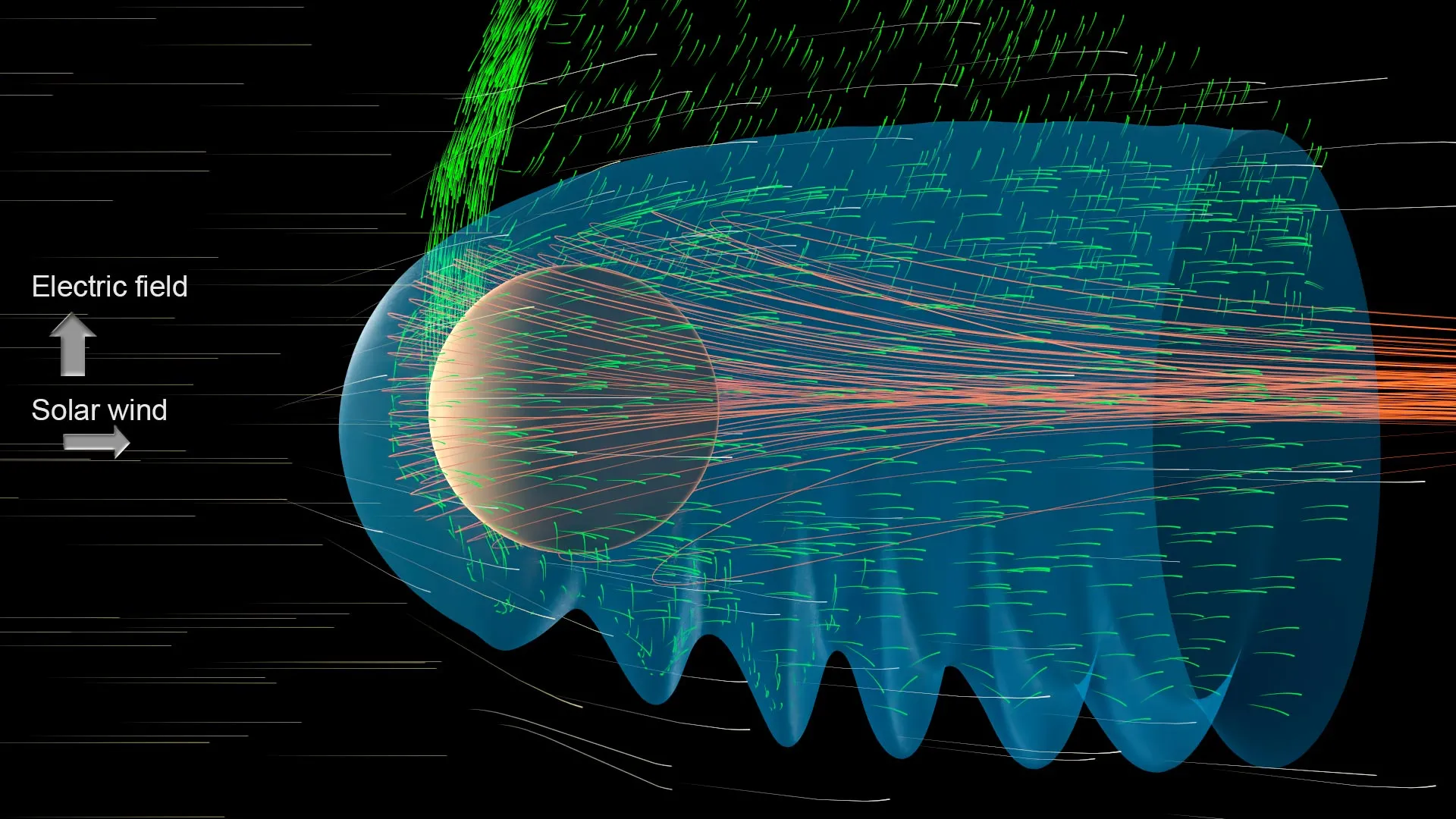
    A new study led by Boston University and published in Science Advances suggests that this atmospheric loss can resemble wind moving across water. On Earth, wind passing over a body of water can create rolling waves and swirling vortices. At Mars, the solar wind appears to produce a similar effect by “stirring” the outer boundary of the upper atmosphere.

    This interaction generates enormous boundary waves called Kelvin-Helmholtz waves.

    First author Chi Zhang, a research scientist at BU’s Center for Space Physics, a collaboration between BU’s College of Arts & Sciences and College of Engineering, worked with colleagues to analyze data from the MAVEN and Tianwen-1 missions. Tianwen-1 measured the incoming solar wind before it reached Mars, while MAVEN tracked atmospheric ions escaping near the planet.

    By combining the two sets of observations, the researchers could directly compare changing solar wind conditions with the movement of Martian atmospheric particles into space.

    Two Spacecraft Reveal Atmospheric Escape

    Large clouds of plasma in the upper atmosphere can produce what researchers call the “bulk escape” of atmospheric ions. Scientists had previously proposed several possible explanations for how these clouds formed, but their origin remained uncertain because direct evidence was limited.

    One major obstacle was that a single spacecraft could not observe the undisturbed solar wind upstream of Mars while also measuring atmospheric ions escaping closer to the planet.

    In an earlier study published in Nature Communications, Zhang and his colleagues showed that simultaneous measurements from MAVEN and Tianwen-1 could connect changes in the incoming solar wind with conditions around Mars. The new Science Advances study builds on that work and identifies Kelvin-Helmholtz waves as an important mechanism behind atmospheric ion loss.

    The researchers found clear evidence that these waves generate the large plasma clouds associated with atmospheric escape. They also discovered that the process is not distributed evenly around Mars.

    “Instead, it is mainly observed on one side of the planet, depending on the direction of the solar wind electric field,” said Zhang.

    The findings provide a direct connection between Kelvin-Helmholtz waves and increased atmospheric ion escape from Mars.

    Measuring the Waves That Drain Mars

    “Future research will focus on identifying the conditions that favor the formation and growth of Kelvin-Helmholtz waves and determining how much they contribute to atmospheric escape from Mars,” Zhang noted.

    Answering those questions will require additional spacecraft measurements and advanced computer simulations. MAVEN is now moving toward the closeout stage of its mission, but researchers expect future missions to continue its work.

    “Its rich scientific legacy will be complemented by NASA’s ESCAPADE mission, which has already launched and will provide an important new opportunity to investigate solar-wind-driven atmospheric loss at Mars,” said Zhang.

    “We want to know when these waves are most likely to form, how they evolve, and how strongly they can drive atmospheric escape,” said Chuanfei Dong, a BU Center for Space Physics faculty member and a College of Arts & Sciences assistant professor of astronomy. “This process could also occur on other planets that lack a strong magnetic field, including some exoplanets.”

    A Clue to Mars’ Lost Habitability

    Understanding atmospheric escape could help explain the dramatic transformation Mars experienced over its history.

    “Mars is thought to have once been potentially habitable, with a thicker atmosphere and surface liquid water. Understanding how it became the cold, dry planet we see today is important for understanding how planetary environments evolve over time,” said Zhang.


    Source link

    Author

    • Admin

      NewsPublicly.com is News & Articles Platform that creating SEO-focused articles on travel, lifestyle, and digital trends.

    Admin
    • Website

    NewsPublicly.com is News & Articles Platform that creating SEO-focused articles on travel, lifestyle, and digital trends.

    Related Posts

    AI reveals a massive algae boom across the world’s oceans

    August 3, 2026

    Scientists twist crystal layers and reshape matter from within

    August 3, 2026

    Two deadly flowers could inspire powerful new medicines

    August 3, 2026
    Leave A Reply Cancel Reply

    Demo
    Top Posts

    The Blue Moon rises on May 30— Where and when to see the second full moon of the month

    May 30, 202640 Views

    New SOCOM rifle allows barrel swapping and cartridge changes

    June 1, 202633 Views

    “Inside Gemini Robotics 1.5: How Robots Learn to Reason & Act

    November 22, 202527 Views

    525 pounds of cocaine seized after Nebraska K9 alerts troopers on I-80

    May 28, 202624 Views
    Don't Miss

    AI reveals a massive algae boom across the world’s oceans

    August 3, 20264 Mins Read0 Views

    Artificial intelligence has helped scientists produce the first comprehensive global assessment of floating algae, revealing…

    Your Sweet Tooth May Be in Your Genes

    August 3, 2026

    After killer quarter, Palantir CEO Alex Karp calls AI industry ‘Marxist’

    August 3, 2026

    SBI, HSBC lead FCNR(B) deposit mobilisation

    August 3, 2026
    Stay In Touch
    • Facebook
    • Twitter
    • Instagram
    • YouTube
    • LinkedIn
    • WhatsApp

    Subscribe to Updates

    Get the latest creative news from SmartMag about art & design.

    Demo
    NEWSPUBLICLY
    Facebook X (Twitter) Instagram LinkedIn

    Home

    • About Us
    • Leadership
    • Advertise & Partner With Us
    • Pitch Your Story
    • Media Kit & Pricing
    • Career
    • FAQs

    Guidelines

    • Editorial & Submission
    • Partnership
    • Advertising & Sponsor
    • Intellectual Property Policy
    • Community & Comment
    • Security & Data Protection
    • Send Your Opinion

    Quick Links

    • Cookie Policy
    • Payment & Billing Terms
    • Refund & Cancellation
    • Copyright Policy
    • Complaint & Support
    • Sitemap
    • Contact Us

    Subscribe Us

    Get the latest news and updates!

    Copyright © 2026 Newspublicly (DIGITALIX COMMUNICATION). All Rights Reserved.
    • Privacy Policy
    • Terms of Use
    • Disclaimer