

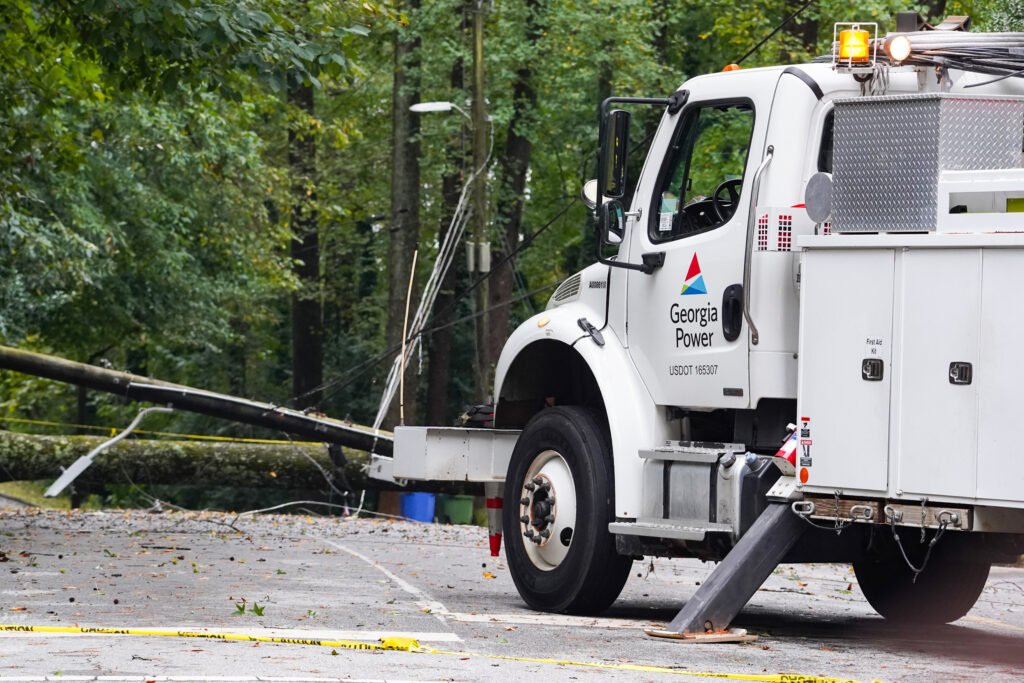
Georgia’s two largest utility proceedings of the year were settled last month between Georgia regulators and Georgia Power. Customers and utility advocates see mixed results in the outcome.
Georgia Power sought approval to recover costs tied to their operations and maintenance. The proceedings, which occur regularly every few years, will ultimately lower near-term costs for customers this cycle, largely due to declining fuel prices. But the filings also highlight how the utility’s cost-recovery structure allows it to pass along climate-driven expenses while still generating returns for their shareholders.
The first proceeding focused on fuel costs—the money Georgia Power spends to buy natural gas, coal and other fuels used to generate electricity. Utilities are allowed to periodically recover those expenses directly from customers through monthly bills.
Georgia Power initially sought to recover about $300 million through the proceeding, but staff with the Georgia Public Service Commission negotiated that amount down by roughly $13 million.
Even so, customer fuel charges this cycle will be lower than in the previous recovery period. The last fuel-cost cycle reflected unusually high gas prices following Russia’s invasion of Ukraine, which disrupted global energy markets and drove up electricity costs across the country. The second proceeding focused on storm recovery costs tied to major weather events and grid restoration. Georgia Power initially requested roughly $269 million in annual storm recovery charges to begin paying down more than $912 million in costs accumulated on the company’s books. Most of those expenses stem from Hurricane Helene, which caused more than $770 million in damage and restoration costs.
PSC staff negotiated that request down to about $109 million annually—a significant reduction that consumer advocates called a victory for ratepayers. Part of the decrease came from Georgia Power agreeing to use federal nuclear production tax credits to offset some storm-related expenses rather than charging customers directly.
Those tax credits, however, are only expected to be available for about two years, raising questions about whether customers could face higher recovery charges in the future once that funding source expires.
Combined with lower fuel recovery costs, the agreement between Georgia Power and PSC staff is expected to reduce the average residential customer’s monthly bill by roughly $4 beginning in June.
“Lower rates mean real savings for Georgia families and businesses as the heat of summer begins which can lead to higher bills,” Tyler Cook, chief financial officer and treasurer for Georgia power, said in a statement. Despite the lower costs, consumer advocates believe there are still major flaws in the way costs are recovered and passed down to consumers. One of the biggest concerns, discovered by Jennifer Whitfield, a senior attorney at the Southern Environmental Law Center, is that Georgia Power has proposed allowing new data centers to avoid paying for some of the system costs they help create.
Those include new power infrastructure and “hedging” costs, which protect against changes in natural gas prices. If data centers do not pay these costs, advocates say they are instead shifted to other customers.
“We are glad that commission staff has negotiated some big improvements, including some much-needed bill relief for customers,” Whitfield said. The Public Service Commission has also agreed to review how data centers are charged for their share of system costs. “It is alarming that Georgia Power’s definition of ‘no cost shift’ for data centers means that everyone else pays for costs the data centers plainly cause,” Whitfield said.
This story is funded by readers like you.
Our nonprofit newsroom provides award-winning climate coverage free of charge and advertising. We rely on donations from readers like you to keep going. Please donate now to support our work.
Another complaint is that storm recovery costs are added to the rate base where Georgia Power earns a guaranteed 11.9 percent profit by regulators.
“It’s a broken utility climate model that allows them to destroy our climate while profiting from it,” Patty Durand, founder of Georgians for Affordable Energy, said.
Southern Company, Georgia Power’s parent company, is among the nation’s largest greenhouse gas emitters, releasing more than 80 million metric tons of climate-warming emissions annually in recent years. When its utilities relied more on coal-fired generation, the utility emitted nearly twice that amount annually.
Burning fossil fuels has made extreme weather events like Hurricane Helene more intense and more likely, according to climate scientists. In the aftermath of those disasters, customers are asked to cover the costs of storm recovery through their utility bills, while Georgia Power earns returns.
Consumer advocates say Georgia Power’s reliance on fossil fuels will deepen with what they describe as a “fossil fuel gamble” tied to the rapid growth of data centers. In late 2025, regulators approved plans for roughly 10 gigawatts of new capacity on the grid, with most of it expected to come from natural gas, to meet rising electricity demand. The result will be an estimated 20 million tons of additional carbon dioxide equivalent emissions annually.
Georgia Power denied that costs for supplying power to data centers were being passed on to consumers. “Large users are paying their fair share, so other customers don’t have to,” a Georgia Power spokesperson said. Georgia Power did not respond to questions about their emissions and profits from storm recovery costs.
“We are grateful the commission staff negotiated some additional bill relief for customers,” Codi Norred, executive director of Georgia Interfaith Power and Light, an advocacy group, said in a statement. “Georgia Power can’t continue to invest in fossil fuels, making storms worse and then profit off those storms.”
“Nor can they pass the costs of supplying fossil fuels to data centers on to everyday Georgians,” he added. “It’s unjust.”
About This Story
Perhaps you noticed: This story, like all the news we publish, is free to read. That’s because Inside Climate News is a 501c3 nonprofit organization. We do not charge a subscription fee, lock our news behind a paywall, or clutter our website with ads. We make our news on climate and the environment freely available to you and anyone who wants it.
That’s not all. We also share our news for free with scores of other media organizations around the country. Many of them can’t afford to do environmental journalism of their own. We’ve built bureaus from coast to coast to report local stories, collaborate with local newsrooms and co-publish articles so that this vital work is shared as widely as possible.
Two of us launched ICN in 2007. Six years later we earned a Pulitzer Prize for National Reporting, and now we run the oldest and largest dedicated climate newsroom in the nation. We tell the story in all its complexity. We hold polluters accountable. We expose environmental injustice. We debunk misinformation. We scrutinize solutions and inspire action.
Donations from readers like you fund every aspect of what we do. If you don’t already, will you support our ongoing work, our reporting on the biggest crisis facing our planet, and help us reach even more readers in more places?
Please take a moment to make a tax-deductible donation. Every one of them makes a difference.
Thank you,

Contributor
Ryan Krugman is a recent graduate of Columbia University’s Climate School focusing on climate change reporting and communications. He also holds a Bachelor’s degree from St. Lawrence University where he studied Environmental Science and Sociology. As a former Inside Climate News fellow, he is now reporting on climate and environmental issues in New England and Georgia.