

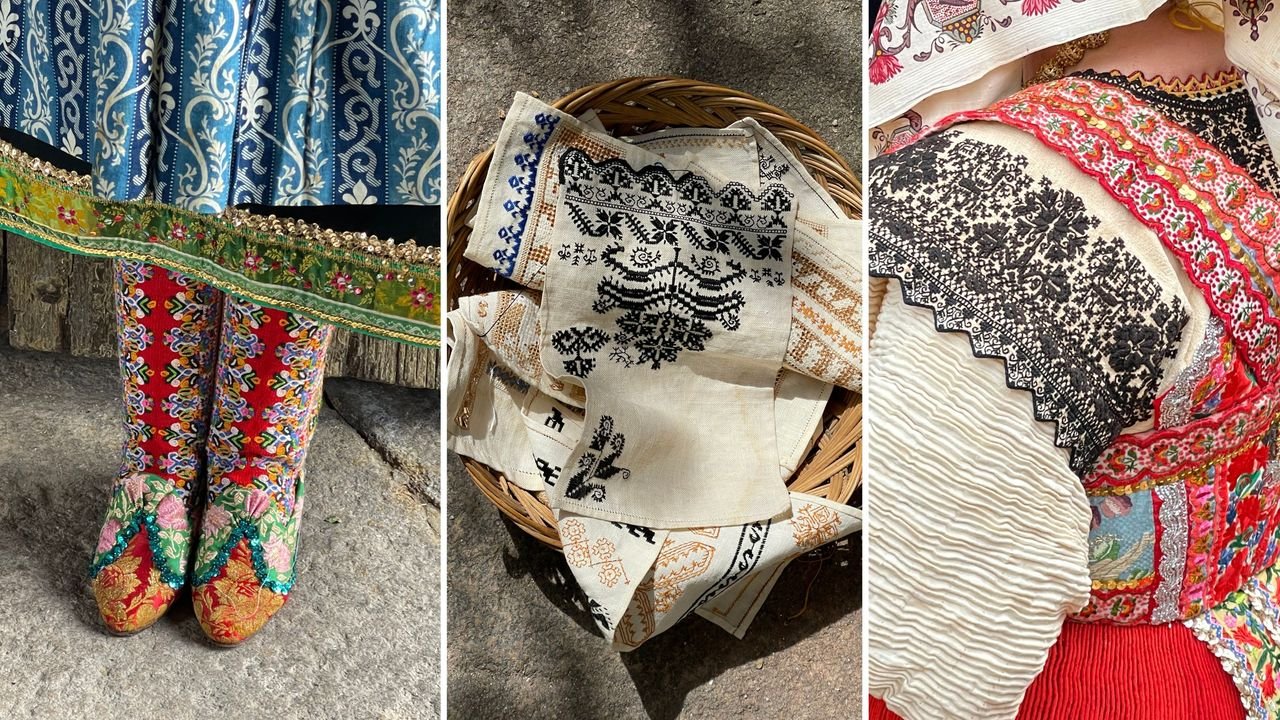
Despite being a town renowned for its textile crafts, Lagartera’s finest works are too elaborate for everyday use, hidden away in wooden chests or closets and reemerging for special occasions. Then, each June, on the Feast of Corpus Christi, the town’s traditional dresses—richly decorated, pleated, and baroque in their ornamentation—are brought back into the light. Residents assemble altars at the thresholds of their homes, adorning them with prized heirloom linens, and step into stockings, underskirts, petticoats, and blouses that have been painstakingly hand-stitched and preserved across generations.
***
I’ve come to Lagartera, a pueblo of 1,200 residents in Castilla La Mancha in central Spain to learn about its textile culture. Madrid is only a 90-minute drive away, but it feels a world apart in this vast stretch of Spain’s interior known as La España vacía, or empty Spain.
As I arrive, I take in the dramatic, snow-capped peaks of the Sierra de Gredos looming ahead, rising abruptly from the flat plains of the Tagus River basin that spans the Iberian Peninsula from central Spain to Portugal. On my way to Museo Municipal Marcial Moreno Pascual, a museum showcasing the town’s history, to meet Moreno García, I pass a row of low-slung storefronts where thread-worked linens hang in the windows.

Moreno García, 60, is a lifelong labrandera and native of Lagartera, and has been stitching since she was a girl. “I learned it from my mother, and she from hers, ” Moreno García says. Today, she’s part of the movement to preserve the craft through both her personal practice and her involvement in the Asociación Amigas del Traje de Lagartera, which offers workshops. “We women from Lagartera are the bearers and guardians of this legacy,” she says. “We created this association to preserve the traditional costume and embroidery. We can’t let a legacy that’s centuries old fade away.”
For generations, women here have passed down this knowledge, gathering to stitch in the cool stone patios of their homes during the summer and moving indoors in winter to the upper rooms of their Lagarteran houses, where large windows draw in the light. Practiced year-round, this work is the central nerve of community—women come together to sew and to socialize.
Even today, many townspeople still learn the skill as children, beginning with simple stitches before advancing to more complex techniques that demand intense concentration: counting the correct stitches and carefully calibrating the thread’s tension.