

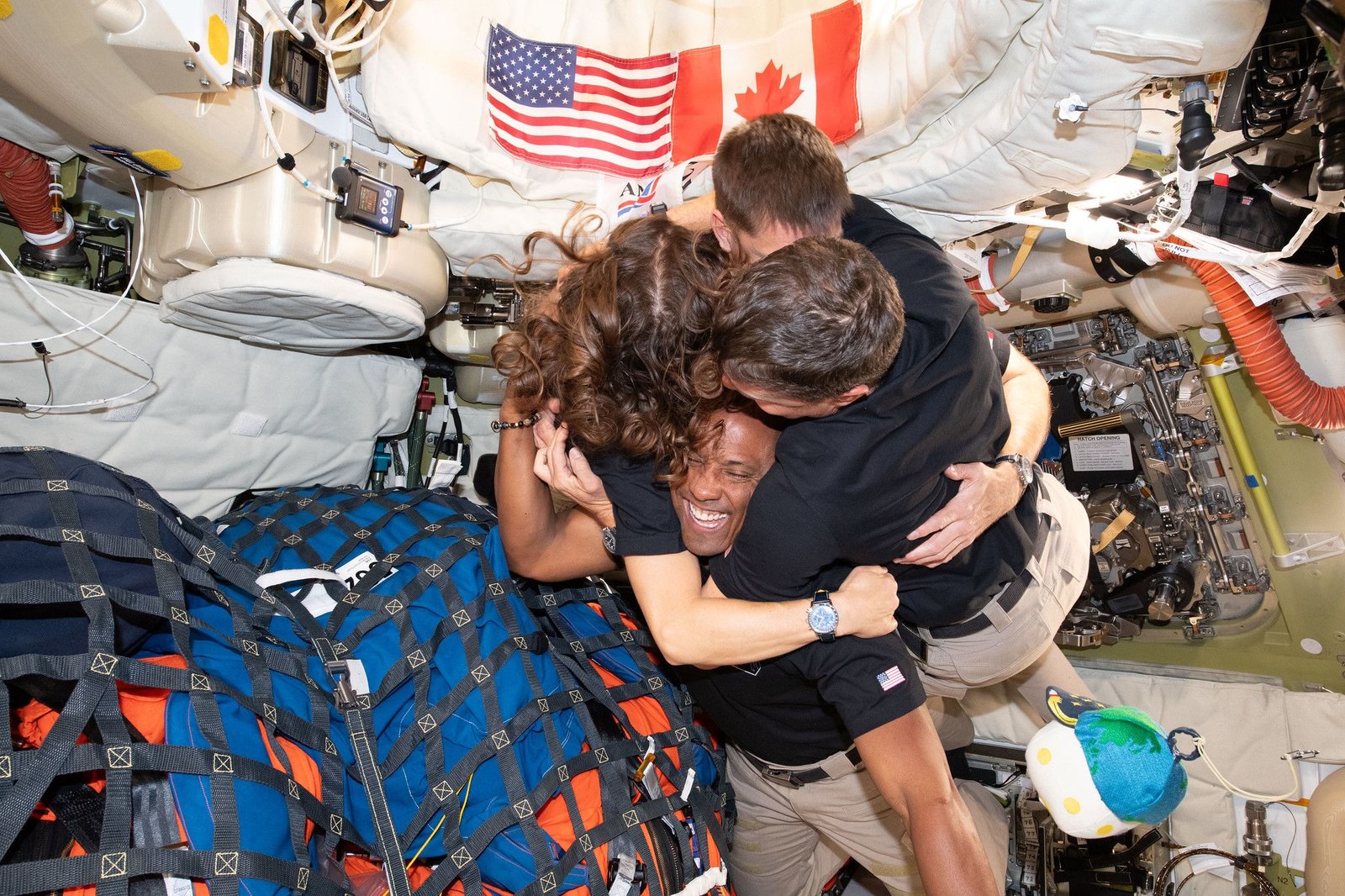
A lot has changed since NASA last sent astronauts to the moon — including the attitudes of those space explorers.
That’s the view of Victor Glover, the NASA astronaut who served as pilot on the Artemis 2 mission around the moon’s far side this past April.
“When you look back on the Apollo missions, there was a lot more competition back in the office. Everybody wanted to be the first, and then everybody wanted to be the next,” Glover told Angels Broadcast Television on June 12, shortly before he threw out the first pitch before a baseball game between the Los Angeles Angels and the Tampa Bay Rays.
“I think our office learned a lot from them,” he added. “There are some good things about that. It makes you work really hard, but it also can create some unnecessary conflict. And so my office really wants to support everybody — wants you to be the guy that does it, and somebody just gets picked to do it, and that’s OK.”
Glover and his Artemis 2 crewmates — NASA’s Reid Wiseman and Christina Koch and Jeremy Hansen of the Canadian Space Agency — did indeed seem to forge a very strong bond during their training and their time in space.
For example, shortly before Artemis 2’s April 1 launch, Glover, Koch and Hansen came up with a plan to name a crater on the moon after Wiseman’s wife Carroll, who died of cancer in 2020.
“They said the three of them had talked, and they would like to do this,” Wiseman said on April 6, the day Artemis 2 looped around the moon and got farther from Earth than any crewed mission ever had. “That was an emotional moment for me. And I just thought that was just a total treasure, that they had thought through this, and they had offered this.”
Wiseman, Artemis 2’s commander, said he broke down when Hansen radioed mission control with the naming request. In fact, all four astronauts were overcome with emotion at that moment.
“That was, I think, where the four of us were the most forged, the most bonded, and we came out of that really focused on that day ahead,” Wiseman said.

The atmosphere was a bit different during the 1960s and early 1970s, as Glover noted; undercurrents of competition and rivalry reportedly ran through the Apollo crews.
For example, multiple people, including Apollo 17 astronaut Gene Cernan, have said that Buzz Aldrin lobbied to be the first person to set foot on the moon, an honor that eventually went to Apollo 11 crewmate Neil Armstrong. (Aldrin has disputed this version of events, saying he didn’t want to be the first-ever moonwalker.)
There are other big differences between Artemis and Apollo, of course. Apollo was designed to get people to the moon before the Soviet Union could do so, a goal that was regarded as a national security imperative because it would demonstrate American technological supremacy. As a result of this need for speed, Apollo did not build anything permanent on the moon, leaving behind only flags, footprints and defunct spacecraft.
Artemis, on the other hand, aims to establish a permanent and sustainable presence on Earth’s nearest neighbor. If all goes to plan, NASA will build one or more moon bases near the lunar south pole, then use the skills and knowledge gained from this endeavor to get astronauts even farther afield — to Mars.