

Close Menu

    Subscribe to Updates

    Get the latest news information from worldwide businesses.

    What's Hot

    India, US conclude two-day trade talks

    June 24, 2026

    The bikers battling extreme heat and armed conflict to smuggle Iranian fuel to Pakistan

    June 24, 2026

    ‘One in, one out’ deal on Channel crossings to end in October, French reports say | Immigration and asylum

    June 24, 2026
    Facebook Instagram YouTube LinkedIn X (Twitter)
    Trending
    • India, US conclude two-day trade talks
    • The bikers battling extreme heat and armed conflict to smuggle Iranian fuel to Pakistan
    • ‘One in, one out’ deal on Channel crossings to end in October, French reports say | Immigration and asylum
    • Germany scraps F126 frigate program, pivots to MEKO warships amid cost and contractor chaos
    • Amit Malviya: ‘Rahul owes nation explanation’: BJP says IAF support tender for 36 Rafales exposes Pakistan propaganda | India News
    • Dems rattled after progressive wave sweeps New York primaries and more top headlines
    • NTA to Release NEET UG 2026 Answer Key PDF Date, Time, Download link at neet.nta.nic.in
    • Evomon Adventure Suit guide
    Newspublicly
    • About Us
    • Advertise & Partner with us
    • Pitch Your Story
    • Contact Us
    Facebook Instagram LinkedIn X (Twitter)
    Subscribe
    • Home
    • World News
      • Asia
      • India
      • USA
      • UK & Europe
      • Middle East
    • Economy & Business
      • Global Economy
      • Corporate & Industry
      • Finance & Markets
      • Policy & Trade
    • Technology
      • Gadgets & Devices
      • Software & Apps
      • AI & Machine Learning
      • Robotics & Automation
    • Health & Medicine
      • Fitness & Nutrition
      • Research & Innovation
      • Disease & Treatment
      • Doctors, Clinics & Patient Care
    • Travel & Tourism
    • Automobile
      • Electric & Hybrid Vehicles
      • Auto Industry Insights
    • Sports
    • More
      • Education
      • Real Estate
      • Environment & Climate
      • Space & Astronomy
      • War & Conflicts
    Newspublicly
    Home»More»Space & Astronomy»Hubble Space Telescope images galaxy scientists thought was impossible to find
    Space & Astronomy

    Hubble Space Telescope images galaxy scientists thought was impossible to find

    AdminBy AdminJune 24, 2026No Comments5 Mins Read0 Views
    Share
    Facebook Twitter LinkedIn Copy Link WhatsApp


    A bright, dense cluster of hot, massive stars in a galaxy that existed 1.4 billion years after the big bang has been found helping to end the early universe’s foggy days during which neutral hydrogen gas was draped across the cosmos, obscuring ultraviolet light from luminous objects.

    The cluster was found emitting ultraviolet light in a small but quickly growing galaxy by the Hubble Space Telescope. The presence of this ultraviolet light, and the star-forming history of the cluster producing it, suggests that bursts of star formation contributed to waves of ionizing radiation that gradually cleared out the opaque neutral hydrogen.

    In the aftermath of the big bang, the universe was filled with neutral hydrogen gas that is opaque at short wavelengths of light, such as ultraviolet. However, this ultraviolet light was the neutral hydrogen’s worst enemy, gradually ionizing the gas across the universe. Once ionized, hydrogen gas cannot absorb ultraviolet light — and so, the cosmos became transparent at those wavelengths.

    Because of this, the first billion or so years are called the Epoch of Reionization. It is referred to as “reionization” rather than ionization because, technically, the gas had already been ionized once before during the first 379,000 years after the Big Bang.

    While investigating what brought about this epoch, astronomers had identified two chief suspects that could have produced sufficient amounts of ultraviolet light to ionize the neutral hydrogen. One is active supermassive black holes and the other is the first generations of hot, massive stars. The problem is, given that neutral hydrogen is adept at absorbing the ultraviolet light, astronomers have had difficulty tracing that ultraviolet back to its source and identifying which of the two suspects are the main culprit.


    You may like

    In 2023 the James Webb Space Telescope (JWST) made a major breakthrough, finding a galaxy that existed just 900 million years after the Big Bang that was producing enough energy to ionize the neutral gas surrounding it.

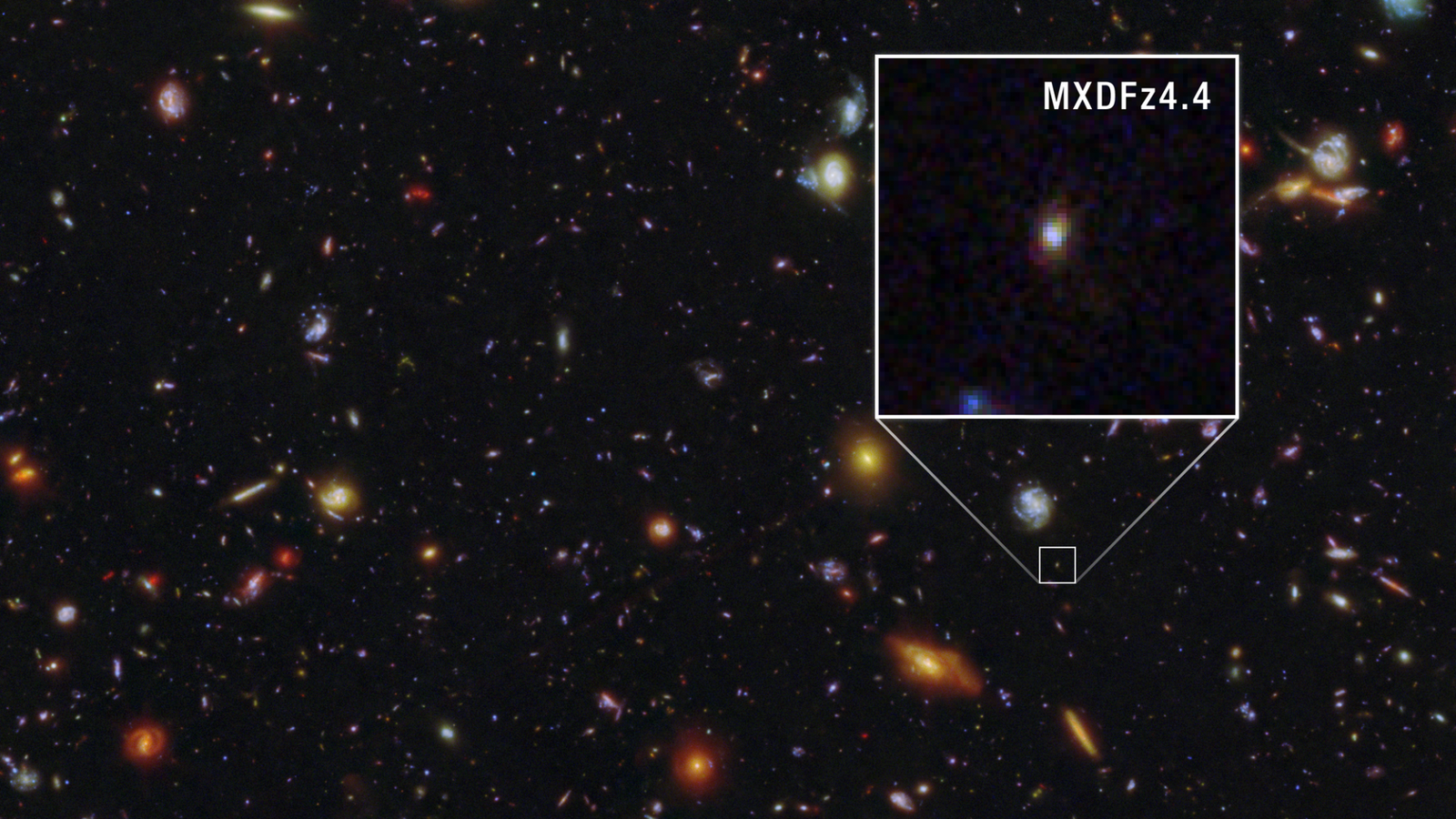
    Now the Hubble Space Telescope has gone further, detecting ultraviolet light from a galaxy called MXDFz4.4. This ultraviolet light should only be visible if the surrounding gas had already been ionized.

    Space

    “Observing a galaxy like this was thought to be impossible,” said Ilias Goovaerts of the Space Telescope Science Institute (STScI) in Baltimore, who led the discovery, in a statement. “Researchers expected the ‘fog’ of neutral hydrogen that filled the early universe would be too thick and obscure our view of its ionizing light. Hubble not only spotted that light, but it also helped reveal incredible details about the galaxy’s characteristics.”

    A full version of the header image, showing lots of colorful blobs with an inset that shows the galaxy of note. It's kind of a blueish white dot. There is a faint reddish ring around it.

    The full Hubble Space Telescope’s view of MXDFz4.4 and its surroundings from our vantage point. (Image credit: NASA/ESA/CSA/STScI/Ilias Goovaerts and Anton Koekemoer (STScI)/Marc Rafelski (STScI, JHU)/ Image Processing: Alyssa Pagan (STScI))

    MXDFz4.4 was first identified in the MUSE eXtremely Deep Field (MXDF), with MUSE being the Multi Unit Spectroscopic Explorer on the European Southern Observatory’s Very Large Telescope in Chile. The “z4.4” part of its name tells us that the galaxy exists at a redshift of 4.4, meaning that it existed 12.37 billion years ago. As the universe has expanded in the time since then, the ultraviolet light has been redshifted into visible wavelengths that were detected by Hubble.

    “Astronomers have found many galaxies that existed at this point in the history of the universe, but we haven’t detected ionizing photons from any of them, making MXDFz4.4 one of a kind,” said Marc Rafelski, who is the Hubble Deputy Mission Head at STScI.


    What to read next

    MXDFz4.4 is 100 times smaller than our Milky Way galaxy but is forming stars ten times faster than our galaxy is. Many of those stars are being born in the tight, luminous cluster producing the ionizing ultraviolet.

    A blue and white glowing, hazy blob against a dark background.

    An artist’s impression of the young, distant galaxy MXDFz4.4 and its dense cluster of luminous stars. (Image credit: NASA/ESA/Leah Hustak (STScI))

    The cluster contains “A lot of young, hot, massive stars in a small space [that] do a better job of blasting through opaque gas,” said Goovaerts.

    Furthermore, by comparing Hubble’s observations of MXDFz.4.4 with those of the JWST, which probed for cooler, older stars in the galaxy, Goovaerts and Rafelski’s team discovered that the stars in the cluster had formed in bursts, each burst producing fresh quantities of ionizing ultraviolet radiation that helped to clear out more and more of the neutral gas over time. We now see the galaxy about 250 million years after it finished reionizing the surrounding gas. These hot, massive stars in the cluster end their lives after a few million years as supernova explosions, the blast waves and radiation from which can create bubbles in the gas light years across, creating further pathways for ultraviolet light to escape and be detected by Hubble.

    The observations seem to nail down the theory that clusters of hot, massive, luminous stars in young galaxies in the early universe played a dominant role in ionizing the universe’s neutral gas.

    “Hubble’s observations of MXDFz4.4 let us test our hypotheses much closer to the Era of Reionization than ever before,” said Rafelski. “Finding more galaxies, especially at slightly later cosmic times where larger samples are within reach, would let us refine these measurements and figure out what cleared our view as that era was ending.”

    The results were published on June 23 in The Astrophysical Journal.


    Source link

    Author

    • Admin

      NewsPublicly.com is News & Articles Platform that creating SEO-focused articles on travel, lifestyle, and digital trends.

    Admin
    • Website

    NewsPublicly.com is News & Articles Platform that creating SEO-focused articles on travel, lifestyle, and digital trends.

    Related Posts

    SpaceX Dragon says goodbye to the ISS photo of the day for June 23, 2026

    June 24, 2026

    ‘Rick and Morty’ cast talk vocal health, hot viscous liquids, and favorite season 9 moments (interview)

    June 24, 2026

    NASA wants to dump the ISS in the sea. Experts say the plan ‘raises serious concerns for ocean health’

    June 24, 2026
    Leave A Reply Cancel Reply

    Demo
    Top Posts

    The Blue Moon rises on May 30— Where and when to see the second full moon of the month

    May 30, 202640 Views

    New SOCOM rifle allows barrel swapping and cartridge changes

    June 1, 202633 Views

    “Inside Gemini Robotics 1.5: How Robots Learn to Reason & Act

    November 22, 202525 Views

    525 pounds of cocaine seized after Nebraska K9 alerts troopers on I-80

    May 28, 202624 Views
    Don't Miss

    India, US conclude two-day trade talks

    June 24, 20262 Mins Read0 Views

    India and the United States on Wednesday concluded two-day ministerial-level talks on the proposed first…

    The bikers battling extreme heat and armed conflict to smuggle Iranian fuel to Pakistan

    June 24, 2026

    ‘One in, one out’ deal on Channel crossings to end in October, French reports say | Immigration and asylum

    June 24, 2026

    Germany scraps F126 frigate program, pivots to MEKO warships amid cost and contractor chaos

    June 24, 2026
    Stay In Touch
    • Facebook
    • Twitter
    • Instagram
    • YouTube
    • LinkedIn
    • WhatsApp

    Subscribe to Updates

    Get the latest creative news from SmartMag about art & design.

    Demo
    NEWSPUBLICLY
    Facebook X (Twitter) Instagram LinkedIn

    Home

    • About Us
    • Leadership
    • Advertise & Partner With Us
    • Pitch Your Story
    • Media Kit & Pricing
    • Career
    • FAQs

    Guidelines

    • Editorial & Submission
    • Partnership
    • Advertising & Sponsor
    • Intellectual Property Policy
    • Community & Comment
    • Security & Data Protection
    • Send Your Opinion

    Quick Links

    • Cookie Policy
    • Payment & Billing Terms
    • Refund & Cancellation
    • Copyright Policy
    • Complaint & Support
    • Sitemap
    • Contact Us

    Subscribe Us

    Get the latest news and updates!

    Copyright © 2026 Newspublicly (DIGITALIX COMMUNICATION). All Rights Reserved.
    • Privacy Policy
    • Terms of Use
    • Disclaimer