

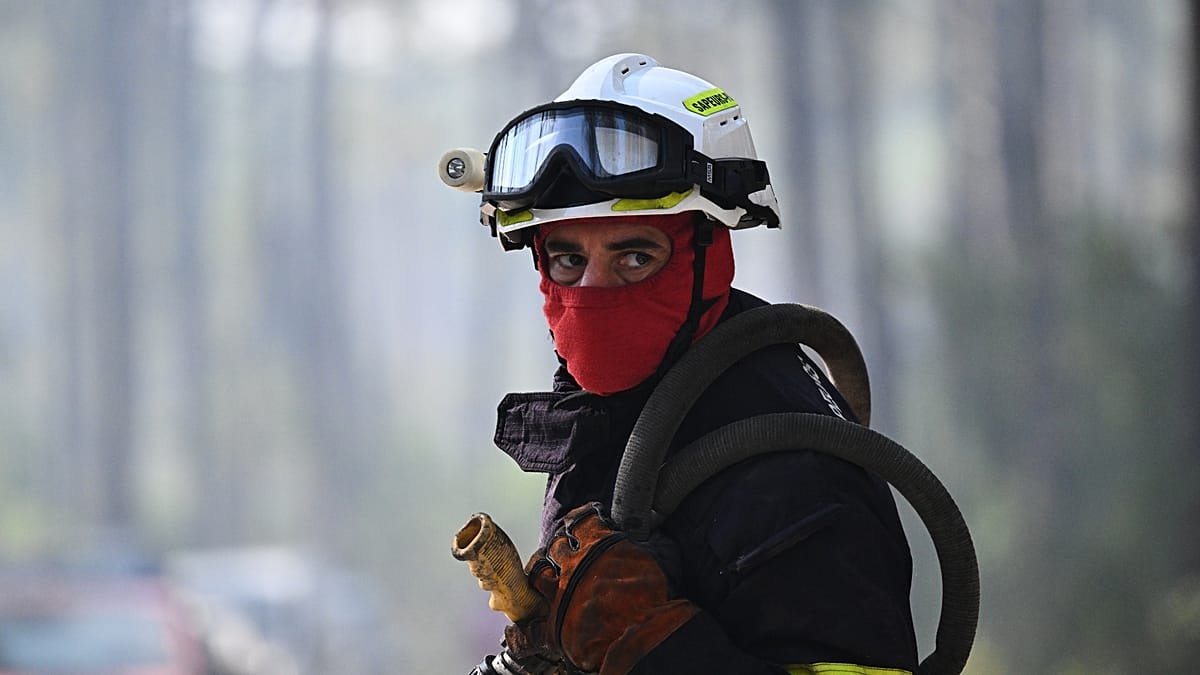
European, national and regional authorities are battling another wave of devastating wildfires this summer, but the scale and frequency of extreme weather events are raising questions over whether Europe’s crisis management systems are adapting fast enough, with a rising political cost for responsible administrations and climate deniers.

ADVERTISEMENT
ADVERTISEMENT
In recent days, Spain and France have been hit by some of the most severe fires of the season. In Spain, wildfires have affected more than 80,000 hectares, while France has seen more than 40,000 hectares burned. Hundreds of thousands of people have been forced to evacuate their homes as flames spread across several regions.
“Europe stands alongside France and Spain in the face of the devastating wildfires ravaging them,” European Commission President Ursula von der Leyen wrote on X. “My thoughts are with the firefighters who bravely battle the flames and with all those evacuated.”
Brussels quickly activated the EU Civil Protection Mechanism, deploying firefighting aircraft and personnel from several European countries.
France received support from Czechia, Croatia, Germany, Portugal, Slovakia, Sweden and Türkiye, while Spain received additional aircraft from Greece, Italy and Türkiye. Portugal also sent personnel and vehicles to support the response in Spain.
But behind the immediate response effort lies a broader challenge: Europe’s wildfire season seems to be changing faster than its emergency response systems.
At a technical briefing with journalists on Monday, European Commission officials acknowledged that simultaneous large-scale fires across several countries are putting increasing pressure on Europe’s common disaster response capacity and highlighted the need to further strengthen preparedness.
“This is the chronicle of a situation long foretold,” said Juli Pausas, a research professor at the Centre for Research on Desertification in Valencia. “Once we, as a society, have accepted that we are changing the climate, these fires become part of the new normal; in other words, they are exactly what we expected.”
A more intense fire season
Wildfires are not new in southern Europe, but climate change is altering the conditions in which they occur.
The European Commission’s Joint Research Centre (JRC), in its assessment of the 2025 wildfire season, identified a clear trend towards “an earlier start, more frequent and intense heat waves, and fires reaching higher latitudes than historically observed.”
The JRC also found that the traditional wildfire season, historically concentrated between June and September, is expanding, with major fires occurring both earlier in spring and later in the year.
Brussels has attempted to anticipate this growing risk. Last year, the Commission presented a preparedness strategy focused on strengthening early warning systems, improving coordination between national authorities and reinforcing the EU Civil Protection Mechanism.
In June, the Commission announced its largest-ever pre-positioning of firefighting resources, with 777 firefighters deployed in high-risk areas across southern Europe through the European Civil Protection Pool.
“When every minute counts, being prepared saves lives, protects livelihoods, and preserves our environment,” European Commissioner for Equality, Preparedness and Crisis Management Hadja Lahbib said while presenting the plan.
However, the scale of this summer’s fires has renewed calls for further investment. As wildfires continue to spread in other vulnerable regions, including parts of southern Italy, concerns are growing about whether Europe has enough resources if several major emergencies occur simultaneously.
On Tuesday, MEP Georgia Tramacere (S&D/Italy) called for an emergency meeting of member states most affected by wildfires, arguing that governments should share lessons learned and discuss how to strengthen prevention and crisis management.
Spain’s political battle over prevention
In Spain, the fires have triggered a political confrontation between the central government led by the centre-left Spanish Socialist Workers’ Party (PSOE) and regional authorities governed by the centre-right Popular Party (PP).
The most visible clash involved Isabel Díaz Ayuso, president of the Madrid region, and Transport Minister Óscar Puente after Madrid requested national emergency status.
Puente accused PP-led authorities of reducing fire prevention efforts and criticised agreements with the far-right Vox party, which has frequently questioned the severity of climate change. Ayuso dismissed the accusations as political attacks.
The dispute reflects a wider question over responsibility. In Spain, regional governments are responsible for forest management and many emergency services, while the central government coordinates national support and international assistance.
As extreme weather events become more frequent, climate policy is becoming an increasingly sensitive political issue.
“Governing with denialists is to leave the population unprotected,” Ecological Transition Minister Sara Aagesen told reporters on Monday.
France faces scrutiny over preparedness
France has also faced political pressure following major fires in the south-west, including the Gironde region near Bordeaux.
President Emmanuel Macron mobilised additional resources as the fires spread, while the government held several interministerial crisis meetings.
“The fight against wildfires begins with prevention. Nine out of ten fires are human-caused, and most arise from carelessness,” Prime Minister Sébastien Lecornu wrote on X. He also warned that some fires appeared to have been deliberately started.
Beyond the immediate response, the fires have revived a debate over whether France has invested enough in prevention and firefighting capacity.
Manuel Bompard, national coordinator of the far-left party La France Insoumise, criticised the previous government led by Gabriel Attal, claiming that cuts to civil protection funding contributed to delays in renewing two firefighting aircraft.
The far-right National Rally has also faced scrutiny, with opponents accusing the party of publicly supporting firefighters while opposing measures to strengthen their resources in the National Assembly.
Wildfires as a political issue
Across Europe, wildfires are becoming a test of whether national governments and local authorities can adapt their response to a changing climate.
In the EU, the challenge is no longer only responding to individual disasters, but ensuring that Europe has enough shared capacity when several crises unfold simultaneously.
Politically, the costs are likely to fall on public authorities that are struggling to keep pace with a rapidly changing reality, as well as on right-wing parties that have made climate change denial a central part of their political identity.