

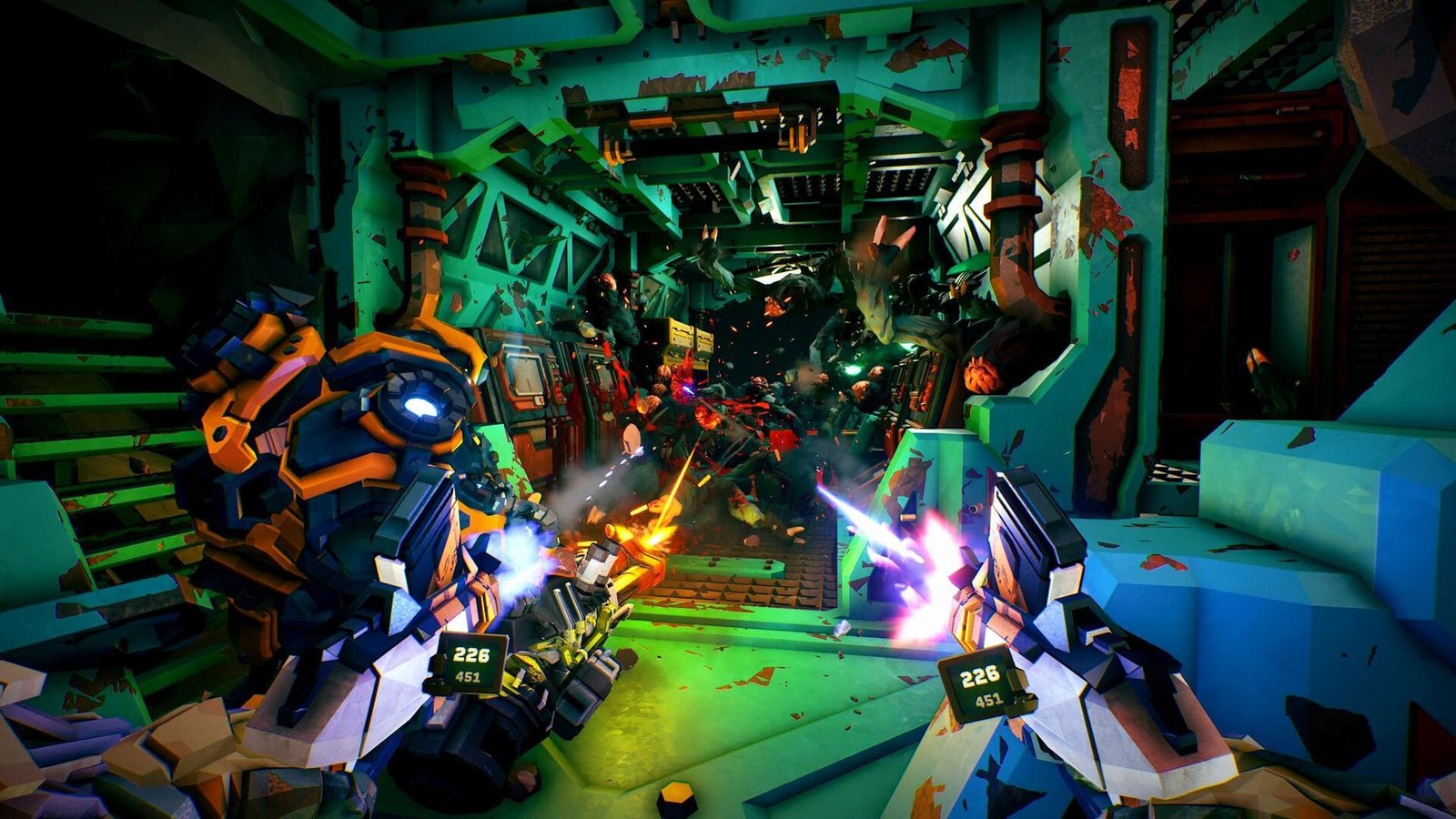

Deep Rock Galactic and Rogue Core may seem similar in many ways, but they are, at their core, two very different games. One is about mining to get a set number of resources, while the other is more about closing incursions to reclaim lost mining facilities.
Although they do share similarities in terms of weapons, enemy types, certain mechanics, and lore, that’s about it. Having said that, I’m going to jot down and explain the seven key differences between DRG and Rogue Core. Here’s what you need to know.
7 ways in which Deep Rock Galactic is fundamentally different from Rogue Core
1) Difficulty scaling is perfect versus Difficulty scaling is a tad out of touch

One of the major differences between Deep Rock Galactic and Rogue Core is the difficulty scaling. I’ve had my fair share of Hazard 4 runs on DRG, and I was surprised to see how my first dive in Rogue Core was more intense (and brutal). By the time we got to the boss fight, we were low on Armor, Ammo, and Health. While there were some deposits of Red Sugar, they weren’t sufficient.
The only reason I survived and didn’t have to be revived is that I consistently chose Expenite Upgrades, which gave me more HP. This allowed me to sort of tank hits and stay alive without much trouble. I had Armor buffs as well. Coming back to the point, the difficulty scaling is, from my experience, unbalanced.
2) Gear can be selected and upgraded versus Gear has to be chosen based on RNG

In Deep Rock Galactic, you can choose and upgrade your weapons/gear as you see fit. This is done before the mission is even selected, giving you enough time to pick a loadout suited for the intended task at hand. When playing with a team, it allows you to synchronize better.
In Rogue Core, all your gear has to be chosen on the go, and due to RNG, it’s all random. If you’re lucky, you’ll start with a solid weapon such as Warthog Auto 210, and if not, something subpar that you’re not familiar with. The upgrades, as well, are random, so the chances of your buffing your weapon exactly how you want are out of the picture.
3) Missions are short versus Missions can last over 45 minutes

Your opening missions in Deep Rock Galactic will be short. Objectives will be simple, and enemies will be rather limited. The layout of the area itself will also be fairly rudimentary, allowing you to learn how to navigate in the darkness. This enables you to learn on the go without having to rush anything, and in 20 minutes tops, you’re done with the mission.
In Rogue Core, the first mission can stretch an upward of 50 minutes, which is a massive amount of time. It’s the equivalent of doing a Deep Dive in DRG, which can only be accessed after your first promotion. Subjecting new players to such a long run is perhaps (in my opinion), not the best way to kick things off. Hopefully, this is looked into and adjusted during the early access period.
4) Mining takes the forefront versus Mining is only needed to get Expenite

Deep Rock Galactic is all about yearning for the mines. Every dive has one thing in common, which is mining as much as possible. There is a plethora of resources that can be mined and used to upgrade weapons, armor, and unlock drinks at the bar. This makes mining them well worth the effort.
In contrast, there is nothing to mine in Rogue Core except Expenite and Red Sugar for Health. Given that it’s more action-oriented, your goal is to destroy the Gatestones and defeat the Gatekeeper to stop the incursion of Corespawn. Reclaimers are not miners either way.
5) Time leniency versus Time constraint

When playing Deep Rock Galactic, time is of the essence, but the urgency is not present. There’s no harm in taking a bit of extra time to go about completing tasks. Since some are indeed complex, the game is linear and allows you to explore to your heart’s content. Even when the enemy attacks, you’re usually in a good position to deal with them head-on.
In Rogue Core, time is running against you. From the moment you enter the facility, everything you do from then onward has to be rushed. There’s no time to explore or take in the scenery, as the longer you stay on one Level, the more Corespawn you attract. If you need to unlock Workbences or hack Bio-Boosters, you need to do it quickly. There’s quite literally no time to waste or lollygag.
6) Classes have specified roles versus Reclaimers have no specialization

In Deep Rock Galactic, each Miner has a specific role. Scout has great mobility, allowing him to explore quickly. Engineer can set up turrets and platforms. Driller can create tunnels to get to objectives easily. Lastly, the Gunner (my favorite), who can set up ziplines for traversing long distances (up to 50 meters) and can drown enemies in a hail of fiery bullets.
In contrast, Reclaimers don’t have a specialized role, per se. Each Class is unique, but they have access to weapons based on RNG. As such, you can play Slicer more defensively than offensively based on his loadout. Another example is traversal tools; unlike DRG, wherein each Miner has a fixed tool, Reclaimers can choose any based on the selection given to them.
7) Miners versus Reclaimers

In Deep Rock Galactic, you play as a Miner. Your goal is simple: mine/extract resources, complete secondary objectives, and return to the station. There are boss fights, but you don’t always have to engage with them. You can bypass them and wrap up the mission, unless they are tied to the main objective.
In Rogue Core, defeating the boss at the end of the level is paramount to success. If you fail at this stage of the mission, you’ve essentially failed. You will still get some XP and rewards, but the main objective has been lost.
Read more articles here:
Edited by Matthew Wilkins