

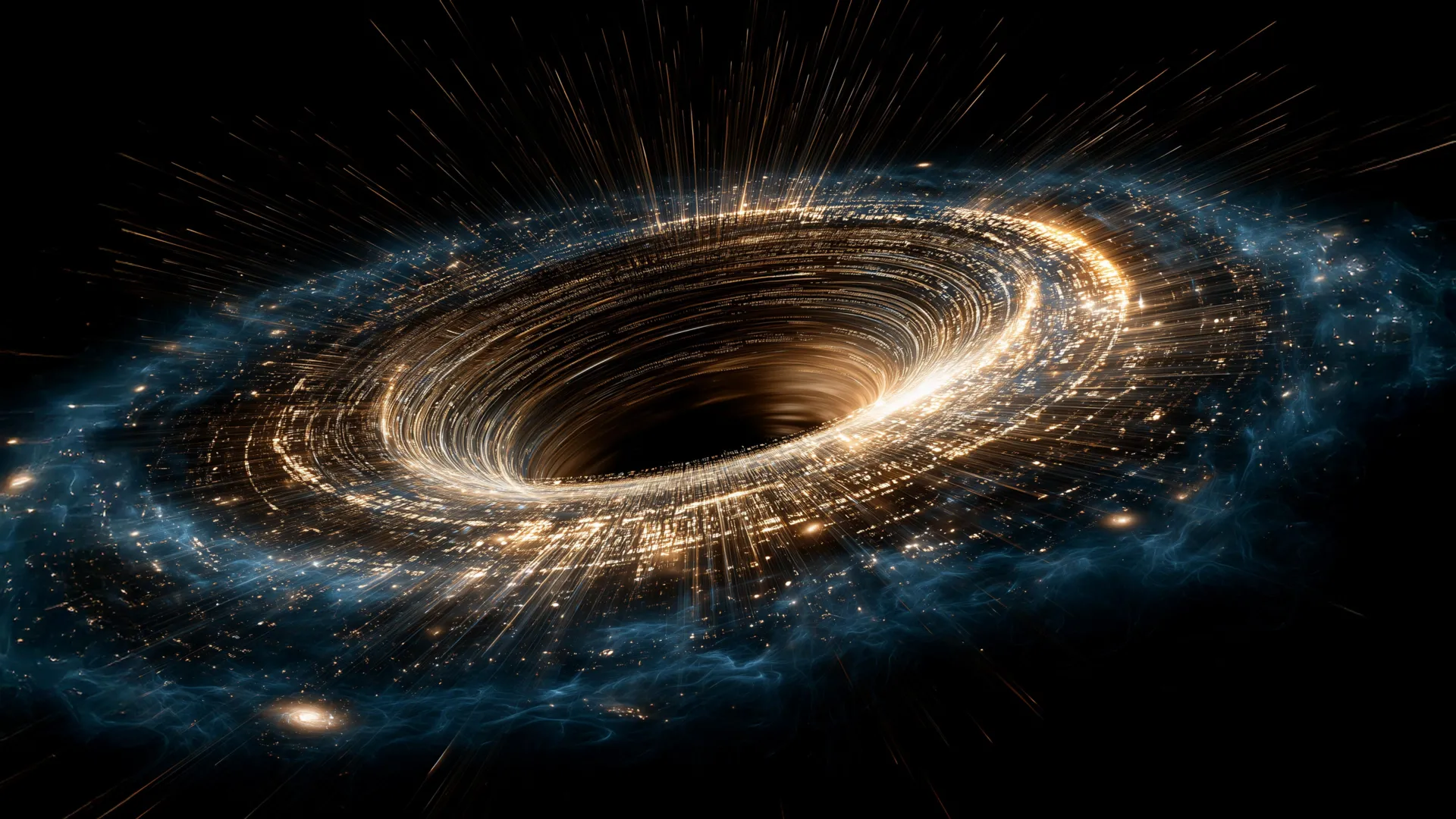
For more than a century, physics has been built on two great theories. Einstein’s general relativity explains gravity as the bending of space and time.
Quantum mechanics governs the world of particles and fields. Both work brilliantly in their own domains. But put them together and contradictions appear – especially when it comes to black holes, dark matter, dark energy and the origins of the cosmos.
My colleagues and I have been exploring a new way to bridge that divide. The idea is to treat information – not matter, not energy, not even spacetime itself – as the most fundamental ingredient of reality. We call this framework the quantum memory matrix (QMM).
At its core is a simple but powerful claim: spacetime is not smooth, but discrete – made of tiny “cells”, which is what quantum mechanics suggests. Each cell can store a quantum imprint of every interaction, like the passage of a particle or even the influence of a force such as electromagnetism or nuclear interactions, that passes through. Each event leaves behind a tiny change in the local quantum state of the spacetime cell.
In other words, the universe does not just evolve. It remembers.
The story begins with the black hole information paradox. According to relativity, anything that falls into a black hole is gone forever. According to quantum theory, that is impossible. Information cannot be ever destroyed.
QMM offers a way out. As matter falls in, the surrounding spacetime cells record its imprint. When the black hole eventually evaporates, the information is not lost. It has already been written into spacetime’s memory.
This mechanism is captured mathematically by what we call the imprint operator, a reversible rule that makes information conservation work out. At first, we applied this to gravity. But then we asked: what about the other forces of nature? It turns out they fit the same picture.
In our models assuming that spacetime cells exist, the strong and weak nuclear forces, which hold atomic nuclei together, also leave traces in spacetime. Later, we extended the framework to electromagnetism (although this paper is currently being peer reviewed). Even a simple electric field changes the memory state of spacetime cells.
Explaining dark matter and dark energy
That led us to a broader principle that we call the geometry-information duality. In this view, the shape of spacetime is influenced not just by mass and energy, as Einstein taught us, but also by how quantum information is distributed, especially through entanglement. Entanglement is a quantum feature in which two particles, for example, can be spookily connected, meaning that if you change the state of one, you automatically and immediately also change the other – even if it’s light years away.
This shift in perspective has dramatic consequences. In one study, currently under peer review, we found that clumps of imprints behave just like dark matter, an unknown substance that makes up most of the matter in the universe. They cluster under gravity and explain the motion of galaxies – which appear to orbit at unexpectedly high speeds – without needing any exotic new particles.
In another, we showed how dark energy might emerge too. When spacetime cells are saturated, they cannot record new, independent information. Instead, they contribute to a residual energy of spacetime. Interestingly, this leftover contribution has the same mathematical form as the “cosmological constant”, or dark energy, which is making the universe expand at an accelerated rate.
Its size matches the observed dark energy that drives cosmic acceleration. Together, these results suggest that dark matter and dark energy may be two sides of the same informational coin.
A cyclic universe?
But if spacetime has finite memory, what happens when it fills up? Our latest cosmological paper, accepted for publication in The Journal of Cosmology and Astroparticle Physics, points to a cyclic universe – being born and dying over and over. Each cycle of expansion and contraction deposits more entropy – a measure of disorder – into the ledger. When the bound is reached, the universe “bounces” into a new cycle.
Reaching the bound means spacetime’s information capacity (entropy) is maxed out. At that point, contraction cannot continue smoothly. The equations show that instead of collapsing to a singularity, the stored entropy drives a reversal, leading to a new phase of expansion. This is what we describe as a “bounce”.
By comparing the model to observational data, we estimate that the universe has already gone through three or four cycles of expansion and contraction, with fewer than ten remaining. After the remaining cycles are completed, the informational capacity of spacetime would be fully saturated. At that point, no further bounces occur. Instead, the universe would enter a final phase of slowing expansion.
That makes the true “informational age” of the cosmos about 62 billion years, not just the 13.8 billion years of our current expansion.
So far, this might sound purely theoretical. But we have already tested parts of QMM on today’s quantum computers. We treated qubits, the basic units of quantum computers, as tiny spacetime cells. Using imprint and retrieval protocols based on the QMM equations, we recovered the original quantum states with over 90% accuracy.
This showed us two things. First, that the imprint operator works on real quantum systems. Second, it has practical benefits. By combining imprinting with conventional error-correction codes, we significantly reduced logical errors. That means QMM might not only explain the cosmos, but also help us build better quantum computers.
QMM reframes the universe as both a cosmic memory bank and a quantum computer. Every event, every force, every particle leaves an imprint that shapes the evolution of the cosmos. It ties together some of the deepest puzzles in physics, from the information paradox to dark matter and dark energy, from cosmic cycles to the arrow of time.
And it does so in a way that can already be simulated and tested in the lab. Whether QMM proves to be the final word or a stepping stone, it opens a startling possibility: the universe may not only be geometry and energy. It is also memory. And in that memory, every moment of cosmic history may still be written.