


Growing up with dirty air harms kids’ health. But reducing pollution can help reverse the damage.
In London, an effort to combat traffic emissions led to measured improvements in kids whose lung growth was previously stunted compared to their peers outside the city. In New York City, policies that lowered prenatal exposure to air pollution helped kids perform better on cognitive tests than previous cohorts.
These findings from two new studies add to a robust body of research emphasizing the health benefits of clean air, particularly for children, who are more vulnerable than adults to its hazards. They also provide a source of hope: Cities suffering from toxic air can become safer, healthier places for kids.
That was a key takeaway for Helen Wood, a research fellow at Queen Mary University of London and a co-author of the study there, which was published in The Lancet Public Health journal last week.
“We’ve seen the damage that air pollution can do, but we’ve shown that it’s not permanent,” Wood said. “Look what we can do if we make the air cleaner.”
Air pollution is a global public health hazard. Physicians, clean air advocates and environmental health researchers said the studies illustrate the importance of policies that reduce it.
In the U.S., the trend is going the other direction. President Donald Trump’s administration is targeting and eliminating clean air standards and granting polluting facilities exemptions from health-focused regulations, while also ramping up production of polluting energy sources like coal and gas.
Elizabeth Bechard, the public health manager at Moms Clean Air Force, a national group focused on reducing air pollution, said she was glad to see the studies illustrate the positive impacts of clean air policies. But she worries what future studies may show about the effects of the Trump administration’s actions on children’s health.
“It’s been just one rollback after another when it comes to air pollution,” Bechard said. “It’s deeply concerning to think that the government, the agency whose job it is to protect human health and the environment, seems to be doing exactly the opposite at every conceivable turn.”
Cleaner Cars Help Kids’ Lungs Grow
Wood and her colleagues focused on the Ultra Low Emission Zone, or ULEZ, a pollution-reduction policy that went into effect in Central London in 2019 and was expanded across the city in 2023. The policy requires drivers of vehicles that don’t meet a set of emission standards—focused on nitrogen oxides and fine particles like soot—to pay a daily charge in order to drive in the zone. It has significantly reduced hazardous pollution levels across London, according to city officials.
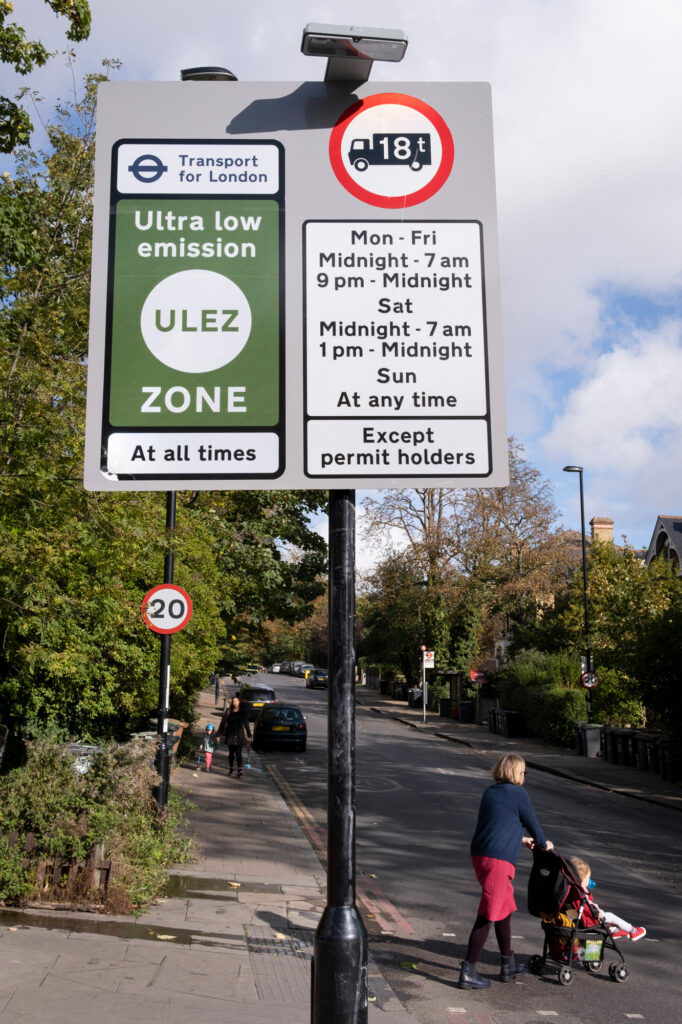
Researchers tracked 3,400 children, ages six to nine, over a period of five years in London and Luton, a town about 30 miles from the city. At the start in 2018, children in the London cohort had significantly stunted lung growth compared to their Luton peers. But over the course of five years, the researchers found that the children’s exposure to nitrogen dioxide—the pollutant most closely associated with tailpipe emissions—decreased faster in London than in Luton, while their lung growth increased at a higher rate. The proportion of children with clinically impaired lung function also fell much faster in London than in Luton.
In other words, lowering pollution helped kids bounce back from once-stunted lung growth.
Wood said she was surprised by how stark her team’s results were.
“Seeing the size of the effect and seeing that recovery of function was just remarkable,” she said.
Children’s growing lungs are particularly vulnerable to the impacts of air pollution, and the World Health Organization estimates that more than 90 percent of the world’s children are exposed to unhealthy air on a daily basis. Stunted lung growth in children can have lifelong effects, including a predisposition for lung diseases and declining lung health in adulthood.
More than two decades ago, researchers in California published similar findings about the restorative power of clean air on children’s lung growth, as part of the landmark Children’s Health Study. Research from that effort in 2001 found that children who relocated to areas with lower air pollution levels showed improved lung growth after one year.
Ed Avol, a professor emeritus at the University of Southern California’s Keck School of Medicine, was one of the 2001 study’s authors and was not involved with the London research. He said the new results were consistent with his research in California and that the new study’s larger cohort strengthens the evidence that cleaner air can tangibly improve children’s lung growth.
That emphasizes the urgency of implementing policies to clean up dirty air today, he added.
“We cannot sit by idly and talk about some far in the future improvement,” Avol said. “The changes we make now affect children’s lung function now, and we can improve the health of children in this current generation by improving air quality now.”
Avol also said the study’s focus on a particular policy—in this case, the ULEZ—makes it even more essential for governments and public understanding.
“It’s critically important that you have these studies that demonstrate that these changes and improvements can be made and are measurable,” he said. “It’s an evidence-based, objective scientific finding.”
This story is funded by readers like you.
Our nonprofit newsroom provides award-winning climate coverage free of charge and advertising. We rely on donations from readers like you to keep going. Please donate now to support our work.
London’s mayor, Sadiq Khan, praised the study’s results in an op-ed for the Guardian.
“This shows that cutting air pollution doesn’t just help Londoners being born today — it can help children whose lungs have already been stunted by toxic air to recover, proving that it’s never too late to act,” Khan wrote.
Traffic Controls Help NYC Kids’ Brains
Meanwhile, researchers at Columbia University in New York City found that several clean air policies, mostly targeting vehicle emissions, resulted in cognitive benefits for children over time.
In a study published in Environmental Health on Aug. 15, the researchers looked at prenatal exposure to fine particles, nitrogen dioxide and polycyclic aromatic hydrocarbons—carcinogenic pollutants from fossil fuel combustion that are known to be hazardous to the developing brain.
From 1998 to 2020, prenatal exposure to those hazardous pollutants dropped significantly. At the same time, markers of early cognitive development improved: Children at 1, 2 and 3 years old were scoring higher on tests meant to evaluate neurocognitive milestones for toddlers.
The researchers identified several policies enacted over the study’s time period, such as lowering city public transportation and taxi emissions and efforts to cut building emissions, including from diesel-based heating. They adjusted for confounding factors like maternal age and education or the presence of a smoker in the household, but noted that unmeasured factors, like changes in a neighborhood, could also have an impact on cognitive development.
Previous research has found that air pollution has myriad effects on the brain, including reducing attention spans, hastening cognitive decline and increasing risks of neurodegenerative conditions including Alzheimer’s and Parkinson’s. It’s also well documented that exposure to pollutants in the womb can cause wide-ranging health harms, including lower birth weight and higher risk of asthma.
The Columbia University study “provides new evidence that policies to reduce fossil fuel emissions benefit developing brains and strongly supports continued efforts to reduce these emissions,” lead author Frederica P. Perera said in a statement.
Dr. Afif El-Hasan, a pediatrician and member of the American Lung Association’s board of directors, said he wasn’t surprised by the study’s results. To him, it reinforces the environmental justice implications of air pollution: Disparate exposures can impact all facets of children’s lives.
“This study shows once again that … living in poor air quality is going to add an extra burden to a child, and to a family, that helps make it harder for them to achieve optimal success in life and society,” El-Hasan said.
Both studies focused on chronic sources of urban air pollution like traffic and building emissions. But climate change is also adding to seasonal and event-related sources of pollution by bringing more heat—which drives up ozone pollution—and amplifying wildfires.
That makes it even more important to enact policies that target chronic sources of air pollution, said Bechard, from Moms Clean Air Force.
“Those risks that are growing mean that we have even more of a responsibility to control the sources of pollution that we can control,” she said. “We have a responsibility to our kids and our communities.”
About This Story
Perhaps you noticed: This story, like all the news we publish, is free to read. That’s because Inside Climate News is a 501c3 nonprofit organization. We do not charge a subscription fee, lock our news behind a paywall, or clutter our website with ads. We make our news on climate and the environment freely available to you and anyone who wants it.
That’s not all. We also share our news for free with scores of other media organizations around the country. Many of them can’t afford to do environmental journalism of their own. We’ve built bureaus from coast to coast to report local stories, collaborate with local newsrooms and co-publish articles so that this vital work is shared as widely as possible.
Two of us launched ICN in 2007. Six years later we earned a Pulitzer Prize for National Reporting, and now we run the oldest and largest dedicated climate newsroom in the nation. We tell the story in all its complexity. We hold polluters accountable. We expose environmental injustice. We debunk misinformation. We scrutinize solutions and inspire action.
Donations from readers like you fund every aspect of what we do. If you don’t already, will you support our ongoing work, our reporting on the biggest crisis facing our planet, and help us reach even more readers in more places?
Please take a moment to make a tax-deductible donation. Every one of them makes a difference.
Thank you,

Reporter, Health and Justice
Keerti Gopal covers intersections between climate change, public health and environmental justice at Inside Climate News. Previously, she covered climate activism and movement repression. She is a National Geographic Explorer and has received fellowships from Fulbright, the Solutions Journalism Network, The Lever, and the National Press Foundation.