

For years, many Western observers believed the internet would inevitably weaken authoritarian regimes.
The logic seemed straightforward: once information could flow freely, state monopolies on propaganda would collapse. The internet, in this view, would become a force of democratization.
Reality turned out differently. Rather than being overwhelmed by the digital revolution, authoritarian governments such as China and Vietnam have adapted to it with remarkable sophistication.
Instead of merely censoring information, they have learned to shape online narratives, manipulate visibility, exploit algorithms and transform cyberspace itself into an instrument of political control.
The authoritarianism of the digital era no longer depends primarily on silencing citizens. Increasingly, it depends on flooding them.
China’s digital authoritarianism laboratory
China pioneered what scholars now describe as “digital authoritarianism.”
Early efforts focused heavily on censorship through the “Great Firewall,” blocking foreign platforms and restricting access to politically sensitive information.
But Beijing gradually realized that blocking alone was insufficient in an era of social media and mobile connectivity. The Chinese model evolved from passive censorship into active narrative management.
Political scientist Gary King and his colleagues estimated that the Chinese government generates hundreds of millions of social media posts annually through coordinated online commentators often referred to as the “50-Cent Party.”
Contrary to popular assumptions, these campaigns do not primarily aim to debate dissidents or refute criticism directly. Instead, they seek to distract public attention, amplify patriotic sentiment and overwhelm politically sensitive discussions with emotional or nationalistic content.
This represents a strategic shift: the goal is no longer simply to suppress dissenting information, but to dilute its political impact.
Equally important, Beijing has decentralized propaganda production itself. Government agencies, local authorities, police departments and state-affiliated influencers increasingly operate as content creators on platforms such as Douyin, China’s version of TikTok.
Nationalist messaging is woven into entertainment, memes, music, lifestyle videos and emotionally engaging short-form content. Propaganda no longer appears solely through rigid ideological slogans or state television broadcasts. It increasingly adopts the language, aesthetics and rhythms of internet culture itself.
The result is a far more adaptive and resilient form of political control. China’s deeper objective is not necessarily to prevent citizens from knowing the truth. Rather, it is to prevent citizens from knowing that others also know the truth, thereby weakening the possibility of collective action.
This dynamic reflects what political theorist Timur Kuran described as the problem of “preference falsification” under authoritarian systems: individuals may privately recognize social discontent while publicly remaining silent because they believe they are isolated.
Digital authoritarianism exploits this uncertainty by manufacturing the illusion of consensus.
From police state to digital police state
Vietnam has increasingly absorbed and adapted elements of the Chinese model while modifying them for a more globally connected internet environment.
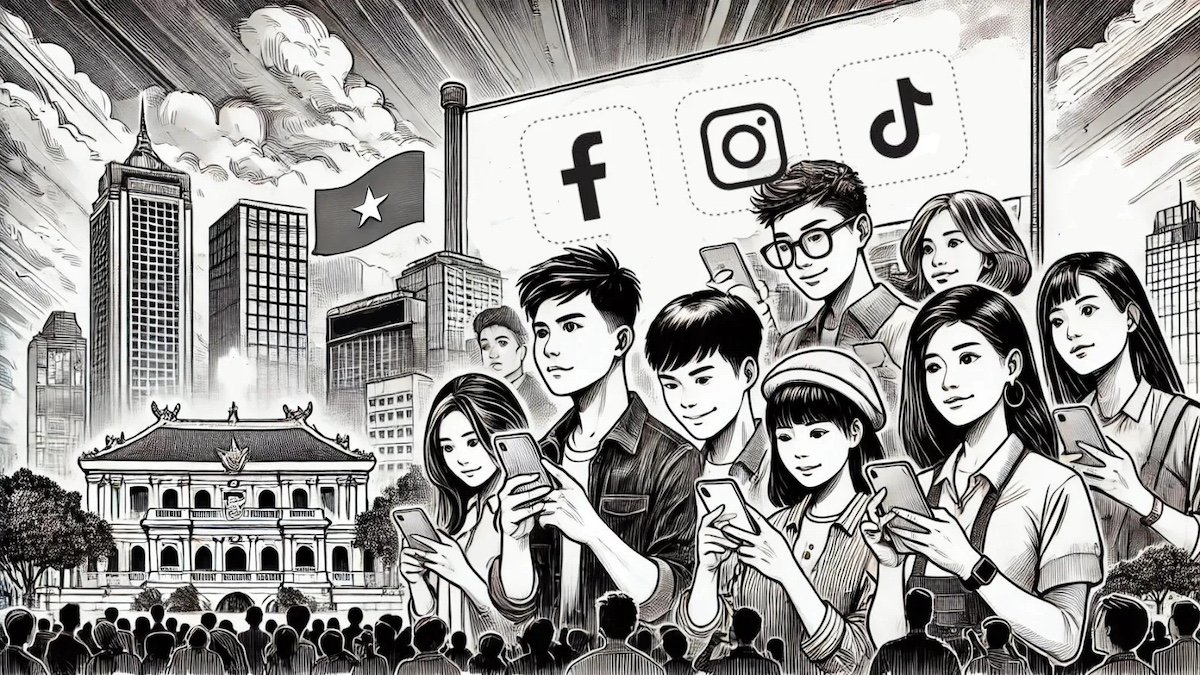
Unlike China, Vietnam has not fully blocked major international platforms such as Facebook, YouTube and TikTok. Instead, Hanoi has pursued a strategy of selective pressure, platform cooperation, online surveillance and narrative flooding.
This hybrid approach allows the Vietnamese state to maintain access to global digital infrastructure while simultaneously expanding domestic control mechanisms.
One major feature of this adaptation is the growing role of security institutions in cyberspace governance. Vietnam’s “Force 47” which is a military-linked online cyber unit reportedly involving thousands of participants that represents an upgraded version of organized digital opinion management.
Alongside state-affiliated media networks and patriotic influencers, these forces operate as decentralized instruments for enforcing online narratives.
This evolution reflects a broader transition from a traditional police state to what may be called a “digital police state,” where surveillance, propaganda, online nationalism and algorithmic amplification merge into a continuous system of governance.
Hanoi has also adopted Beijing’s strategy of narrative flooding. Rather than relying solely on arrests or direct censorship, Vietnamese authorities increasingly promote campaigns centered on “positive content” and patriotic messaging.
Official initiatives encouraging the use of “the beautiful to eliminate the ugly” aim to saturate social media with state-approved narratives while marginalizing critical voices.
The strategy is politically efficient. Excessive arrests generate international criticism and may create domestic sympathy for dissidents. By contrast, mobilizing influencers, entertainment content or patriotic TikTok campaigns creates the appearance of voluntary social consensus.
The state’s role becomes less visible even as its influence expands.
Vietnam has also followed China’s regulatory trajectory. Shortly after Beijing enacted its Cybersecurity Law in 2017, Hanoi passed its own Cybersecurity Law in 2018, incorporating similar provisions regarding data localization, platform obligations and content management.
These legal frameworks provide institutional foundations for expanding digital control while pressuring international technology companies to comply with domestic political demands.
Algorithms as governance
The effectiveness of modern digital authoritarianism lies not only in censorship capacity but in understanding how social media systems function.
Authoritarian regimes increasingly recognize that algorithms reward engagement, emotional intensity, outrage and repetition. Content that generates coordinated interaction gains visibility regardless of its informational quality.
By mobilizing networks of commentators, patriotic influencers, or state-affiliated content creators, governments can artificially amplify preferred narratives and dominate users’ feeds without formally banning opposing viewpoints.
In this environment, visibility itself becomes political power. The result is a subtle yet profound transformation of authoritarian governance, in which the state no longer needs to persuade every citizen.
It merely needs to shape the informational environment sufficiently to fragment public attention, exhaust outrage and discourage coordinated dissent.
This model is particularly effective among younger generations whose political perceptions are increasingly shaped by algorithmically curated short-form video content rather than traditional ideological education.
Digital democratic challenge
The adaptation of authoritarian regimes to the digital era presents a far more complex challenge than earlier theories of internet democratization anticipated.
China demonstrated that authoritarian governments could survive the internet age. Vietnam demonstrates that these methods can be adapted even within globally connected digital ecosystems.
The danger is not simply censorship in its traditional form. It is the normalization of invisible influence systems embedded within entertainment culture, influencer economies and algorithmic recommendation systems.
When propaganda no longer resembles rigid state doctrine but instead wears the face of relatable influencers, viral memes, lifestyle content and patriotic entertainment, authoritarian control becomes harder to identify and thus potentially more effective than ever.
The future struggle between democracy and authoritarianism may therefore depend less on access to information itself than on who controls the systems that determine visibility, attention and collective perception online.
Nguyen Ngoc Nhu Quynh, also known as Mother Mushroom, is a Vietnamese writer, human rights commentator and former political prisoner based in Texas, United States. She is the founder of WEHEAR, an independent initiative focusing on Southeast Asian politics, human rights and economic transparency.