

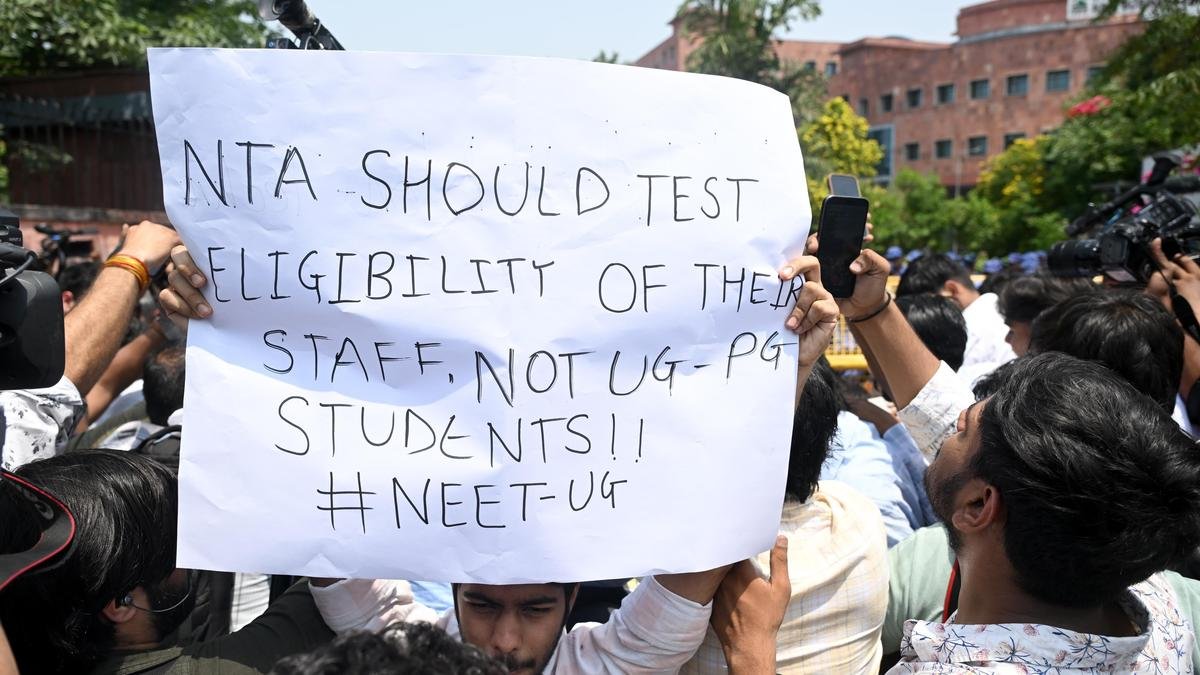
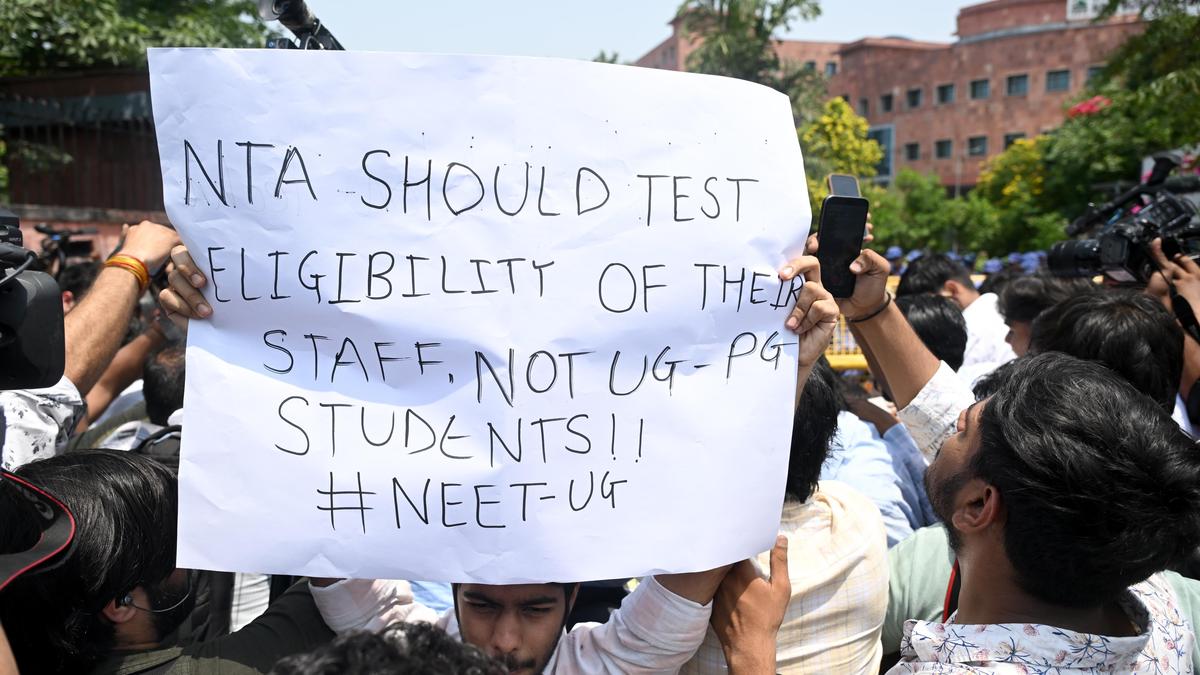
ABVP members and supporters stage a protest against the alleged NEET 2026 cancellation in New Delhi. File
| Photo Credit: Shashi Shekhar Kashyap
Experts suggest compulsory registration of all medical entrance exam coaching centres, bringing in computerised entrance exam for National Eligibility cum Entrance Test (Undergraduate) (NEET-UG) and exempting State-government controlled undergraduate, postgraduate, and super-specialty medical seats from the single-window national to minimise and prevent malpractices in the NEET exam.

Doctors’ Association for Social Equality general secretary G.R. Ravindranath, while condemning the Central Government for its negligent handling leading up to the NEET-UG exam cancellation, said that the fraud and paper leak is also an administrative failure.
“Appropriate measures must be taken to ensure such irregularities do not occur in the future. Our association has sent suggestions to the Union Government, including conducting the exam by online method using computers. The recommendations of the Radhakrishnan Committee for conducting NEET and All India exams must be implemented. Also the long-standing demand of the people of Tamil Nadu — to exempt State government-controlled undergraduate, postgraduate, and super-specialty medical seats from NEET — must be granted. This would help to avoid the situation where lakhs of students take the exam simultaneously, and irregularities could be prevented,” he said.
Regarding private NEET coaching centres collecting huge amounts from students, the Association said that Union and State governments must take steps to register all coaching centres to regulate them and fix nominal fees to ensure the safety of students.

“The Union and State governments should start free coaching centres across our country with free boarding facilities for the poor students,’’ it suggested.
Aditya Kelkar, director, NIO Super Specialty Hospital Pune said that every NEET aspirant who dedicated their time working hard for the paper deserves an exam process that is transparent, secure, and merit‑based. He added that credibility of national examinations must be protected at all costs.
He noted that decentralisation of the NEET exam has both advantages and risks.
“A centralised exam ensures uniform standards and equal opportunity across India, which is important for providing fair and equal opportunities. At the same time, decentralisation could reduce logistical challenges and allow States to manage exams more smoothly. If decentralisation is considered, we would recommend that it should operate under a strong national framework so that merit and parity of these exams are not compromised,’’ Dr. Kelkar said.

He suggested minimal human handling of question papers and last‑minute printing at exam centres to be considered as a safety measure. Moreover, regular audits, strict accountability for officials, and the use of CCTV surveillance technology can further reduce the risks. “The role of technology, building a culture of responsibility and ethics among all personnel involved is essential to restore credibility,’’ he said.
Rajeev Jayadevan, former president of the Indian Medical Association (IMA), Cochin too said that the solution to prevent leaks is to digitise the exam as is already the case with numerous other high-stakes exams in India and elsewhere, so that the questions remain encrypted, becoming available only at the time of taking the test.
“Multi-session testing eliminates the risk of a localised leak leading to a systemic collapse again. Within this format, psychometric normalization is a well-established fairness technique which removes the asymmetry that a more difficult paper can create. By converting raw marks into a percentile score, a student gets ranked against others who faced the exact same paper,’’ he said .
He added that by mathematically neutralising the difficulty level, it ensures that regardless of whether a particular session was “easy” or “hard,” merit is determined by a student’s relative standing, rather than by absolute score.
Published – May 14, 2026 10:30 am IST