

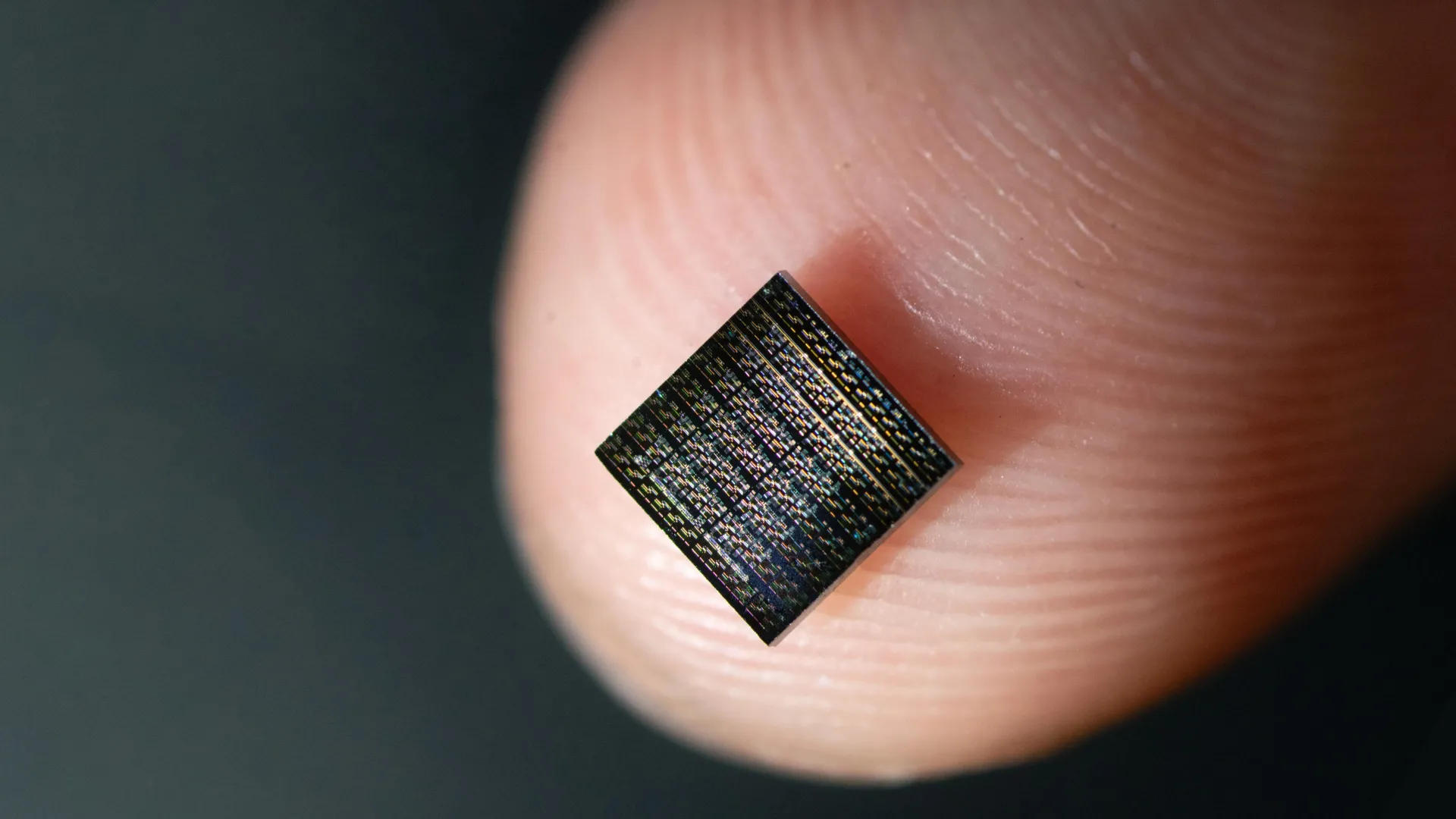
Scientists at the USC Viterbi School of Engineering and the School of Advanced Computing have created artificial neurons that reproduce the intricate electrochemical behavior of real brain cells. The discovery, published in Nature Electronics, marks a major milestone in neuromorphic computing, a field that designs hardware modeled after the human brain. This advancement could shrink chip sizes by orders of magnitude, cut energy use dramatically, and push artificial intelligence closer to achieving artificial general intelligence.
Unlike digital processors or earlier neuromorphic chips that only simulate brain activity through mathematical models, these new neurons physically reproduce how real neurons operate. Just as natural brain activity is triggered by chemical signals, these artificial versions use actual chemical interactions to start computational processes. This means they are not just symbolic representations but tangible recreations of biological function.
A New Class of Brain-Like Hardware
The research, led by Professor Joshua Yang of USC’s Department of Computer and Electrical Engineering, builds on his earlier pioneering work on artificial synapses more than a decade ago. The team’s new approach centers on a device called a “diffusive memristor.” Their findings describe how these components could lead to a new generation of chips that both complement and enhance traditional silicon-based electronics. While silicon systems rely on electrons to perform computations, Yang’s diffusive memristors use the motion of atoms instead, creating a process that more closely resembles how biological neurons transmit information. The result could be smaller, more efficient chips that process information the way the brain does and potentially pave the way toward artificial general intelligence (AGI).
In the brain, both electrical and chemical signals drive communication between nerve cells. When an electrical impulse reaches the end of a neuron at a junction called a synapse, it converts into a chemical signal to transmit information to the next neuron. Once received, that signal is converted back into an electrical impulse that continues through the neuron. Yang and his colleagues have replicated this complex process in their devices with striking accuracy. A major advantage of their design is that each artificial neuron fits within the footprint of a single transistor, whereas older designs required tens or even hundreds.
In biological neurons, charged particles known as ions help create the electrical impulses that enable activity in the nervous system. The human brain relies on ions such as potassium, sodium, and calcium to make this happen.
Using Silver Ions to Recreate Brain Dynamics
In the new study, Yang — who also directs the USC Center of Excellence on Neuromorphic Computing — used silver ions embedded in oxide materials to generate electrical pulses that mimic natural brain functions. These include fundamental processes like learning, movement, and planning.
“Even though it’s not exactly the same ions in our artificial synapses and neurons, the physics governing the ion motion and the dynamics are very similar,” says Yang.
Yang explains, “Silver is easy to diffuse and gives us the dynamics we need to emulate the biosystem so that we can achieve the function of the neurons, with a very simple structure.” The new device that can enable a brain-like chip is called the “diffusive memristor” because of the ion motion and the dynamic diffusion that occurs with the use of silver.
He adds, the team chose to utilize ion dynamics for building artificial intelligent systems “because that is what happens in the human brain, for a good reason and since the human brain, is the ‘winner in evolution-the most efficient intelligent engine.”
“It’s more efficient,” says Yang.
Why Efficiency Matters in AI Hardware
Yang emphasizes that the issue with modern computing isn’t lack of power but inefficiency. “It’s not that our chips or computers are not powerful enough for whatever they are doing. It’s that they aren’t efficient enough. They use too much energy,” he explains. This is especially important given how much energy today’s large-scale artificial intelligence systems consume to process massive datasets.
Yang goes on to explain that unlike the brain, “Our existing computing systems were never intended to process massive amounts of data or to learn from just a few examples on their own. One way to boost both energy and learning efficiency is to build artificial systems that operate according to principles observed in the brain.”
If you are looking for pure speed, electrons that run modern computing would be the best for fast operations. But, he explains, “Ions are a better medium than electrons for embodying principles of the brain. Because electrons are lightweight and volatile, computing with them enables software-based learning rather than hardware-based learning, which is fundamentally different from how the brain operates.”
In contrast, he says, “The brain learns by moving ions across membranes, achieving energy-efficient and adaptive learning directly in hardware, or more precisely, in what people may call ‘wetware’.”
For example, a young child can learn to recognize handwritten digits after seeing only a few examples of each, whereas a computer typically needs thousands to achieve the same task. Yet, the human brain accomplishes this remarkable learning while consuming only about 20 watts of power, compared to the megawatts required by today’s supercomputers.
Potential Impact and Next Steps
Yang and his team see this technology as a major step toward replicating natural intelligence. However, he acknowledges that the silver used in these experiments is not yet compatible with standard semiconductor manufacturing processes. Future work will explore other ionic materials that can achieve similar effects.
The diffusive memristors are efficient in both energy and size. A typical smartphone may contain around ten chips, each with billions of transistors switching on and off to perform calculations.
“Instead [with this innovation], we just use a footprint of one transistor for each neuron. We are designing the building blocks that eventually led us to reduce the chip size by orders of magnitude, reduce the energy consumption by orders of magnitude, so it can be sustainable to perform AI in the future, with similar level of intelligence without burning energy that we cannot sustain,” says Yang.
Now that we have demonstrated capable and compact building blocks, artificial synapses and neurons, the next step is to integrate large numbers of them and test how closely we can replicate the brain’s efficiency and capabilities. “Even more exciting,” says Yang, “is the prospect that such brain-faithful systems could help us uncover new insights into how the brain itself works.”