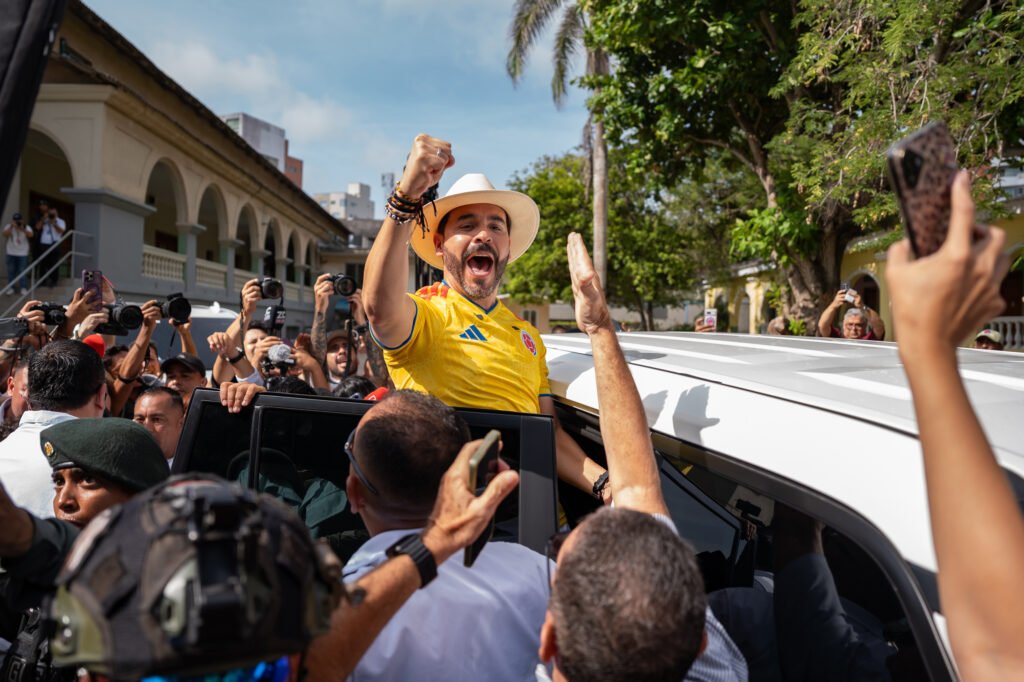
Right-wing businessman Abelardo de la Espriella holds a razor-thin lead in Colombia’s preliminary presidential vote count, positioning the Donald Trump ally to clear the way for expanded fossil fuel extraction, including controversial fracking projects.
A de la Espriella presidency would mark a sharp reversal for one of the world’s most ambitious experiments in fossil fuel phaseout. Under outgoing President Gustavo Petro, Colombia banned fracking and became the first major oil-producing nation to halt new oil and gas exploration licenses, positioning itself as a bellwether for developing countries seeking to align their economic policies with climate goals.
Election authorities said on Monday that with 99.9 percent of the results in, de la Espriella holds 49.66 percent of the vote, while progressive lawmaker and Petro-ally Iván Cepeda Castro has 48.7 percent. De la Espriella claimed victory Sunday night.
Petro alleged irregularities in the vote count in social media posts Sunday. He and Cepeda said they will challenge the results.
De la Espriella, 47, campaigned on aggressively expanding oil, gas and mineral extraction, saying that his policy platform will provide economic security and energy self-sufficiency.
In May, de la Espriella said that Colombia should do “all the fracking possible.” He also dismissed concerns about fracking’s environmental risks as “urban myths.”
Unlike the United States, where fracking has taken hold for more than a decade, most Latin American countries have resisted the water-intensive drilling method known to contaminate aquifers and ecosystems with toxic spills. Argentina and Mexico currently have commercial-scale operations.
De la Espriella—a multimillionaire criminal-defense attorney who owns businesses in real estate, luxury goods and alcohol—has called leftist groups the “plague” and said that he would “gut” them. In Colombia, the political left has long championed environmental causes.
On Sunday, de la Espriella told supporters that “I will govern for all Colombians, for those who voted for me and for those who chose the other candidate.”
Under Petro, Colombia enacted some of the region’s most ambitious climate policies and sought to transition the country away from fossil fuels. He co-hosted the world’s first conference to quit fossil fuels and supported the Fossil Fuel Non-Proliferation Treaty.
Even so, Colombia remained heavily dependent on oil revenues, and Petro’s implementation of environmental policies was often constrained by economic pressures.
The prospect of a de la Espriella presidency has raised concerns among environmental advocates, who say Colombia could reverse progress on environmental protection and human rights, however uneven that progress has been.
Gina Cortés Valderrama, a Colombian climate policy advocate, said a de la Espriella administration would treat the country as “a pantry of resources to be exploited and placed on the market,” with consequences far beyond national borders.
“What is at stake is not only domestic policy,” Cortés Valderrama said. “It is Colombia’s position in the international arena. … The energy transition is not a technical choice—it is a political obligation.”
Her greatest concern, she said, is the impact on communities in what she called “sacrifice zones” of extraction, including Afro-descendant communities in Magdalena Medio, Indigenous peoples in Putumayo and “peasant women who have spent decades defending aquifers that they now want to fracture.”
“The message sent to those defending the territory is that the state not only fails to protect
them but is on the side of those who threaten them,” she said. “And in Colombia, that message has lethal consequences.”
Watchdog organizations have repeatedly ranked Colombia as the deadliest country for environmental defenders—people who peacefully act to defend ecosystems and the people living within them. They are often on the front lines of resisting mining, oil, gas and other extractive projects. Many work in remote regions where corporate interests, criminal organizations and armed groups often overlap, and where state protection is limited.
More than 15,000 people and 318 communities currently receive protection from the Colombian government for their work defending the environment, protecting human rights or speaking out against corruption. Still, dozens of Colombian activists are murdered each year, and many more are threatened, assaulted or otherwise attacked.
Juan David Amaya, founder of the Bogotá-based environmental nonprofit Life of Pachamama, said “it would be naive” to deny that there is fear and uncertainty among environmentalists and human rights advocates over the prospect of a de la Espriella presidency. Amaya characterized the tone of de la Espriella’s campaign as “harsh and confrontational.”
“The signals that come from those in power matter,” he said.
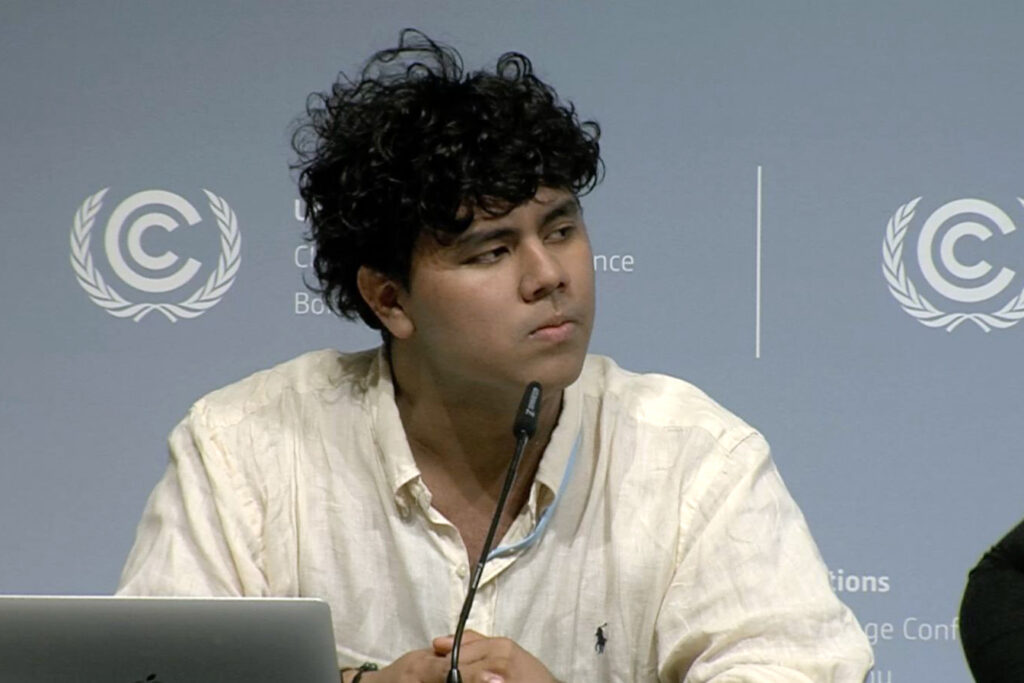
Mariana Terán Ramirez, a Colombian lawyer and climate activist, said in a written statement that a de la Espriella presidency will increase pressure on, and conflict in, communities that have resisted fossil fuel development for years.
“My concern is not only the environmental impacts of fracking itself, but also the possibility that community voices and democratic participation could be marginalized in the process,” she said.
Terán Ramirez and other activists emphasized that Colombia is already experiencing climate-intensified droughts, floods and other extreme weather events.
“The decisions made in the coming years will have real consequences for millions of people,” Terán Ramirez said. “Climate change is not an ideological issue.”
Earlier this month, a group of Colombian activists, Indigenous representatives and climate policy experts called on their government to reject fracking regardless of the election’s outcome.
Among them was Arhuaco Indigenous leader Dwirunney Torres, who said that communities on the front lines of extractive development see the issue as one of survival rather than politics.
“Our territories are not sacrifice zones,” said Torres, who is based in Colombia’s Sierra Nevada. “Fracking destroys water, destroys land, destroys people.”
De la Espriella’s apparent ascent to the presidency comes as the Trump administration intensifies a U.S. push to extract critical minerals from South America—a geopolitical pivot aided by business-friendly, deregulatory allies in power.
“The Trump Administration looks forward to working closely with your incoming administration to advance regional security cooperation, end illegal immigration to the United States, and strengthen our economic ties,” U.S. Secretary of State Marco Rubio said in a post on X Sunday evening.
This story is funded by readers like you.
Our nonprofit newsroom provides award-winning climate coverage free of charge and advertising. We rely on donations from readers like you to keep going. Please donate now to support our work.
A de la Espriella presidency would be the latest in a broader right-wing shift across the region, following the recent elections of José Antonio Kast in Chile, Rodrigo Paz in Bolivia and Nasry Asfura in Honduras. During his campaign, de la Espriella cast himself in the mold of other right-wing Latin American leaders like El Salvador’s Nayib Bukele and Argentina’s Javier Milei.
Beyond his pro-extractive policies, de la Espriella campaigned on a hardline security agenda, triggering alarm among civil society groups who warn that a regional pattern is emerging where environmental defense is being stigmatized and criminalized under the guise of national security. They point to Guatemala, where last year Indigenous leaders were arrested and charged with terrorism and sedition following peaceful community protests against mining and dam construction.
Ecuador is held up as another example. There, President Daniel Noboa’s administration has labeled more than 60 prominent Indigenous and anti-mining activists and organizations “terrorists” and opened criminal investigations into some of them.
As a candidate, de la Espriella pledged an aggressive military offensive against criminal groups.
“I will give the order to bomb all of the camps holding narco-terrorists,” he said in an interview in May. He’s also vowed to fumigate swaths of land to eradicate coca and to build “mega-prisons.”
While those proposals have resonated with voters frustrated by rising violence, environmental and human rights advocates worry de la Espriella’s militarized approach could further marginalize communities already struggling to make their voices heard in decisions about mining, oil and gas development.
“Threatening and criminalizing the protest—as we have seen in multiple far-right governments—builds public narratives that present environmental defenders as enemies of progress and creates conditions of impunity,” Cortés Valderrama said.
Amaya said environmental organizations need “channels for dialogue and the confidence that they can carry out their work without being stigmatized” and urged the incoming administration to recognize that environmental protection is not a partisan issue.
“Millions of Colombians voted for different visions of the country, and among them are many who cast their votes thinking about nature, climate action and environmental protection,” he said.
“Colombia belongs to all of us. Listen to those who think differently. Understand that protecting the environment is not the agenda of one political sector—it is a national responsibility.”
About This Story
Perhaps you noticed: This story, like all the news we publish, is free to read. That’s because Inside Climate News is a 501c3 nonprofit organization. We do not charge a subscription fee, lock our news behind a paywall, or clutter our website with ads. We make our news on climate and the environment freely available to you and anyone who wants it.
That’s not all. We also share our news for free with scores of other media organizations around the country. Many of them can’t afford to do environmental journalism of their own. We’ve built bureaus from coast to coast to report local stories, collaborate with local newsrooms and co-publish articles so that this vital work is shared as widely as possible.
Two of us launched ICN in 2007. Six years later we earned a Pulitzer Prize for National Reporting, and now we run the oldest and largest dedicated climate newsroom in the nation. We tell the story in all its complexity. We hold polluters accountable. We expose environmental injustice. We debunk misinformation. We scrutinize solutions and inspire action.
Donations from readers like you fund every aspect of what we do. If you don’t already, will you support our ongoing work, our reporting on the biggest crisis facing our planet, and help us reach even more readers in more places?
Please take a moment to make a tax-deductible donation. Every one of them makes a difference.
Thank you,