

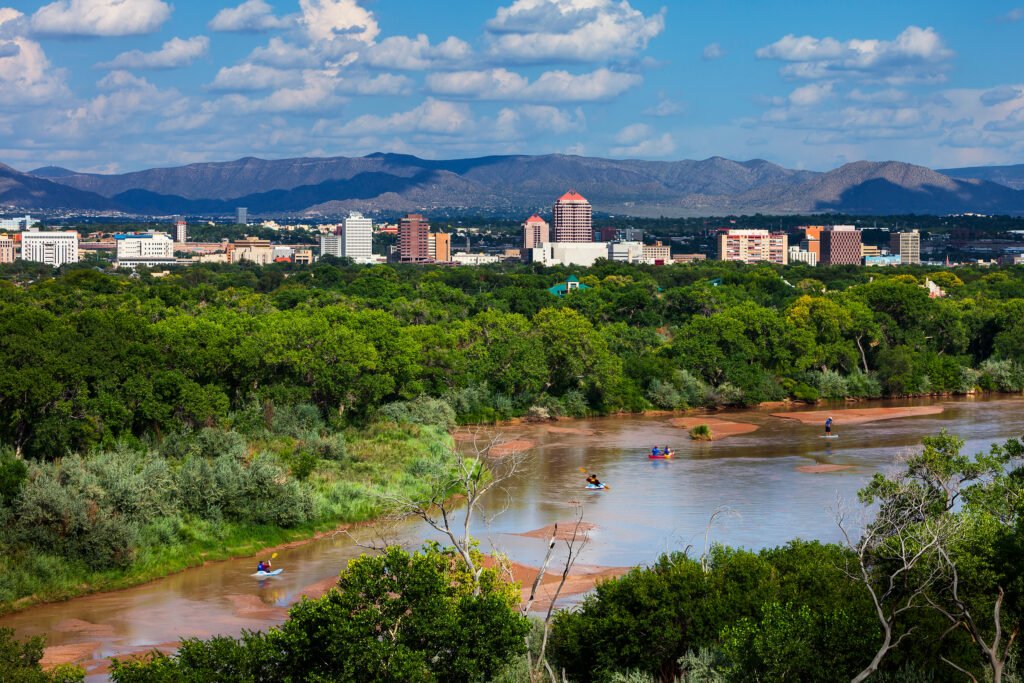
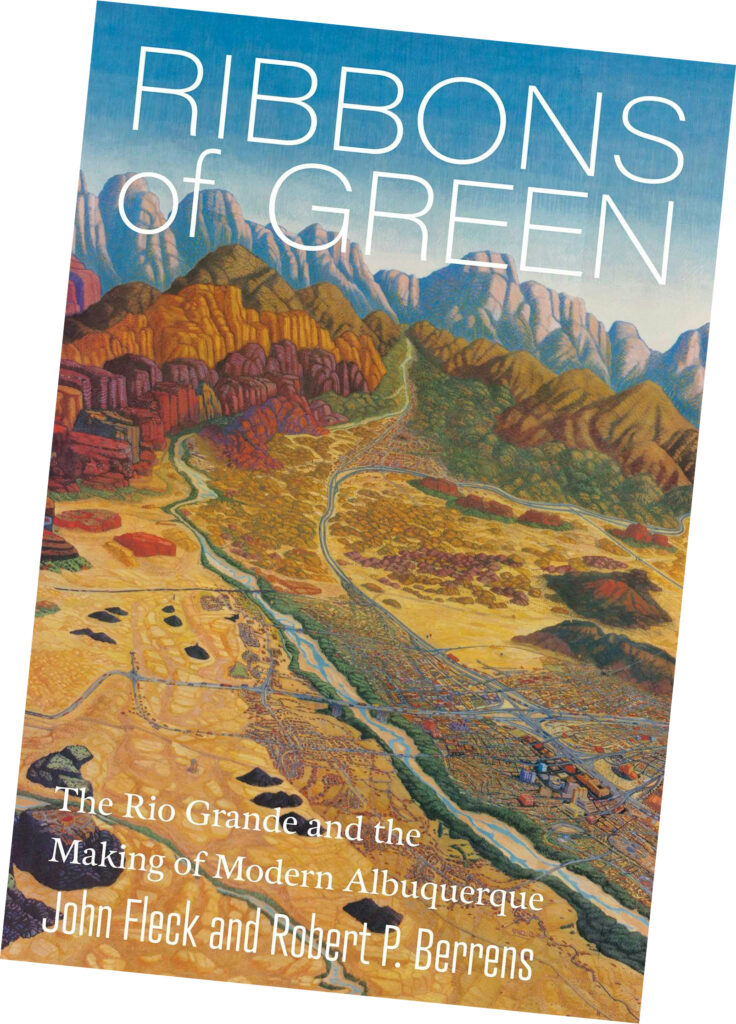
In “Ribbons of Green: The Rio Grande and the Making of Modern Albuquerque,” John Fleck and Robert P. Berrens explore Albuquerque’s relationship to the Rio Grande. The co-authors, collaborators at the University of New Mexico (UNM), chart the history of institutions that changed how residents relate to the river and its physical path through the valley. Fleck and Berrens explain how the Rio Grande was managed to allow “ribbons of green” to run through arid New Mexico.
Prolonged drought and climate change are straining water sources in New Mexico. This year, the Rio Grande is already running dry through Albuquerque.
Fleck, a longtime journalist who is now the writer in residence at UNM’s Utton Transboundary Resources Center, explained in an interview with Inside Climate News why he delved into the history of the Rio Grande. He said this history is instructive as less water flows through Albuquerque.
“Right now, in Albuquerque, we’re at a very similar juncture to where we were 100 years ago. Back then we had a flooding river, and we didn’t have the right institutions to deal with it,” he said. “Now, we have a drying river, and we don’t have the right institutions to deal with it.”
Ribbons of Green is available from University of New Mexico Press.
This interview has been edited for length and clarity.
MARTHA PSKOWSKI: You have written about the Colorado River and Western water issues for decades. Why did you and Robert Berrens decide to write this book about the Rio Grande?
JOHN FLECK: Bob and I have been teaching together for almost 15 years. We teach a class every fall for graduate students in the UNM Water Resources program. We focus our pedagogy on the importance of the institutions that we have created in our communities to manage water.
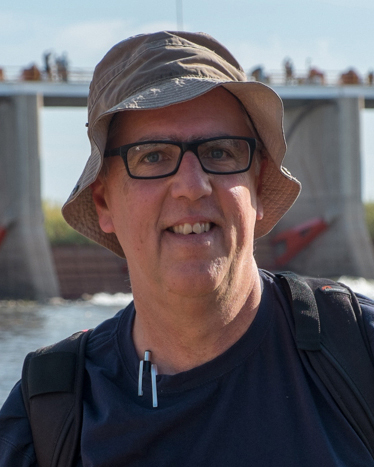
That’s where you come together as a community and decide, collectively, what’s our desired future and what are the things we need to do to get there? I wanted to do a book about how rules change landscapes.
Water is always one of the first problems that communities have to solve. How do we get water to our homes? How do we get rid of our waste? How do we protect ourselves from flooding so that we can build stable houses? How do we get irrigation water to the land?
We said, let’s take a deep dive and look at how Albuquerque did that. And in the course of doing that, how did that become the modern community?
PSKOWSKI: You worked for many years as a journalist, including at the Albuquerque Journal. How did you end up focusing on water and how communities manage water?
FLECK: I began my journalism career working in weekly and then daily newspapers in Southern California. I was working for the Pasadena Star News in Pasadena, California. I was on the city hall beat. Pasadena has its own water department. I was really interested in how communities come together to provide the shared public infrastructure that you need. I wondered, where does the water come from?
I realized that when you’re in a community, and you want to try to understand the nature and the structure of the community, you can always start with the water. Everybody has a water story, and everybody’s water story is integral to their origin story. I realized that early on as a journalist.
As I went through my journalistic career and then moved here to Albuquerque in 1990, I was super attentive to water as this fundamental sort of connective tissue and social fabric. Now I’ve been writing about water for 40 years.
PSKOWSKI: What is the Middle Rio Grande Conservancy District and how did it form?
FLECK: If you go back to the 1800s in what we now would call Albuquerque, you had one long, narrow river valley along the Rio Grande. It was a series of loosely connected but separate villages up and down the river. There were Native American communities and the first wave of colonization from Spanish communities. People grew their own food.
In 1880, the railroad arrived, and the population started growing rapidly. To build a city, rather than a series of separate villages, you needed to manage the river. Where we had built all these villages was in the floodplain of the river. Villages would be flooded out routinely.
People cast around for a long time trying to figure out how to build an institution that would have the capability to build the levees. We were also having rising water tables that needed to be drained. We needed to build these big ditches that lower the water table. You needed to create a government agency that would do this, that had the powers to do this, that had the ability to raise money.
They created the Middle Rio Grande Conservancy District. The notion of modern Albuquerque emerged from the act of solving this water problem. Instead of 20, 40 individual villages with their individual ditches, we were starting to think collectively as one big community.
PSKOWSKI: I loved learning about the historical figures in the book, like Max Gutierrez [a farmer who at first supported the creation of the Conservancy District and later opposed the taxation it imposed on his community]. How did you conduct the research? Were you going through old newspapers?
FLECK: I really want to focus on the bike rides! I have a friend I ride with every Sunday on the valley floor. My friend, Scot Key, is a retired middle school teacher and really interested in community history.
I asked him one time, Scot, what were the farmers thinking back then in the 1920s? He’s the one who found Max Gutierrez. We used newspapers.com and found all the old places where Max lived and we found his gravestone in the Mount Calvary Cemetery, which I now visit at least once a year.
It was about attaching the specifics of history to places on the landscape and moving back and forth in time. We made connections with the folks at the Conservancy District. They have this amazing collection of these insanely detailed old maps of the valley floor a century ago.
As a newspaper guy, I just was so fond of those old newspaper people back in the 1920s. They were writing everything! Like, who’s playing bridge with who. Then Bob [Berrens], my co-author, is just a brilliant researcher in the academic literature as well a master of census data. We would find a name on the map, in the newspaper article, and Bob would dig into the old census records. We would piece together family trees.
Part of it was that there were stories that are commonly told about the history of Albuquerque that didn’t quite ring true to us. That’s my journalistic instinct to just be skeptical of all the common narratives and find ways to test them.
PSKOWSKI: Agriculture in the Middle Rio Grande is quite different from other parts of the basin. How do you think about the role of agriculture in the region?
FLECK: Agriculture is one of the most interesting pieces of the climate change puzzle that we need to solve going forward. If you look at the history of agriculture in the Middle Rio Grande Valley, this region was never terribly good farmland. Over and over again, people thought, if we can just get this commercial crop going, that will be an economic engine. It will provide tax revenues.
But it never worked. What we are left with is this vestigial cultural agriculture. We have all these small parcels that are culturally important. They’re part of the fabric of the community. As a community, we’re really attached to them.
People sometimes pejoratively call it hobby farming. I prefer custom and culture farming. In these neighborhoods there will be a five-acre alfalfa farm, and there will be one guy in the neighborhood who’s got a harvester and cuts everybody’s hay for them. They put them in small bales and they’re mostly sold to other people in the neighborhood for their horses.
This story is funded by readers like you.
Our nonprofit newsroom provides award-winning climate coverage free of charge and advertising. We rely on donations from readers like you to keep going. Please donate now to support our work.
A great advantage we have is that the income from crops is not central to the economy of the valley. When there is less water, we irrigate less. It becomes a sort of resilience buffer. The fields are getting really brown right now because we’re having a really bad year. Everybody’s sort of waiting it out for the summer rains.
As we’re thinking about adapting to the reality that there’s less water, that means we’re going to have less green stuff. How do we allocate the distribution of green?
PSKOWSKI: You recently wrote on your blog about the paradox of having a “well-tended bosque and a river at its heart going dry.” [The bosque is the riparian corridor along the Rio Grande.] How do you see these decisions playing out today as water is increasingly scarce?
FLECK: We have spent all this time thinking deeply about how we ended up with the institutions we have today. The question going forward is, do we have the right institutional mix and the right rules of operation and government agencies to use those rules to solve this next set of problems?
Right now, in Albuquerque, we’re at a very similar juncture to where we were 100 years ago. Back then we had a flooding river and we didn’t have the right institutions to deal with it. Now, we have a drying river, and we don’t have the right institutions to deal with it.
The institutions that we developed over the last century were designed to remove water from the ground or the river, and move it onto landscapes to benefit human desires. We take water out and make stuff green. We’ve designed institutions that are really good at doing that.
But we do not have the tools to leave water in the river or to put water in different places than we put it now. We do not have the tools to allocate scarcity, in the same way that we have tools to create scarcity. We have gotten by in the Middle Rio Grande Valley for years. But we’ve gotten by because there was always enough water to keep the river flowing through Albuquerque and have all our green stuff, too.
Starting in 2022, we started to see river drying commonly in Albuquerque. This is a phenomenon that’s been going on for years south of Albuquerque. But it hasn’t happened here.
By some measures on the Rio Grande, where I am, it’s the driest year since we began measuring in the late 1800s. The river’s dry right now in the middle of my town. This is horrifying to me. Over the weekend, my wife and I went for a long walk in the bed of the Rio Grande, and our feet did not get muddy.
The only way to have water in that river channel is to stop taking so much out and using it in these other places. We built a set of institutions around the old availability of water that right now don’t seem to have the adaptive capacity to do the new stuff. I think there are ways we can try to achieve these multiple goals. But we don’t have a framework for having that conversation.
We came together as a community a century ago, because we didn’t have the institutions. We needed to achieve our desired future conditions. Maybe we need to do that now in some new way. What that looks like, that’s what I am working on and thinking about a lot right now. So I should write another book.
PSKOWSKI: Your book looks at institutions in Albuquerque, which connect with larger institutions, whether the Bureau of Reclamation or New Mexico’s compact commitments to other states. In this moment, how prepared are we to adapt, collectively?
FLECK: I’ve worked a lot on the Colorado River basin. I’m frustrated with the governance at these larger scales. I have made my arguments for what I think we ought to be doing, in terms of the need for collaborative governance to adapt to climate change. For whatever reason, on the Colorado River, the people running the show have chosen a different path. I think they’re on the wrong path. I wish them well. I’ve said what I think needs to be done.
But I think the action ultimately comes down to much more local levels. Because each community is going to have to figure out how to use less water. If we do it well, the cuts required will be more modest. If we do it poorly, it’s entirely possible that some communities could suffer and have to deal with draconian cuts. We have to build the kind of institutional structures to solve this new set of problems.
I’m here in Albuquerque. What is it that we can do to have the best possible future for the community that I love? That’s where the action is. Ultimately all climate adaptation comes down to local action.
About This Story
Perhaps you noticed: This story, like all the news we publish, is free to read. That’s because Inside Climate News is a 501c3 nonprofit organization. We do not charge a subscription fee, lock our news behind a paywall, or clutter our website with ads. We make our news on climate and the environment freely available to you and anyone who wants it.
That’s not all. We also share our news for free with scores of other media organizations around the country. Many of them can’t afford to do environmental journalism of their own. We’ve built bureaus from coast to coast to report local stories, collaborate with local newsrooms and co-publish articles so that this vital work is shared as widely as possible.
Two of us launched ICN in 2007. Six years later we earned a Pulitzer Prize for National Reporting, and now we run the oldest and largest dedicated climate newsroom in the nation. We tell the story in all its complexity. We hold polluters accountable. We expose environmental injustice. We debunk misinformation. We scrutinize solutions and inspire action.
Donations from readers like you fund every aspect of what we do. If you don’t already, will you support our ongoing work, our reporting on the biggest crisis facing our planet, and help us reach even more readers in more places?
Please take a moment to make a tax-deductible donation. Every one of them makes a difference.
Thank you,

Reporter, El Paso, Texas
Martha Pskowski covers climate change and the environment in Texas from her base in El Paso. She was previously an environmental reporter at the El Paso Times. She began her career as a freelance journalist in Mexico, reporting for outlets including The Guardian and Yale E360. Martha has a B.A. in Environmental Studies from Hampshire College and a master’s degree in Journalism and Latin American Studies from New York University. She is a former Fulbright research fellow in Mexico. Martha can be reached on Signal at psskow.33.