

Close Menu

    Subscribe to Updates

    Get the latest news information from worldwide businesses.

    What's Hot

    Business News Today: Stock and Share Market News, Economy and Finance News, Sensex, Nifty, Global Market, NSE, BSE Live IPO News

    May 11, 2026

    How long can the Voyager probes keep exploring interstellar space? NASA gearing up for ‘Big Bang’ maneuver to boost dwindling power levels

    May 11, 2026

    US government increases AI suppliers and rethinks Anthropic’s role

    May 11, 2026
    Facebook Instagram YouTube LinkedIn X (Twitter)
    Trending
    • Business News Today: Stock and Share Market News, Economy and Finance News, Sensex, Nifty, Global Market, NSE, BSE Live IPO News
    • How long can the Voyager probes keep exploring interstellar space? NASA gearing up for ‘Big Bang’ maneuver to boost dwindling power levels
    • US government increases AI suppliers and rethinks Anthropic’s role
    • AI just discovered new physics in the fourth state of matter
    • Another setback for AAP: Punjab CM Bhagwant Mann’s cousin Gyan Singh Mann joins BJP ahead of polls | India News
    • Venmo’s biggest makeover in years comes at a very interesting time
    • No Evidence of Spread in India After Hantavirus Cases on Cruise Ship: ICMR-NIV
    • Scientists stunned as volcano cloud destroys methane in the atmosphere
    Newspublicly
    • About Us
    • Advertise & Partner with us
    • Pitch Your Story
    • Contact Us
    Facebook Instagram LinkedIn X (Twitter)
    Subscribe
    • Home
    • World News
      • Asia
      • India
      • USA
      • UK & Europe
      • Middle East
    • Economy & Business
      • Global Economy
      • Corporate & Industry
      • Finance & Markets
      • Policy & Trade
    • Technology
      • Gadgets & Devices
      • Software & Apps
      • AI & Machine Learning
      • Robotics & Automation
    • Health & Medicine
      • Fitness & Nutrition
      • Research & Innovation
      • Disease & Treatment
      • Doctors, Clinics & Patient Care
    • Travel & Tourism
    • Automobile
      • Electric & Hybrid Vehicles
      • Auto Industry Insights
    • Sports
    • More
      • Education
      • Real Estate
      • Environment & Climate
      • Space & Astronomy
      • War & Conflicts
    Newspublicly
    Home»Technology»Robotics & Automation»Scientists built a memory chip that breaks the rules of miniaturization
    Robotics & Automation

    Scientists built a memory chip that breaks the rules of miniaturization

    Divya SharmaBy Divya SharmaMay 11, 2026No Comments3 Mins Read0 Views
    Share
    Facebook Twitter LinkedIn Copy Link WhatsApp


    Have you ever felt your smartphone heat up after heavy use or watched the battery drop at the worst possible moment? A big reason is the electronic circuits and memory inside the device, which consume energy and release heat as they operate.

    At the most basic level, computer memory stores information as 0s and 1s by controlling how easily electricity can pass through a material. If scientists can design memory that requires far less electricity, it could dramatically reduce the energy demands of phones, computers, and other electronics.

    A New Approach to Low Power Memory

    One idea aimed at solving this problem dates back to 1971, when researchers proposed the ferroelectric tunnel junction (FTJ). This type of memory depends on ferroelectricity, a property in which a material’s internal electric polarization can be switched. When this polarization changes, it affects how easily current flows, allowing the device to store data.

    Despite its promise, traditional materials used for this type of memory struggled as devices were scaled down. Performance often dropped as components became smaller, limiting how far the technology could go.

    Hafnium Oxide Enables Ultra Small Memory

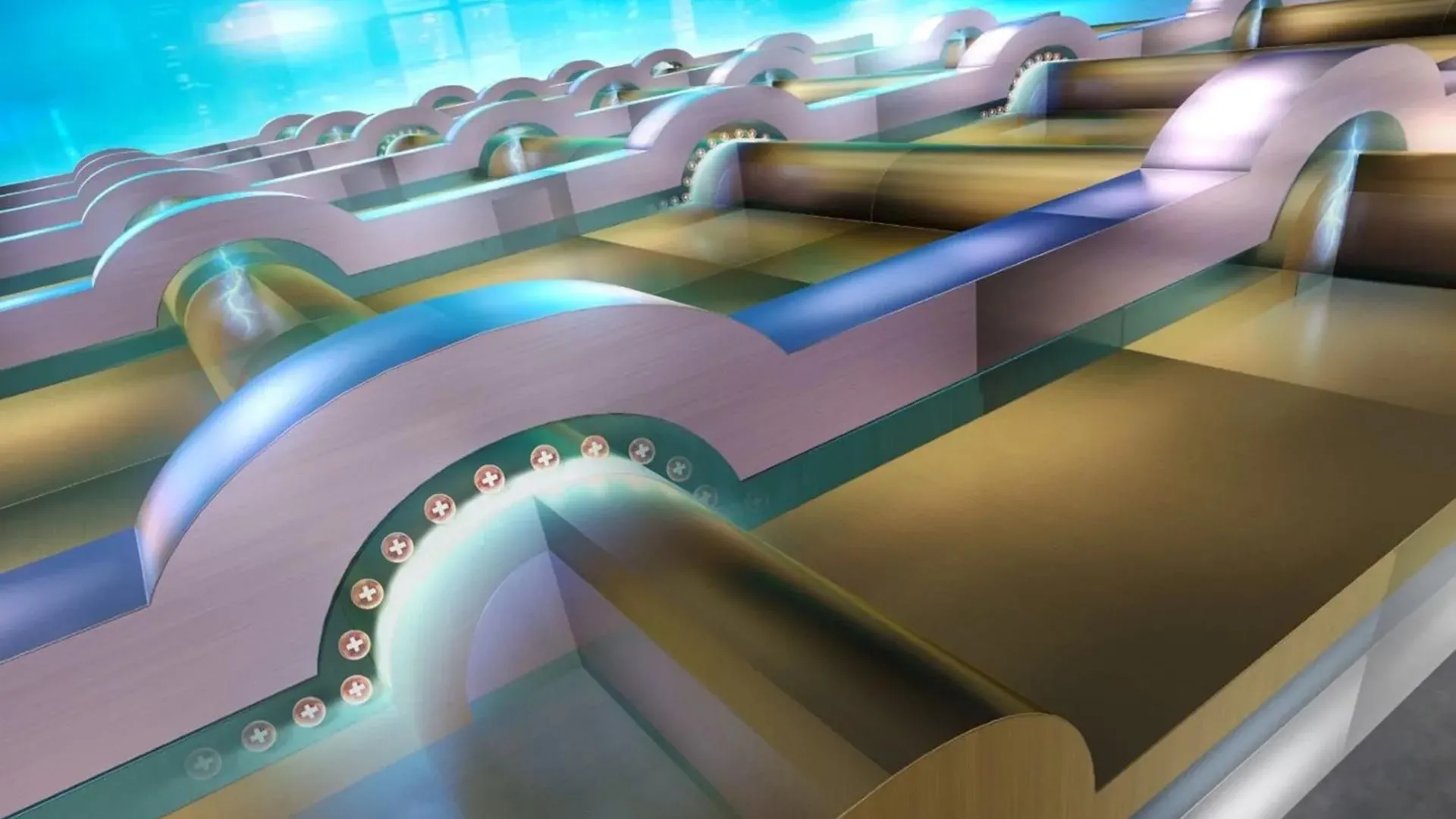
    A key advance came in 2011, when scientists discovered that hafnium oxide, a widely used material, could retain its electric polarization even when extremely thin. Building on this finding, Professor Yutaka Majima and his team at the Institute of Science Tokyo (Science Tokyo) set out to develop an extremely small memory device measuring just 25 nanometers across, roughly one three-thousandth the thickness of a human hair.

    Solving Leakage at the Nanoscale

    Shrinking memory to this scale introduces a major challenge. Electrical current tends to leak through the boundaries between tiny crystals in the material, which has long prevented further miniaturization.

    Instead of trying to avoid this issue, the researchers took a different approach. They made the device even smaller, which reduced the impact of those crystal boundaries.

    They also developed a new fabrication method by heating the electrodes so they naturally formed a semicircular shape. This design created a structure closer to a single crystal, meaning there were fewer boundaries where leakage could occur.

    A Breakthrough Where Smaller Means Better

    By combining this structural design with extreme miniaturization, the team achieved high performance in their device. More importantly, they demonstrated something unexpected. The memory actually performs better as it becomes smaller, overturning a long-held assumption in electronics.

    What This Means for Future Devices

    If this technology is brought into real-world use, it could have wide-reaching effects. Devices like smartwatches could run for months on a single charge, and networks of connected sensors might operate without needing frequent battery replacements.

    In artificial intelligence (AI), this type of memory could support faster processing while using far less energy. Because hafnium oxide is already compatible with existing semiconductor manufacturing, integrating this new memory into everyday electronics could happen relatively quickly.

    Comment from the researcher

    Challenging what seem to be the limits of science — such as ‘we cannot make things any smaller’ or ‘they will break if we do’ — is like walking in the dark. It is a continuous struggle. However, by questioning traditional assumptions and exploring new ways to overcome these barriers, we were able to discover an entirely new perspective. I would be delighted if this achievement sparks the curiosity of young people who will shape the future and helps build a better world. — Yutaka Majima, Professor, Materials and Structures Laboratory, Institute of Integrated Research, Institute of Science Tokyo.


    Source link

    Divya Sharma
    • Website

    Divya Sharma is a content writer at NewsPublicly.com, creating SEO-focused articles on travel, lifestyle, and digital trends.

    Related Posts

    AI just discovered new physics in the fourth state of matter

    May 11, 2026

    This AI knew the answers but didn’t understand the questions

    May 11, 2026

    Powerful AI finds 100+ hidden planets in NASA data including rare and extreme worlds

    May 11, 2026
    Leave A Reply Cancel Reply

    Demo
    Top Posts

    “Inside Gemini Robotics 1.5: How Robots Learn to Reason & Act

    November 22, 202524 Views

    How US Tariffs Are Reshaping the Global Growth Landscape?

    November 21, 202518 Views

    Pakistani Journalist Laughing at Tejas Fighter Jet Crash at Dubai Airshow Sparks Massive Outrage Worldwide

    November 23, 202517 Views

    Vibe-Coding Boom: How Non-Coders Build Apps With AI Agents

    November 22, 202515 Views
    Don't Miss

    Business News Today: Stock and Share Market News, Economy and Finance News, Sensex, Nifty, Global Market, NSE, BSE Live IPO News

    May 11, 20261 Min Read0 Views

    Copyright © Network18 Media & Investments Limited. All rights reserved. Reproduction of news articles, photos,…

    How long can the Voyager probes keep exploring interstellar space? NASA gearing up for ‘Big Bang’ maneuver to boost dwindling power levels

    May 11, 2026

    US government increases AI suppliers and rethinks Anthropic’s role

    May 11, 2026

    AI just discovered new physics in the fourth state of matter

    May 11, 2026
    Stay In Touch
    • Facebook
    • Twitter
    • Instagram
    • YouTube
    • LinkedIn
    • WhatsApp

    Subscribe to Updates

    Get the latest creative news from SmartMag about art & design.

    Demo
    NEWSPUBLICLY
    Facebook X (Twitter) Instagram LinkedIn

    Home

    • About Us
    • Leadership & Certification
    • Advertise & Partner With Us
    • Pitch Your Story
    • Media Kit & Pricing
    • Career
    • FAQs

    Guidelines

    • Editorial & Submission
    • Partnership
    • Advertising & Sponsor
    • Intellectual Property Policy
    • Community & Comment
    • Security & Data Protection
    • Send Your Opinion

    Quick Links

    • Cookie Policy
    • Payment & Billing Terms
    • Refund & Cancellation
    • Copyright Policy
    • Complaint & Support
    • Sitemap
    • Contact Us

    Subscribe Us

    Get the latest news and updates!

    Copyright © 2026 Newspublicly (DIGITALIX COMMUNICATION). All Rights Reserved.
    • Privacy Policy
    • Terms of Use
    • Disclaimer