

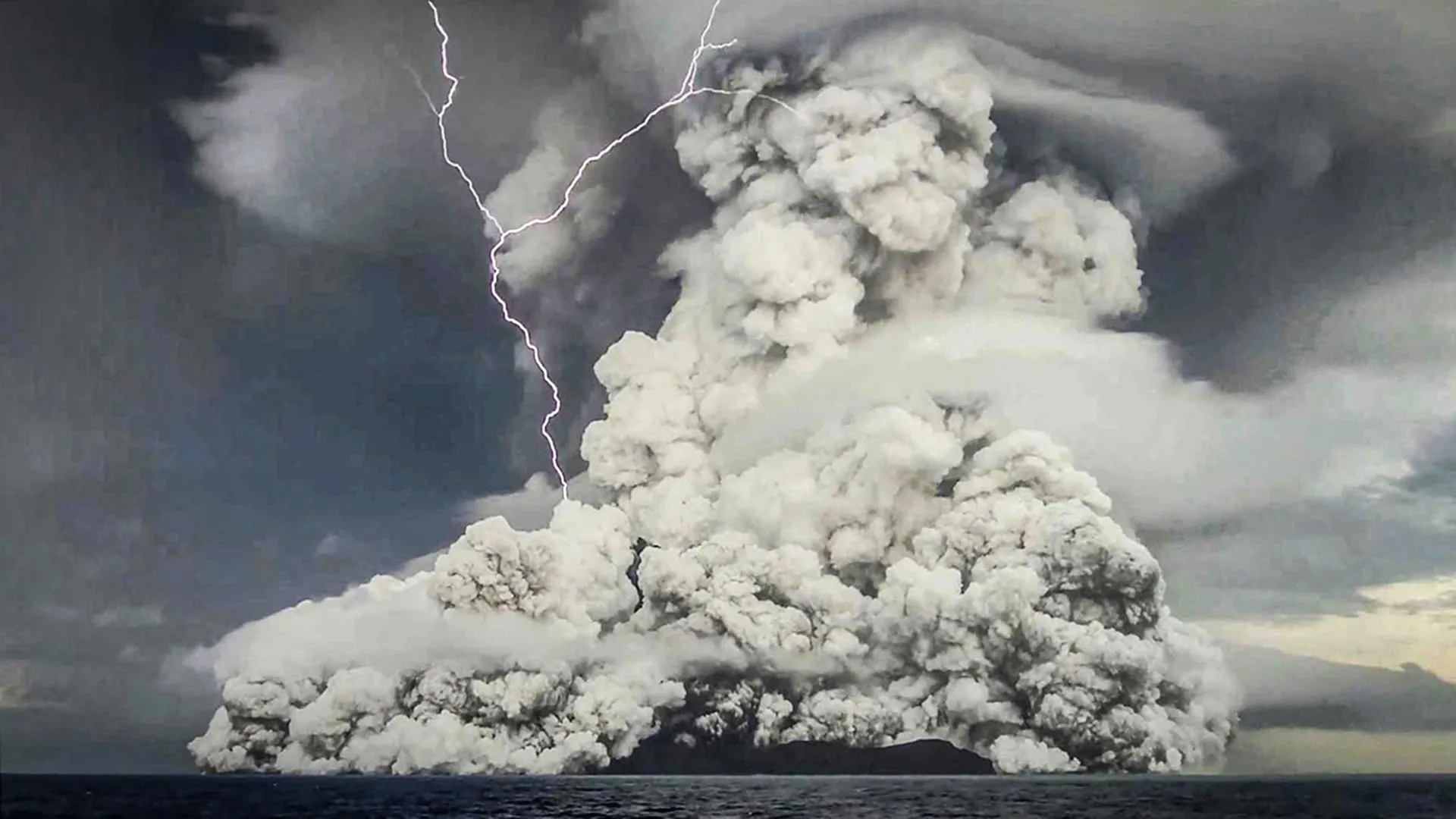
In January 2022, the underwater volcano Hunga Tonga-Hunga Ha’apai in the South Pacific produced one of the most powerful eruptions in modern history. But scientists have now discovered that the eruption also triggered an unexpected atmospheric reaction that partially removed methane, a potent greenhouse gas, from the air. Researchers say the finding could eventually help scientists develop new strategies to slow global warming.
Using satellite observations, scientists detected unusually high levels of formaldehyde inside the enormous volcanic plume created by the eruption. That discovery immediately caught their attention because formaldehyde is produced when methane breaks down in the atmosphere.
“When we analyzed the satellite images, we were surprised to see a cloud with a record-high concentration of formaldehyde. We were able to track the cloud for 10 days, all the way to South America. Because formaldehyde only exists for a few hours, this showed that the cloud must have been destroying methane continuously for more than a week,” explains Dr. Maarten van Herpen from Acacia Impact Innovation BV, first author of the study, which has just been published in Nature Communications.
“It is known that volcanoes emit methane during eruptions, but until now it was not known that volcanic ash is also capable of partially cleaning up this pollution,” he adds.
Volcano Ash, Sea Salt, and Sunlight Triggered Chemical Reaction
The researchers believe the eruption activated a rare chemical process that they had previously identified in an entirely different environment.
In earlier research published in 2023, scientists discovered that dust blowing from the Sahara Desert across the Atlantic Ocean can combine with salt from sea spray to create tiny particles called iron salt aerosols. When sunlight strikes these particles, chlorine atoms are released. Those chlorine atoms react with methane and help break it apart in the atmosphere. The discovery significantly changed scientists’ understanding of atmospheric chemistry in the troposphere.
“What is new — and completely surprising — is that the same mechanism appears to occur in a volcanic plume high up in the stratosphere, where the physical conditions are entirely different,” says Professor Matthew Johnson from the Department of Chemistry at the University of Copenhagen, one of the researchers behind both discoveries.
During the Tonga eruption, massive amounts of salty seawater were blasted into the stratosphere together with volcanic ash. Researchers think sunlight interacting with this mixture created highly reactive chlorine that then helped destroy methane released during the eruption. The unusually high formaldehyde levels detected by satellites served as evidence that methane breakdown was taking place.
Scientists Say Global Methane Estimates May Need Revision
The discovery also suggests that scientists may need to rethink the global methane budget, which estimates how much methane enters and leaves Earth’s atmosphere.
“We now know that atmospheric dust — for example from a volcanic eruption — impacts the methane budget, meaning the budget of how much methane is added to the atmosphere and how much is removed. Because dust has not previously been taken into account, it is important that we correct the data on which these estimates are based,” says Matthew Johnson.
Why Methane Matters for Climate Change
Methane is responsible for about one third of current global warming. Over a 20-year period, methane traps roughly 80 times more heat than CO2. Unlike carbon dioxide, however, methane does not remain in the atmosphere for centuries. It typically breaks down within about 10 years.
Because methane has a shorter atmospheric lifetime, reducing methane pollution could produce climate benefits relatively quickly. Scientists sometimes describe methane reduction as an “emergency brake” for climate change because lowering methane levels could help slow warming within the next decade and potentially reduce the risk of climate tipping points. Researchers stress, however, that cutting CO2 emissions remains critical for long-term climate stability.
Discovery Could Inspire Future Climate Technologies
The team says the findings may help advance efforts to artificially accelerate methane removal from the atmosphere. Scientists around the world are currently exploring several possible approaches, but accurately measuring methane removal has been a major challenge.
“How do you prove that methane has been removed from the atmosphere? How do you know your method works? It’s very difficult. But here we address that problem by showing that methane breakdown can in fact be observed using satellites,” says Dr. Jos de Laat from the Royal Netherlands Meteorological Institute, senior author of the study.
The research relied on the TROPOMI instrument aboard the European Space Agency’s Sentinel-5P satellite, which tracks greenhouse gases and air pollution around the globe every day.
“Retrieving formaldehyde from TROPOMI in a stratospheric volcanic plume is far outside the instrument’s standard operating conditions — we had to carefully correct the satellite’s sensitivity for the unusual altitude of the signal and account for interference from the high sulfur dioxide concentrations. Getting these corrections right was essential to confirm that what we were seeing was real,” said Dr. Isabelle De Smedt, Royal Belgian Institute for Space Aeronomy.
Researchers believe the discovery could eventually inspire practical engineering solutions aimed at reducing methane pollution.
“It’s an obvious idea for industry to try to replicate this natural phenomenon — but only if it can be proven to be safe and effective. Our satellite method could offer a way to help figure out how humans might slow global warming,” concludes Matthew Johnson.
About the Study
- Researchers estimate that the Tonga eruption released roughly 300 gigagrams (Gg) of methane, an amount comparable to the annual methane emissions produced by more than two million cows. At the same time, the volcanic plume removed about 900 megagrams (Mg) of methane per day, equal to the daily emissions from approximately two million cows.
- The study was published in Nature Communications.
- The research team included Maarten van Herpen (Acacia Impact Innovation BV, Netherlands); Isabelle De Smedt (Royal Belgian Institute for Space Aeronomy, Belgium); Daphne Meidan and Alfonso Saiz-Lopez (CSIC, Spain); Matthew Johnson (University of Copenhagen, Denmark); Thomas Röckmann (Utrecht University, Netherlands); and Jos de Laat (Royal Netherlands Meteorological Institute, Netherlands).
- The work was supported by Spark Climate Solutions.