

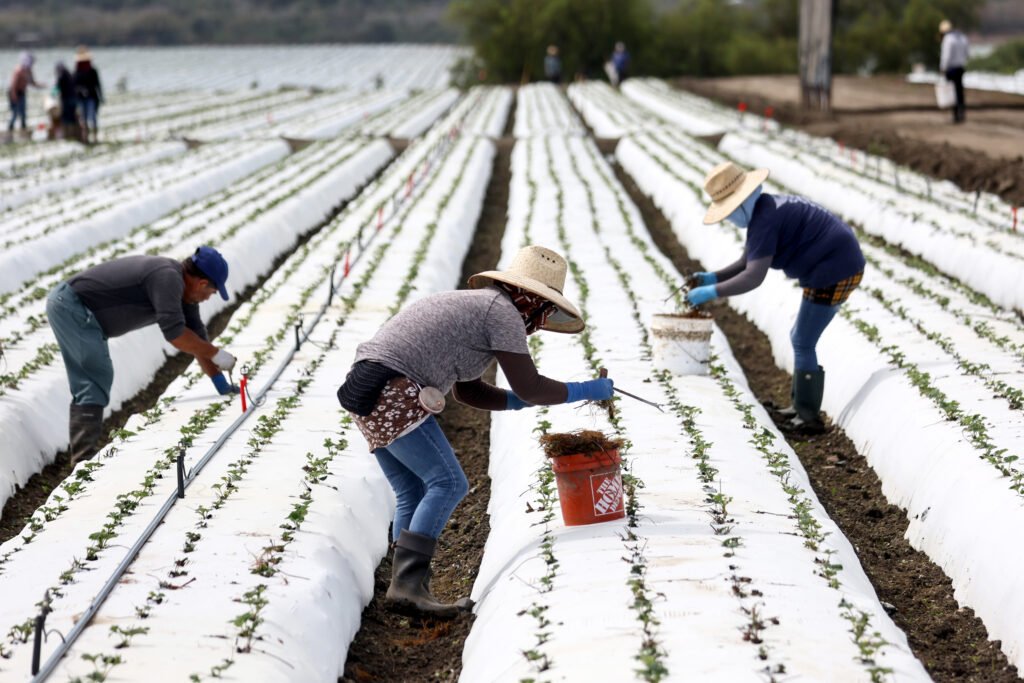
Farmers have relied on plastic since the 1960s, when the mass production of affordable agricultural tools derived from petrochemicals made them widely accessible. Plastic mulch quickly became a cornerstone of crop production, helping farmers boost yields of everything from corn to tomatoes by stabilizing soil temperature and controlling diseases and weeds with fewer pesticides.
Now scientists and policymakers are struggling to preserve the benefits of farmers’ dependence on plastic—dubbed “plasticulture”—while mitigating a growing litany of environmental costs.
“How do you balance the use of this technology that has completely revolutionized agriculture with the environmental concerns that arise from that?” asked Jazmine Mejia-Muñoz, a water quality program manager at the nonprofit California Marine Sanctuary Foundation, at a recent briefing on plasticulture hosted by California State University’s Council on Ocean Affairs, Science & Technology.
The marine sanctuary foundation works with agricultural stakeholders to prevent plastic materials from draining into the bay and ocean. The goal is to protect waterways while retaining plastics’ agricultural benefits, Mejia-Muñoz said.
Plastic production has skyrocketed, from about 2 million tons in 1950 to 460 million tons in 2019, and is expected to triple by 2060. Nearly all plastic is made from oil and gas. Extracting and refining fossil fuels to make plastic polymers releases climate-warming pollutants and perpetuates the demand for oil and gas as other sectors transition to renewable fuels.
Once in the environment, a dizzying array of agricultural plastics—irrigation drip tape, fertilizer sacks, greenhouses and tunnels, shade nets, pesticide containers and mulching films, to name a few—fragment into “microplastics” that accumulate in soils, contaminate waterways as runoff and escape into the air.
By 2017, scientists realized that plastic pollution, long recognized as a major threat to marine ecosystems, may be contaminating lands in far greater volumes, partly due to agricultural debris.
“Globally we’re using over 12.5 million metric tons of agricultural plastics annually,” said Seeta Sistla, a soil ecologist at California Polytechnic State University, San Luis Obispo, at the briefing. “This is probably an underestimate.”
Glimmering Fields of Plastic
Drive through any agricultural region in California and you’ll likely see fields glimmering in the sun, Sistla said. “That glimmering is actually plastic that’s laid down on soils and used as a mulch in lieu of natural organic mulches that were used historically.”
Once plastic mulch is spread across soil, it starts to fragment, leaving microplastics in soil when films are removed from fields.
“More and more plastics get left behind as more and more field seasons of single-use plastic come and go,” Sistla said, adding that sludge, biowaste and fertilizers also deposit microplastics.
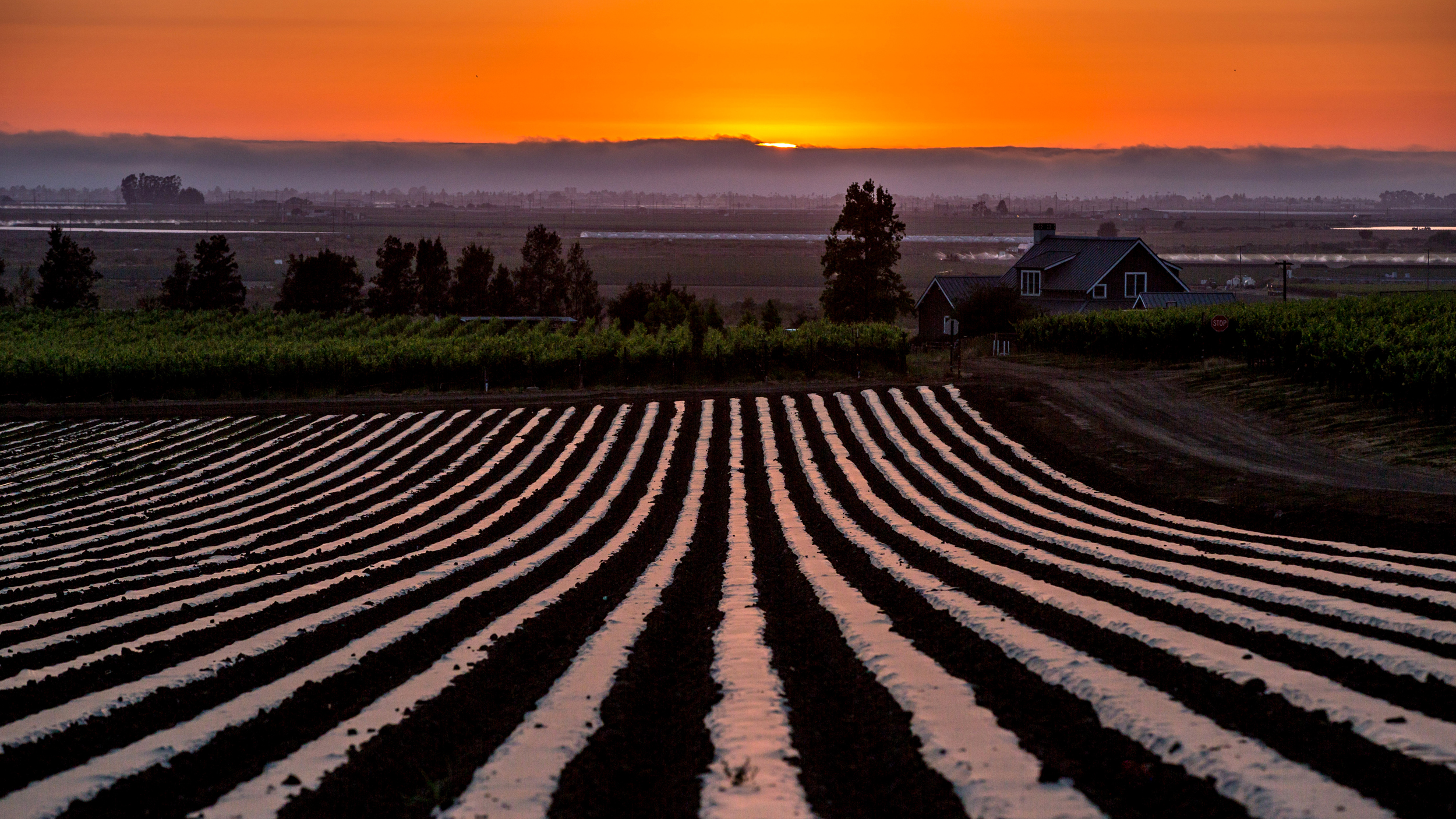
Mejia-Muñoz and her colleagues determined in 2019 that Monterey County growers used nearly 8 million pounds of plastic mulch, mostly on strawberries, every year. The team monitored plastic debris in stream banks near fields that could drain into the Monterey Bay and traced more than 80 percent of the plastic back to mulch.
They started looking into biodegradable alternatives and found a product certified to biodegrade within two years that farmers could presumably till back into the soil after the growing season.
But when Mejia-Muñoz and her colleagues tested the product in California, Washington, Nebraska and Florida, they found several limitations.
The plastic can actually take up to six years to biodegrade, she said, and may shed even smaller bits of debris called nanoplastics. One solution might be to deploy stronger materials that can be lifted more easily with machines, which California strawberry growers are starting to adopt at no extra cost, Mejia-Muñoz said.
This story is funded by readers like you.
Our nonprofit newsroom provides award-winning climate coverage free of charge and advertising. We rely on donations from readers like you to keep going. Please donate now to support our work.
Inside Climate News asked the California Farm Bureau and Western Growers Association, which represent agricultural interests, to comment on efforts to reduce plastic in agriculture but received no response.
Norm Groot, executive director of the Monterey County Farm Bureau, has acknowledged concerns about the use of agricultural plastics. He said the bureau supports the marine sanctuary foundation’s program to address plastic mulch in strawberry production.
As reliance on single-use plastics in agriculture has grown, so has the need to find ways to recycle the waste or divert it from landfills, particularly for mulch.
In China, which uses more plastic mulch than any other nation, scientists analyzed soil in fields across the country in a 2020 Global Change Biology study. Hundreds of thousands of tons of plastic residue had accumulated in soils and reduced cotton yields, they reported.
China’s story sounds the alarm for the use of plastic film in other developing countries, the authors warned.
Sistla wondered if the same thing was happening in California. She and her team sampled fields in the state’s coastal agricultural regions to measure macro- and microplastics in soils and found more than 215,000 pieces of plastic per hectare (about 87,000 per acre), even in fields where growers had tried to remove plastic. Echoing the Chinese study, they also found that higher concentrations of plastics lowered the levels of crop-nourishing soil nutrients.
Clearly, Sistla said, agricultural plastics are contaminating the food supply.
As plastic particles accumulate in croplands, so do the thousands of chemicals added to confer color, strength and other properties. Hardly any of these chemicals have undergone safety or toxicity testing.
Studies show that plants can absorb microplastics through their tissues. But scientists don’t know how much of this plastic people ingest or how it’s affecting health.
The consequences are not well understood because the threat is so novel, Sistla said. But to be safe, she added, “I would rather err on the side of not consuming plastic that’s being taken up by plants.”
That’s why experts like Sistla and Mejia-Muñoz say it’s so important to develop biologically based, biodegradable alternatives to plastic that don’t compromise productivity. A few promising alternatives include using organic materials like paper and wood fiber and mixing them with water to suppress weeds.
Instituting major changes across California’s $60 billion agricultural industry, Sistla said, will require help from legislators.
“I encourage our Legislature to really think about how do we stop the inputs, or reduce the inputs in meaningful ways, and remediate places where there are hotspots of plastic contamination already,” she said.
Although microplastics have gotten the most attention, she said, the problem starts with the widespread reliance on plastic in general.
Scientifically it’s “interesting” to try to understand the pathway of micro- and nanoplastics in organisms beyond soils, Sistla said. But pragmatically and practically, she added, “we need to control the input of the larger plastic debris. Period.”
About This Story
Perhaps you noticed: This story, like all the news we publish, is free to read. That’s because Inside Climate News is a 501c3 nonprofit organization. We do not charge a subscription fee, lock our news behind a paywall, or clutter our website with ads. We make our news on climate and the environment freely available to you and anyone who wants it.
That’s not all. We also share our news for free with scores of other media organizations around the country. Many of them can’t afford to do environmental journalism of their own. We’ve built bureaus from coast to coast to report local stories, collaborate with local newsrooms and co-publish articles so that this vital work is shared as widely as possible.
Two of us launched ICN in 2007. Six years later we earned a Pulitzer Prize for National Reporting, and now we run the oldest and largest dedicated climate newsroom in the nation. We tell the story in all its complexity. We hold polluters accountable. We expose environmental injustice. We debunk misinformation. We scrutinize solutions and inspire action.
Donations from readers like you fund every aspect of what we do. If you don’t already, will you support our ongoing work, our reporting on the biggest crisis facing our planet, and help us reach even more readers in more places?
Please take a moment to make a tax-deductible donation. Every one of them makes a difference.
Thank you,

Reporter, California
Liza Gross is a reporter for Inside Climate News based in Northern California. She is the author of The Science Writers’ Investigative Reporting Handbook and a contributor to The Science Writers’ Handbook, both funded by National Association of Science Writers’ Peggy Girshman Idea Grants. She has long covered science, conservation, agriculture, public and environmental health and justice with a focus on the misuse of science for private gain. Prior to joining ICN, she worked as a part-time magazine editor for the open-access journal PLOS Biology, a reporter for the Food & Environment Reporting Network and produced freelance stories for numerous national outlets, including The New York Times, The Washington Post, Discover and Mother Jones. Her work has won awards from the Association of Health Care Journalists, American Society of Journalists and Authors, Society of Professional Journalists NorCal and Association of Food Journalists.