

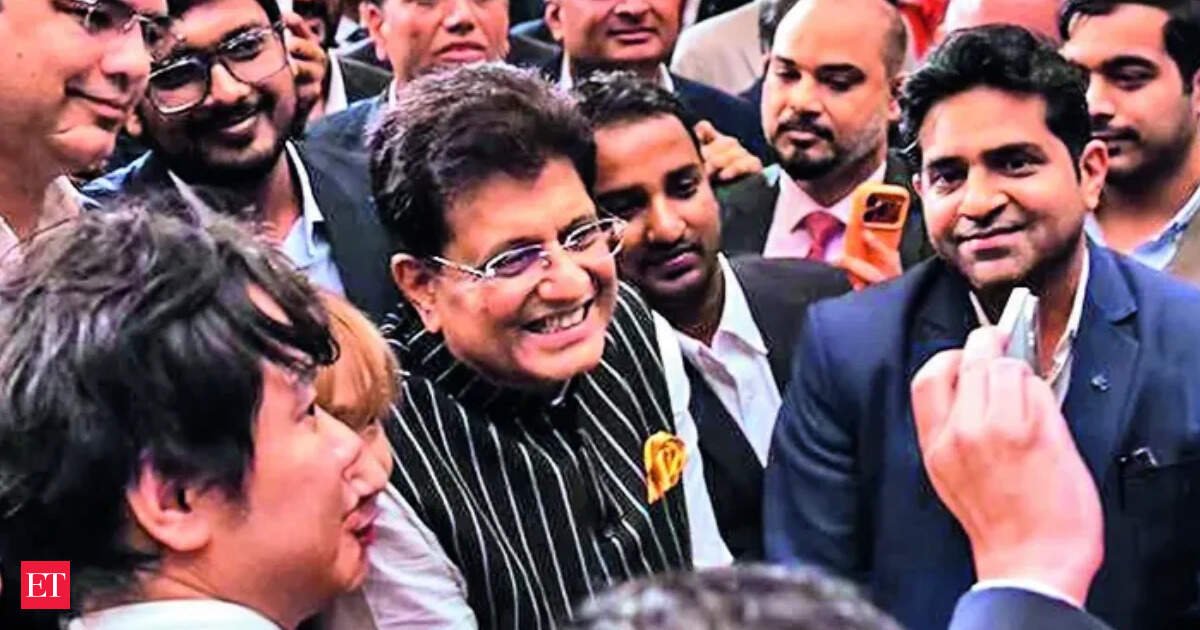
The minister was speaking at the end of his official visit to Japan, where he held a series of high-level engagements aimed at accelerating Japanese investment in India, strengthening industrial partnerships and expanding bilateral economic cooperation across emerging and strategic sectors. “Our focus is on process and procedures… there are very few sectors where FDI is restricted but we are open to ideas whatever industry demands… during these engagements here, new ideas have come up,” Goyal said.
Total FDI, including equity inflows, reinvested earnings and other capital, rose 17% year on year to $94.5 billion in FY26. “More importantly, there is tremendous scope to improve process and procedures to help faster flow of FDI and help give comfort to the investors… the fact that their investments will lead to production and productivity will be faster,” he said. On manufacturing, Goyal said his effort was to achieve end-to-end upstream and downstream indigenisation, along with businesses that are either operating in India or coming to India.
Citing the paint industry, which uses “billion dollars of imported titanium dioxide”, Goyal said the government is promoting domestic manufacturing of the compound. In semiconductors, too, the effort is to bring the entire value chain to India, rather than just design, assembly and testing. “Our effort is more and more going deep dive and self reliance,” he said, adding that he had asked the Bureau of Indian Standards to examine a new framework or create a new rule or regulation to help companies locate in India and bring high-tech production here. “So, such companies or products or value chains, we may consider giving an omnibus exemption from BIS,” Goyal said.

Also Read: India’s budget math brightens with asset sales target in sight
China tradeAsked about rejecting the idea of India being viewed merely as a “plus one” destination, Goyal said: “It’s not that we are dependent on people moving out of one geography”. India’s goods exports to China in April-July FY27 were $7.78 billion, up 35.97% year on year while imports were $52.71 billion, compared with $40.65 billion a year earlier. “When new technologies come and new (trade) relationships are made, then automatically the over-dependence on China will reduce,” he said.
Alternative routes
Goyal said Gulf countries were looking at their eastern shore and creating new routes from there, leading to the development of new pipelines and railway lines. “Some people are creating alternate routes. All our imports continue to come or exports continue to go from other routes, otherwise we wouldn’t have had such a fabulous performance in the first four months,” he said. India’s goods exports rose 15% year on year in the first three weeks of August to around $25 billion, an official said. Exports in April-August 21, 2026, are almost $200 billion. Goyal said “a lot of people are asking us to consider” India joining the 12-member Comprehensive and Progressive Agreement for Trans-Pacific Partnership (CPTPP), but “we have not yet really applied our mind”.