

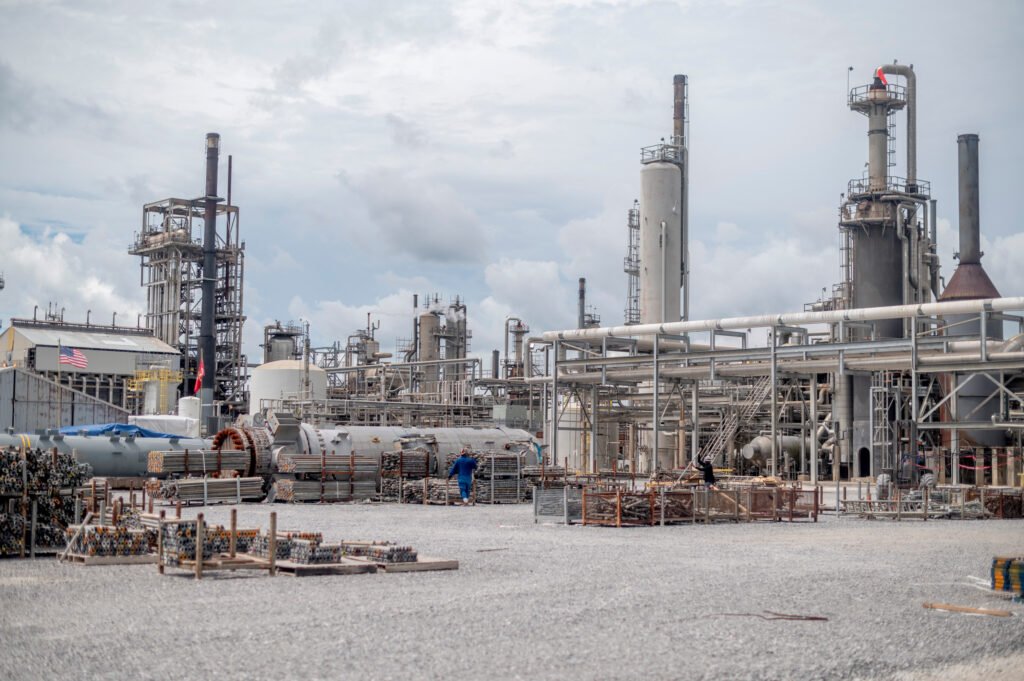
As farmers balk at skyrocketing fertilizer costs and runoff threatens drinking water sources in Iowa, North American manufacturers are raking in cash.
Illinois-based CF Industries and Canadian company Nutrien dominate the domestic market for nitrogen-based fertilizers. Together, the two corporations are responsible for 55 percent of U.S. fertilizer production. In recent years, they have seen massive increases in their profits, an analysis of their annual reports by environmental advocacy group Food & Water Watch notes.
“Industrial agriculture polluters are ruining Iowa’s water, driving our cancer crisis, and bleeding farmers dry—and they’re making billions doing it,” said Jennifer Breon, a senior organizer with Food & Water Watch, in a statement issued by the organization. “No one should be in the business of pollution.”
The group has been heavily involved in clean water advocacy in Iowa, where nitrate levels in surface waters routinely exceed federal drinking water limits. Nitrogen fertilizer that isn’t used by crops enters drinking water sources as toxic nitrate, posing both acute and long-term health risks.
From the first quarter of 2025 to the first quarter of 2026, CF Industries and Nutrien saw a combined 19 percent increase in total sales but a whopping 120 percent increase in net earnings. Neither company responded immediately to a request for comment on profit growth.
The amount of nitrogen fertilizer used to grow an acre of Midwest corn has climbed steadily for decades, research shows. Higher costs for diesel, seeds and fertilizer push farmers to maximize yields to break even on corn sold for livestock feed or ethanol production. But higher yields require more nutrients, creating a cycle where farmers become increasingly dependent on larger amounts of costly fertilizer.
In places like Iowa, which produces more corn than any other state, nutrient runoff and water pollution have worsened alongside increased fertilizer use.
Iowa’s largest water utility, Des Moines Water Works, spends $10,000 each day that it operates its state-of-the art nitrate-removal facility. So far in 2026, the plant has operated for nearly 200 days to keep drinking water below the legal nitrate limit, costing roughly $2 million.
“With the nitrate crisis at fever pitch, this research was in part born out of our organizers’ need to answer questions about the companies driving the pollution,” wrote Kat Ruane, the lead researcher for the Food & Water Watch report.
Closure of the Strait of Hormuz following U.S. airstrikes on Iran earlier this year wracked the global fertilizer market, with the Gulf region responsible for nearly a quarter of all nitrogen exports worldwide. According to the World Trade Organization (WTO), outbound fertilizer-related shipments through the Strait of Hormuz have remained close to zero since the conflict started.
North American producers, including CF Industries, have cited that disruption as a reason for the increase in fertilizer prices. However, the U.S. market is far less dependent on Gulf exports than many other countries, such as India, which sources nearly two-thirds of its nitrogen fertilizer from the region, and Thailand, which sources half. According to the WTO, about 16 percent of U.S. fertilizer imports come from the Persian Gulf, accounting for only about 4 percent of all fertilizer used in the country.
North American fertilizer manufacturers instead benefit from extensive local production infrastructure and a largely self-sufficient domestic supply of natural gas, the primary feedstock for nitrogen fertilizers.
Under President Donald Trump, American natural gas has received unprecedented federal support, with agencies pledging more than $4 billion to boost exports. The Trump U.S. Department of Agriculture has also announced $500 million to expand domestic fertilizer manufacturing and “improve long-term affordability for American farmers.”
Still, U.S. farmers are facing higher fertilizer prices and tighter margins. An April survey conducted by the American Farm Bureau Federation reported that nearly three-quarters of U.S. farmers were unable to afford all the fertilizer they needed.
Farmers were already struggling financially before the war in Iran, said Aaron Lehman, president of the Iowa Farmers Union. Rising fertilizer costs driven by the conflict, retaliatory tariffs and an industry controlled by just a few manufacturers have only compounded the strain, he said.
Meanwhile, CF Industries and Nutrien earned a combined $754 million in profit in the first quarter of 2026 alone, according to the companies’ financial reports.
“To see profits being pulled in by fertilizer companies, it feels like we’re being gouged at the worst possible time,” Lehman said.
Just four companies, CF Industries, Nutrien, Koch Ag & Energy Solutions and The Mosaic Co., account for 75 percent of all domestic fertilizer production. The consolidation and profitability of fertilizer firms in the U.S. has led to multiple class-action lawsuits alleging price fixing, along with calls for a more competitive market by state corn producer associations and Stephen Vaden, deputy secretary of agriculture.
Bloomberg reported in March that the U.S. Department of Justice was probing the industry to determine whether pricing practices violated antitrust laws.
About This Story
Perhaps you noticed: This story, like all the news we publish, is free to read. That’s because Inside Climate News is a 501c3 nonprofit organization. We do not charge a subscription fee, lock our news behind a paywall, or clutter our website with ads. We make our news on climate and the environment freely available to you and anyone who wants it.
That’s not all. We also share our news for free with scores of other media organizations around the country. Many of them can’t afford to do environmental journalism of their own. We’ve built bureaus from coast to coast to report local stories, collaborate with local newsrooms and co-publish articles so that this vital work is shared as widely as possible.
Two of us launched ICN in 2007. Six years later we earned a Pulitzer Prize for National Reporting, and now we run the oldest and largest dedicated climate newsroom in the nation. We tell the story in all its complexity. We hold polluters accountable. We expose environmental injustice. We debunk misinformation. We scrutinize solutions and inspire action.
Donations from readers like you fund every aspect of what we do. If you don’t already, will you support our ongoing work, our reporting on the biggest crisis facing our planet, and help us reach even more readers in more places?
Please take a moment to make a tax-deductible donation. Every one of them makes a difference.
Thank you,

Reporter, Iowa
Anika Jane Beamer covers the environment and climate change in Iowa, with a particular focus on water, soil and CAFOs. A lifelong Midwesterner, she writes about changing ecosystems from one of the most transformed landscapes on the continent. She holds a master’s degree in science writing from the Massachusetts Institute of Technology as well as a bachelor’s degree in biology and Spanish from Grinnell College. She is a former Outrider Fellow at Inside Climate News and was named a Taylor-Blakeslee Graduate Fellow by the Council for the Advancement of Science Writing.