

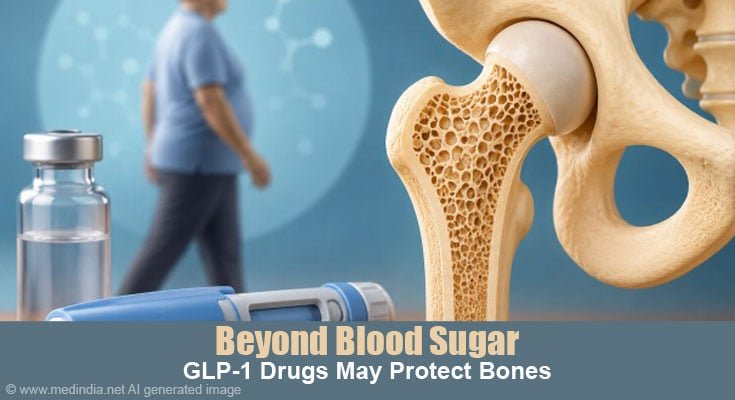
GLP-1 medicines may do more than lower blood sugar. A new study links them to a lower risk of bone fractures in people with type 2 diabetes.

- GLP-1 users had a 21% lower risk of fragility fractures than DPP-4 users
- The biggest reductions were seen in hip, femur, and spinal fractures
- Researchers say more clinical trials are needed before confirming a protective bone effect
People with type 2 diabetes have a higher risk of bone fractures even when their bone density appears normal.
While GLP-1 receptor agonists such as semaglutide and tirzepatide are widely used to improve blood sugar control and promote weight loss, their effects on bone health have remained uncertain.
A new study now suggests these medicines may also lower the risk of fragility fractures in older adults with type 2 diabetes (1✔ ✔Trusted Source
Glucagon-Like Peptide-1 Receptor Agonists and Fragility Fracture Risk in Type 2 Diabetes
The findings are supported by recent reviews and clinical studies that indicate GLP-1 drugs may influence bone metabolism beyond their effects on weight loss, although experts say more clinical trials are needed before confirming a direct protective effect.
Advertisement
Can GLP-1 Weight-Loss Medicines Reduce Fracture Risk?
According to the study, researchers analyzed electronic health records of 133,606 adults aged 50 to 90 years with type 2 diabetes in the United States who began treatment with either GLP-1 receptor agonists or DPP-4 inhibitors between 2015 and 2022.
During nearly three years of follow-up, people receiving GLP-1 receptor agonists had a 21% lower risk of fragility fractures compared with those receiving DPP-4 inhibitors.
The largest reductions were seen in:
- Vertebral fractures (32% lower risk)
- Hip and femur fractures (30% lower risk)
Researchers also found that the lower fracture risk remained even after accounting for changes in body weight and blood sugar levels, suggesting the medicines may influence bone health through additional biological mechanisms rather than weight loss alone.
However, the researchers emphasized that this was an observational study and cannot prove that GLP-1 medicines directly prevent fractures. Randomized clinical trials will be needed to confirm the findings.
Advertisement
Why Are People With Type 2 Diabetes More Likely to Experience Bone Fractures?
According to a narrative review, diabetes-related bone disease is increasingly recognized as a distinct complication of type 2 diabetes.
Unlike osteoporosis, many people with diabetes have normal or even higher bone mineral density (BMD), yet remain more vulnerable to fractures because the quality and strength of their bones are impaired rather than the amount of bone itself (2✔ ✔Trusted Source
Diabetic Bone Disease: A Comprehensive Narrative Review of Pathophysiology, Diagnosis, and Evidence-Based Management
The review explains that long-term high blood sugar can damage the internal structure of bone through advanced glycation end products (AGEs), chronic inflammation, reduced bone remodeling, and changes in bone-forming and bone-resorbing cells.
These changes weaken bone quality and increase fracture risk, even when routine bone density scans appear reassuring.
This underlying bone fragility has prompted researchers to investigate whether diabetes medicines themselves could influence skeletal health.
Advertisement
Why Did Researchers Previously Worry About Bone Health?
Before the new study, researchers were concerned that the rapid weight loss caused by GLP-1 medicines could reduce bone mineral density and increase the risk of fractures.
Supporting this concern, a study published in the Journal of Clinical Endocrinology & Metabolism found that people taking semaglutide or tirzepatide experienced bone mineral density loss over time (3✔ ✔Trusted Source
Skeletal effect of semaglutide and tirzepatide in patients with increased risk of fractures
Among individuals without diabetes, hip bone loss was greater than in matched controls and was linked to greater weight loss.
However, among people with type 2 diabetes, bone loss was similar in both GLP-1 users and non-users, suggesting that diabetes status may influence how these medicines affect bone.
Against this backdrop, the new study provides an important new perspective.
Instead of finding a higher fracture risk, researchers observed that adults with type 2 diabetes taking GLP-1 receptor agonists had a lower risk of fragility fractures than those receiving DPP-4 inhibitors.
Together, the two studies suggest that while weight loss may contribute to bone loss in some people, the overall effects of GLP-1 medicines on bone health may differ between individuals with and without type 2 diabetes.
Could GLP-1 Medicines Benefit Bones Beyond Weight Loss?
Several recent studies suggest that GLP-1 receptor agonists may have effects on bone health beyond lowering blood sugar and promoting weight loss. While the evidence is still evolving, researchers have reported several encouraging findings.
According to a recent systematic review and meta-analysis published in Acta Diabetologica, which pooled data from 25 randomized clinical trials, GLP-1 receptor agonists were associated with (4✔ ✔Trusted Source
Effect of GLP-1 receptor agonists on bone mineral density, bone metabolism markers, and fracture risk in type 2 diabetes: a systematic review and meta-analysis
- No increase in fracture risk compared with other treatments.
- Improved bone mineral density (BMD) at the lumbar spine, femoral neck, and total hip.
- Favorable changes in bone turnover markers, including increased P1NP, osteocalcin (OC), bone-specific alkaline phosphatase (b-ALP), and vitamin D (25-OH-D), along with reduced β-CTX, a marker of bone breakdown.
Similarly, according to the Diabetology review, previous systematic reviews and meta-analyses have also reported promising effects of GLP-1 receptor agonists on bone metabolism. Researchers suggest these medicines may:
- Support bone formation.
- Reduce bone resorption (breakdown).
- Improve bone metabolism while helping control blood sugar.
- Act directly on GLP-1 receptors found on bone cells, although the exact mechanisms are still being investigated.
Taken together, these studies suggest that the potential benefits of GLP-1 receptor agonists on bone health may extend beyond their well-established effects on blood sugar control and weight loss.
Should People Taking GLP-1 Medicines Expect Stronger Bones?
Not yet.
Although the new study provides encouraging evidence for adults with type 2 diabetes, the same benefit was not observed in people using GLP-1 medicines without diabetes, indicating the findings should not automatically be applied to individuals taking these drugs only for weight management.
Researchers from all four studies agree that longer-term randomized clinical trials are still needed to determine whether GLP-1 receptor agonists directly protect bones, identify which patients benefit the most, and understand how long any protective effects may last.
Until then, GLP-1 medicines should continue to be prescribed primarily for their approved benefits in diabetes and obesity management, with bone health monitored according to each patient’s overall fracture risk.
Frequently Asked Questions
Q: What are GLP-1 receptor agonists?
A: GLP-1 receptor agonists are medicines used to treat type 2 diabetes and obesity by improving blood sugar control and promoting weight loss.
Q: What did the new study find?
A: Adults with type 2 diabetes taking GLP-1 medicines had a lower risk of fragility fractures than those taking DPP-4 inhibitors.
Q: Which fractures showed the greatest reduction?
A: The largest reductions were seen in vertebral fractures and hip/femur fractures.
Q: Does this mean GLP-1 medicines strengthen bones?
A: Not yet. The study found an association but did not prove that the medicines directly protect bones.
Q: Should GLP-1 medicines be taken to prevent fractures?
A: No. They should continue to be used only for their approved indications until clinical trials confirm a bone-protective effect.
Q: Why do people with type 2 diabetes have a higher fracture risk?
A: Diabetes can weaken bone quality even when bone density appears normal, increasing the risk of fractures.
References:
- Glucagon-Like Peptide-1 Receptor Agonists and Fragility Fracture Risk in Type 2 Diabetes – (https://jamanetwork.com/journals/jamanetworkopen/fullarticle/2852068)
- Diabetic Bone Disease: A Comprehensive Narrative Review of Pathophysiology, Diagnosis, and Evidence-Based Management – (https://www.mdpi.com/2673-4540/6/11/140)
- Skeletal effect of semaglutide and tirzepatide in patients with increased risk of fractures – (https://academic.oup.com/jcem/article-abstract/111/7/1959/8467122?redirectedFrom=fulltext)
- Effect of GLP-1 receptor agonists on bone mineral density, bone metabolism markers, and fracture risk in type 2 diabetes: a systematic review and meta-analysis – (https://link.springer.com/article/10.1007/s00592-025-02468-5)
Source-Medindia