

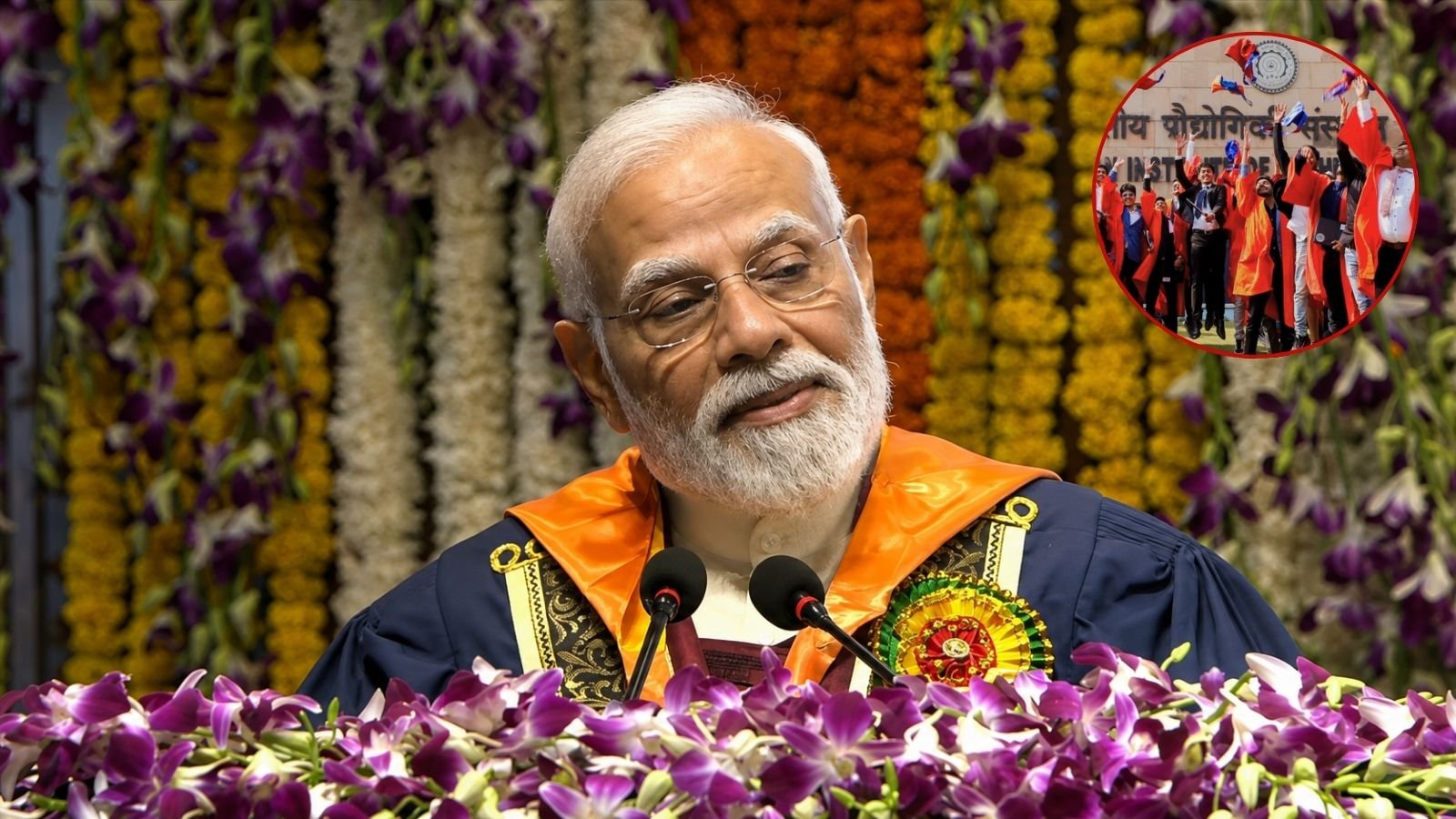
More than 3,000 graduating students, including undergraduates, postgraduates and 587 PhD scholars, walked up to receive their degrees at IIT Delhi‘s 57th convocation on Saturday, with Prime Minister Narendra Modi presiding as chief guest.
PM Modi opened not with policy but with feeling, telling the graduating class that they weren’t merely collecting a degree but carrying out a dream for the country. The speech then moved along familiar lines of Viksit Bharat, research funding, self-reliance across sectors, etc. But it was “bloodline” and “leaderboard” and the calling out of hostel blocks that the hall really responded to.

The choice of words wasn’t incidental: since Gen Z-led protests broke out in the national capital and elsewhere in the country, MPs across the political aisle have visibly leaned on the same internet-native lingo in Parliament and beyond.
The speech’s centre of gravity was a phrase PM Modi repeated like a refrain, and it’s the one that will likely travel furthest beyond the halls of IIT Delhi: “First in my bloodline.” He used it first for a hypothetical young engineer building a rocket, then for someone making a semiconductor chip in India, then for someone assembling a drone — each time invoking a young Indian saying it with pride, marking a personal, generational first inside sectors the government has been positioning as newly opened to entrepreneurial youth: space, semiconductors, drones.
Warning students against ‘distraction’
He carried that same register into the speech’s other big idea, warning students against what he called distraction — from the comparison trap that social media entrenches: who got what package, who joined which company, who moved to which city or country, who started a startup first. His answer was blunt and, again, borrowed from a very online register: life, he said, “is not a leaderboard”. Your real race isn’t against anyone else; it’s against yourself, trying each day to be a little better than the one before, while not losing sight of physical and mental health along the way.
Campus life, he said, comes with a syllabus; life outside does not. “On campus, ‘sab funda clear hai’: everything was sorted, what to study, what assignment was due, what exam was next. Outside, there’s no fixed course, no question paper, and often nobody to even tell you what the real question is; you have to identify it yourself,” he said. He drew on IIT alumni journeys to argue that their success lay less in answering questions correctly than in noticing questions the world had stopped treating as questions at all — urging the students to keep their curiosity lit, question easy assumptions, and pair every question with the courage to chase a solution.
This was also a batch of firsts: the maiden graduating cohorts of the Bachelor of Design, the Executive MBA, the MSc in Biological Sciences and the MA in Culture, Society and Thought programmes received their degrees alongside the older, more familiar BTech and MTech contingents. Union Education Minister Pralhad Joshi and NITI Aayog member Prof Abhay Karandikar attended as guests of honour, while Harish Salve, Chairperson of IIT Delhi’s Board of Governors, and Director Prof. Rangan Banerjee led proceedings from the institute’s side.
Story continues below this ad
The ceremony also saw the inauguration of new AI-linked initiatives at the institute, even as the mood in Dogra Hall stayed determinedly informal, heavy on nostalgia, light on protocol, and, in the Prime Minister’s own delivery, tuned to a discernable Gen-Z frequency.
‘Nicer to see more daughters on winners’ list’
PM Modi congratulated the medal winners, then broke into an aside that got a laugh in the hall, that it would have been “a little nicer” to see one or two more daughters on that list, before correcting himself: “not one or two, but far more”.
From there, PM Modi turned confessional in a way rarely associated with his regular addresses. He ‘is not Baba Vageshwar’, he joked, saying that he can’t read what’s playing on everyone’s mind, but he was certain something was stirring in each student’s head, beyond the caps and gowns.
Some, he said, were waiting for their first salary. Others were bracing for a fresh start in a new city. Some were nursing the dream of a first startup, and some had already fixed their sights on the next competitive exam. Every path was different, every dream distinct, but one feeling, he insisted, would be common to them all: the ambush of memory, the sudden recall of that first day on campus, arriving at a moment that felt like only yesterday was orientation and today was already convocation.
Story continues below this ad
Parathas from Satpura mess
He went on to name the hostels one by one, the way only someone who’d clearly been briefed by people who lived there could: Kumaon, Aravali called as ‘Ara’, Karakoram as ‘Kara’, Vindhyachal ‘Vindhy’, Nilgiri, Kailash, Himadri. He spoke of inter-hostel competition stories, of “purani lokjok”, the old in-jokes, and pushed the point that this wasn’t only about academics. The reference landed with specific, almost on a logistical tone: the parathas from Satpura mess were probably being served right about now, he noted, and if anyone made it to the local tea-spot for one last round, they should think of him too.
He then turned that sentimentality into instruction. The friends, teachers, mentors and support staff who’d become family, the professors who’d taken on the job of shaping talent like theirs, the institute that had slowly become a second home, carry all of it out with you as an asset, he said: “Don’t forget it. Don’t leave it behind. Take it with you.” PM Modi wrapped up thanking students and parents, wishing them “nayi unchaiyan” – new heights.