

Close Menu

    Subscribe to Updates

    Get the latest news information from worldwide businesses.

    What's Hot

    AI reveals a massive algae boom across the world’s oceans

    August 3, 2026

    Your Sweet Tooth May Be in Your Genes

    August 3, 2026

    After killer quarter, Palantir CEO Alex Karp calls AI industry ‘Marxist’

    August 3, 2026
    Facebook Instagram YouTube LinkedIn X (Twitter)
    Trending
    • AI reveals a massive algae boom across the world’s oceans
    • Your Sweet Tooth May Be in Your Genes
    • After killer quarter, Palantir CEO Alex Karp calls AI industry ‘Marxist’
    • SBI, HSBC lead FCNR(B) deposit mobilisation
    • Trump says US-Iran talks continue, warns Tehran faces 'last chance'
    • Hungary’s nuclear crisis tests new PM Magyar’s leadership
    • Zuckerberg should apologise for removing PM Modi’s video: Nishikant Dubey | India News
    • Clay Travis pledges $10M for ‘battle of the sexes’ matchup as WNBA trans debate intensifies
    Newspublicly
    • About Us
    • Advertise & Partner with us
    • Pitch Your Story
    • Contact Us
    Facebook Instagram LinkedIn X (Twitter)
    Subscribe
    • Home
    • World News
      • Asia
      • India
      • USA
      • UK & Europe
      • Middle East
    • Economy & Business
      • Global Economy
      • Corporate & Industry
      • Finance & Markets
      • Policy & Trade
    • Technology
      • Gadgets & Devices
      • Software & Apps
      • AI & Machine Learning
      • Robotics & Automation
    • Health & Medicine
      • Fitness & Nutrition
      • Research & Innovation
      • Disease & Treatment
      • Doctors, Clinics & Patient Care
    • Travel & Tourism
    • Automobile
      • Electric & Hybrid Vehicles
      • Auto Industry Insights
    • Sports
    • More
      • Education
      • Real Estate
      • Environment & Climate
      • Space & Astronomy
      • War & Conflicts
    Newspublicly
    Home»Health & Medicine»Research & Innovation»Scientists twist crystal layers and reshape matter from within
    Research & Innovation

    Scientists twist crystal layers and reshape matter from within

    AdminBy AdminAugust 3, 2026No Comments4 Mins Read0 Views
    Share
    Facebook Twitter LinkedIn Copy Link WhatsApp


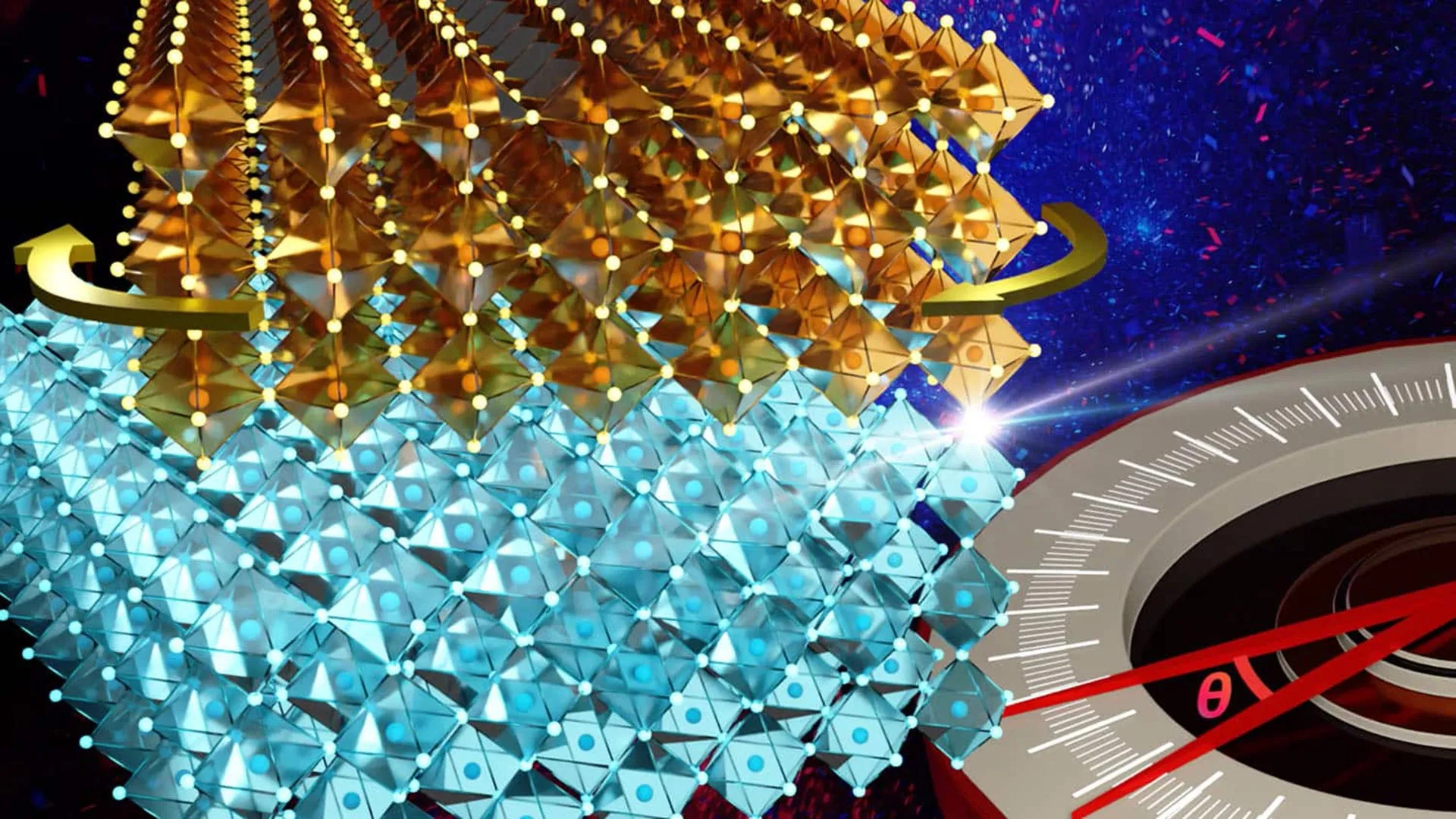
    Researchers have developed a way to make twisted oxide materials over much larger areas while maintaining precise control over how their layers are rotated. The advance could help move twistronics closer to practical electronic devices by giving scientists greater control over both the scale and internal structure of these materials.

    Twistronics explores how rotating one layer of a two-dimensional (2D) material relative to another can change the material’s electronic behavior. Until now, much of the field has focused on extremely thin materials held together by relatively weak forces.

    “The field of twistronics was developed using 2D materials that are bonded by weak van der Waals forces,” says Ruijuan Xu, corresponding author of a paper on the work and an assistant professor of materials science and engineering at North Carolina State University. “Our work here demonstrates it is possible to use layers of oxide materials that are connected by strong chemical bonds – while precisely controlling the twist angle between crystalline oxide membranes.

    “The strong interlayer bonding we found between oxide layers suggests there may be entirely new interfacial phenomena to explore,” adds Xu. “We’ve demonstrated the ability to control many of the materials’ characteristics – including phase structure and domain configuration – in ways that offer new routes for designing materials and devices tailored to specific applications.”

    Building Large Twisted Oxide Membranes

    To demonstrate the technique, the team produced crystalline sodium niobate (NaNbO3) membranes. Using photolithography, they added visual reference markers around the edges of each membrane.

    The researchers then lifted one NaNbO3 membrane and positioned it on top of a second membrane. By watching how the reference markers lined up during assembly, they could carefully set the rotation angle between the two layers.

    After reaching the desired orientation, the team used an annealing process designed specifically for the material. This treatment formed strong chemical bonds between the stacked membranes.

    “Scale matters for devices,” says Xu. “Because these crystalline membranes can be fabricated over large areas and transferred onto different supports, this approach provides a practical path toward twist-engineered oxide electronics.”

    Strong Bonds Reshape the Atomic Lattice

    The scientists used synchrotron X-ray diffraction to examine the boundary where the two oxide layers meet. The measurements revealed that the strong bonding between the membranes does more than simply hold them together.

    “We found that the bonds between the two layers are so strong that they are distorting the atomic structure of the material – creating a gradual rotation of the atomic lattice at the interface between the layers,” says Xu. “We also found changes to the phase structure of the material. It remains to be seen how this will affect material properties, but that’s something we are exploring.”

    These structural changes could eventually influence the material’s electronic and physical behavior, although further research will be needed to determine their full effects.

    A Broader Platform for Oxide Electronics

    The experiment used NaNbO3 as a model system, but the researchers say the same method may also work with other complex oxide materials.

    “Our work demonstrates a technique for creating large-area oxide twistronic materials with controlled twist angles and a strong chemical bond between layers,” says Xu. “It’s an exciting time for oxide twistronics, with new opportunities to engineer complex oxide functionalities through twist.”

    The paper, “Deterministic Fabrication of Large-Area, High-Crystallinity Oxide Moiré Superlattices,” is published in the journal ACS Nano.

    Co-lead authors of the paper are Reza Ghanbar, a Ph.D. student at NC State; and Eli Rodrigues, a graduate student at NC State who was involved with this work while still an undergraduate. The paper was co-authored by Konnor Koons, Kabelo Lebogang, Yiming Ding and Yueyin Wang, who are Ph.D. students at NC State; undergraduate Doug Barefoot; Yin Liu, an assistant professor of materials science and engineering at NC State; Young-Hoon Kim of Oak Ridge National Laboratory; Yan Li and Hua Zhou of Argonne National Laboratory; and Miaofang Chi of Oak Ridge National Laboratory and Duke University.

    This work was done with support from the National Science Foundation under grants 2442399 and 2340751; the American Chemical Society Petroleum Research Fund under award 68244-DNI10; the Army Research Office under grant W911NF-25-1-0201; the Scialog grant #SA-QMI-2025-097c from Research Corporation for Science Advancement; and the U.S. Department of Energy.


    Source link

    Author

    • Admin

      NewsPublicly.com is News & Articles Platform that creating SEO-focused articles on travel, lifestyle, and digital trends.

    Admin
    • Website

    NewsPublicly.com is News & Articles Platform that creating SEO-focused articles on travel, lifestyle, and digital trends.

    Related Posts

    AI reveals a massive algae boom across the world’s oceans

    August 3, 2026

    Giant waves are sweeping Mars’ atmosphere into space

    August 3, 2026

    Two deadly flowers could inspire powerful new medicines

    August 3, 2026
    Leave A Reply Cancel Reply

    Demo
    Top Posts

    The Blue Moon rises on May 30— Where and when to see the second full moon of the month

    May 30, 202640 Views

    New SOCOM rifle allows barrel swapping and cartridge changes

    June 1, 202633 Views

    “Inside Gemini Robotics 1.5: How Robots Learn to Reason & Act

    November 22, 202527 Views

    525 pounds of cocaine seized after Nebraska K9 alerts troopers on I-80

    May 28, 202624 Views
    Don't Miss

    AI reveals a massive algae boom across the world’s oceans

    August 3, 20264 Mins Read0 Views

    Artificial intelligence has helped scientists produce the first comprehensive global assessment of floating algae, revealing…

    Your Sweet Tooth May Be in Your Genes

    August 3, 2026

    After killer quarter, Palantir CEO Alex Karp calls AI industry ‘Marxist’

    August 3, 2026

    SBI, HSBC lead FCNR(B) deposit mobilisation

    August 3, 2026
    Stay In Touch
    • Facebook
    • Twitter
    • Instagram
    • YouTube
    • LinkedIn
    • WhatsApp

    Subscribe to Updates

    Get the latest creative news from SmartMag about art & design.

    Demo
    NEWSPUBLICLY
    Facebook X (Twitter) Instagram LinkedIn

    Home

    • About Us
    • Leadership
    • Advertise & Partner With Us
    • Pitch Your Story
    • Media Kit & Pricing
    • Career
    • FAQs

    Guidelines

    • Editorial & Submission
    • Partnership
    • Advertising & Sponsor
    • Intellectual Property Policy
    • Community & Comment
    • Security & Data Protection
    • Send Your Opinion

    Quick Links

    • Cookie Policy
    • Payment & Billing Terms
    • Refund & Cancellation
    • Copyright Policy
    • Complaint & Support
    • Sitemap
    • Contact Us

    Subscribe Us

    Get the latest news and updates!

    Copyright © 2026 Newspublicly (DIGITALIX COMMUNICATION). All Rights Reserved.
    • Privacy Policy
    • Terms of Use
    • Disclaimer