

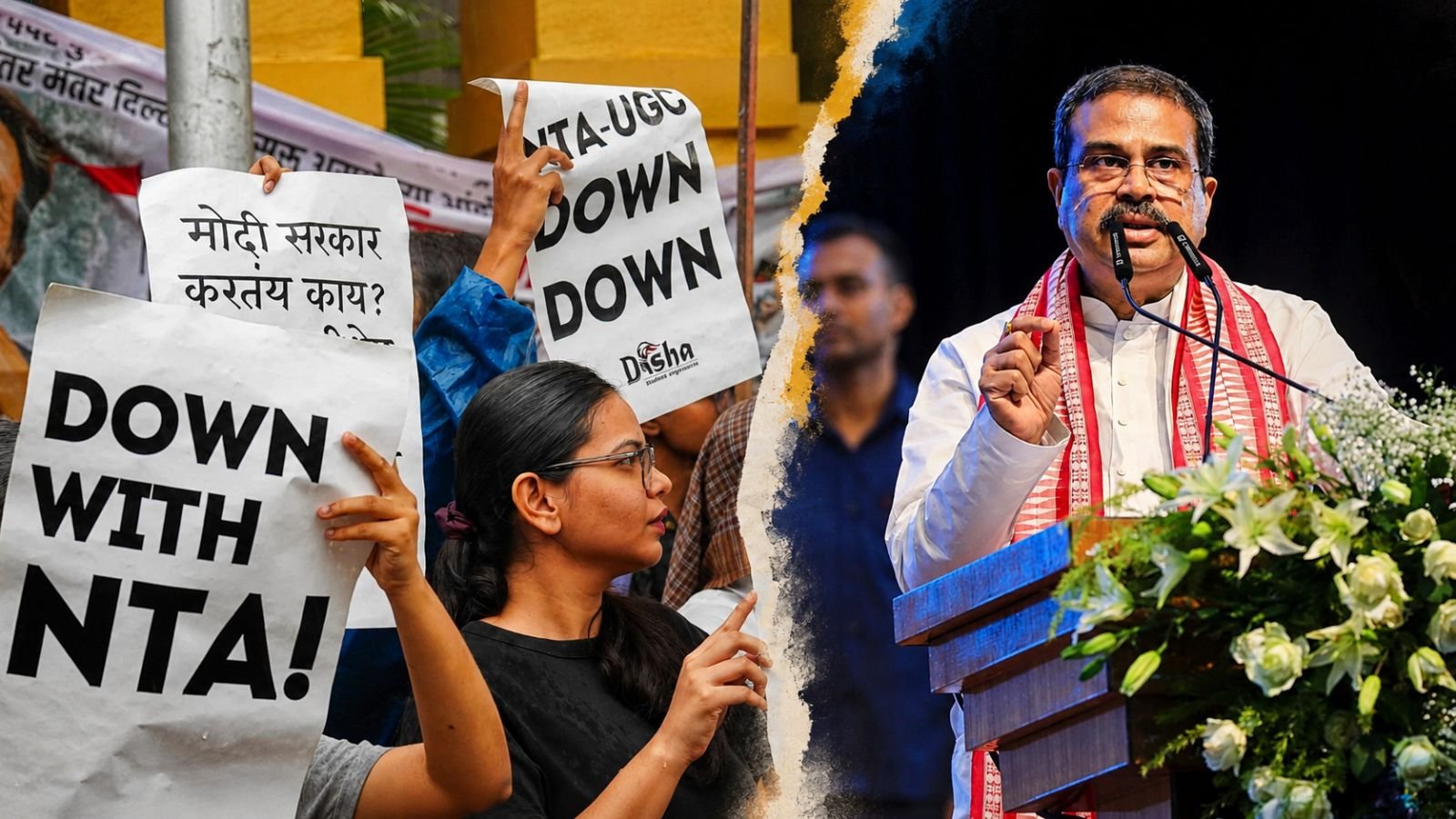
A whistleblower tutor cross-checking allegedly leaked exam questions, a courtroom remark that sparked the satirical Cockroach Janta Party (CJP), and, weeks later, Education Minister Dharmendra Pradhan’s resignation. These were not separate stories but part of a single crisis that became one of the most contentious education controversies India has seen in recent years.
It began with NEET-UG 2026, held on May 3 for more than 22 lakh candidates. Soon after the exam, tutor Shashikant Suthar said he noticed that questions in the paper closely matched a PDF that had been circulating before the test. According to his public statements, he alerted the National Testing Agency (NTA) and other authorities, and the case was later handed over to the Central Bureau of Investigation (CBI). Subsequent investigations led the NTA to cancel the examination and order a fresh test for nearly all candidates who had appeared. A similar controversy over alleged leaks had surfaced during NEET-UG 2024, but that exam was never cancelled nationwide.

The controversy soon grew beyond the examination itself. What began as a self-deprecating joke after remarks by the Chief Justice of India (CJI) led a student to suggest that all the “cockroaches” should unite, giving birth to the satirical CJP. Within weeks, it had evolved into one of the country’s most visible youth-led protest movements, with the NEET paper leak emerging as one of its central causes. Here’s how the events unfolded:
May 3: NEET-UG 2026 is conducted across the country for admission to MBBS, BDS and allied medical courses, with more than 22 lakh candidates appearing for India’s largest medical entrance examination.
Days after the exam: Rajasthan-based tutor Shashikant Suthar says he compares a viral “guess paper” PDF with the NEET-UG 2026 paper seen by his students and finds that many questions, especially in Chemistry, match exactly. According to his account, he emails the NTA, CBI and the Education Ministry about the suspected leak, after which officials begin internal verification, and the probe is eventually handed over to the CBI.
May 12: The NTA cancels NEET-UG 2026 after its investigators find substantial overlap between a leaked PDF and the actual examination paper, and the government orders a CBI probe. It announces a nationwide re-test for all affected candidates, marking the first complete cancellation of NEET-UG since the NTA took over its conduct in 2019.
May 16: During an unrelated Supreme Court hearing, a remark by Justice Surya Kant is widely interpreted online as demeaning unemployed youth, with critics accusing him of comparing them to “cockroaches”, even though the Court later clarifies that the comment was taken out of context. That same day, a student’s satirical post proposes a “Cockroach Janta Party” for angry, jobless aspirants, and the label quickly spreads across social media.
Story continues below this ad
May 22: According to CBI remand documents and media reports, investigators arrest a school headmistress from Pune who had previously served as an NTA subject expert, alleging that she reconstructed questions from memory after the examination, shared them with others and later attempted to destroy evidence.
Late May: A small group of student organisers, including Abhijeet Dipke, 21, emerge as leading faces of the loose collective now calling itself the Cockroach Janta Party, as thousands of students begin organising online. What starts as satire rapidly transforms into a coordinated campaign demanding accountability, sweeping examination reforms and Education Minister Dharmendra Pradhan’s resignation.
Early June: The CJP holds its first major demonstrations in Delhi, with Jantar Mantar becoming the focal point of protests, and the movement begins to draw in aspirants preparing for other competitive examinations as well.
June 21: The NEET-UG 2026 re-examination is conducted nationwide for candidates whose earlier exam was cancelled, as per the NTA schedule. According to the agency, almost all of the more than 22 lakh affected candidates appear for the fresh test.
Story continues below this ad
Late June: Senior Union ministers open talks with prominent student spokespersons linked to the Cockroach Janta Party, but the discussions fail to produce a breakthrough. Protesters reiterate that Dharmendra Pradhan’s resignation remains their central demand.
June 28: High-profile activist Sonam Wangchuk visits the protest site and announces a solidarity fast with students, giving the movement national visibility beyond the education sector.
Early July: The protest movement spreads across several states, with student groups, opposition leaders and civil society organisations joining demonstrations demanding accountability for the examination system and reforms to public recruitment tests.
July 20: Thousands of protesters attempt to march towards Parliament in Delhi, where the police stop the march, use tear gas and baton charges and detain several demonstrators, leading to viral images of the crackdown and allegations of police brutality.
Story continues below this ad
July 21: After the police dismantle the protest camp overnight, demonstrators rebuild it within hours, and many return despite injuries from the previous day’s clashes, indicating that the movement is unlikely to lose momentum.
July 22-23: The movement continues to grow despite administrative action, including restrictions on some of its main social media channels, as student leaders accuse authorities of attempting to suppress the campaign while demonstrations continue in Delhi and other cities.
July 24: Even as Prime Minister Narendra Modi announced, in a late-night video posted on social media, additional examination reforms, including the introduction of fast-track courts and more stringent punishments for paper-leak syndicates, and reiterated that investigations would continue, protesters refused to end their agitation, insisting that ministerial accountability, not just administrative reforms, was necessary.
July 25: Education Minister Dharmendra Pradhan resigns amid the NEET-UG 2026 paper leak storm. He defends the government by citing the CBI investigation, cancellation of the May 3 exam and completion of the re-test, and pledges deeper reforms to restore trust in national-level examinations.
Story continues below this ad
In his resignation letter, he indicates that from 2027 the government will work towards shifting NEET to a computer-based format, though detailed modalities are yet to be notified.
At Jantar Mantar, protesters celebrated the resignation, while Cockroach Janta Party spokespersons met Union ministers Jitendra Singh and J P Nadda, and announced the withdrawal of the protests from Jantar Mantar after being assured of their demands being met.