

This article previously appeared in Cambridge Day.
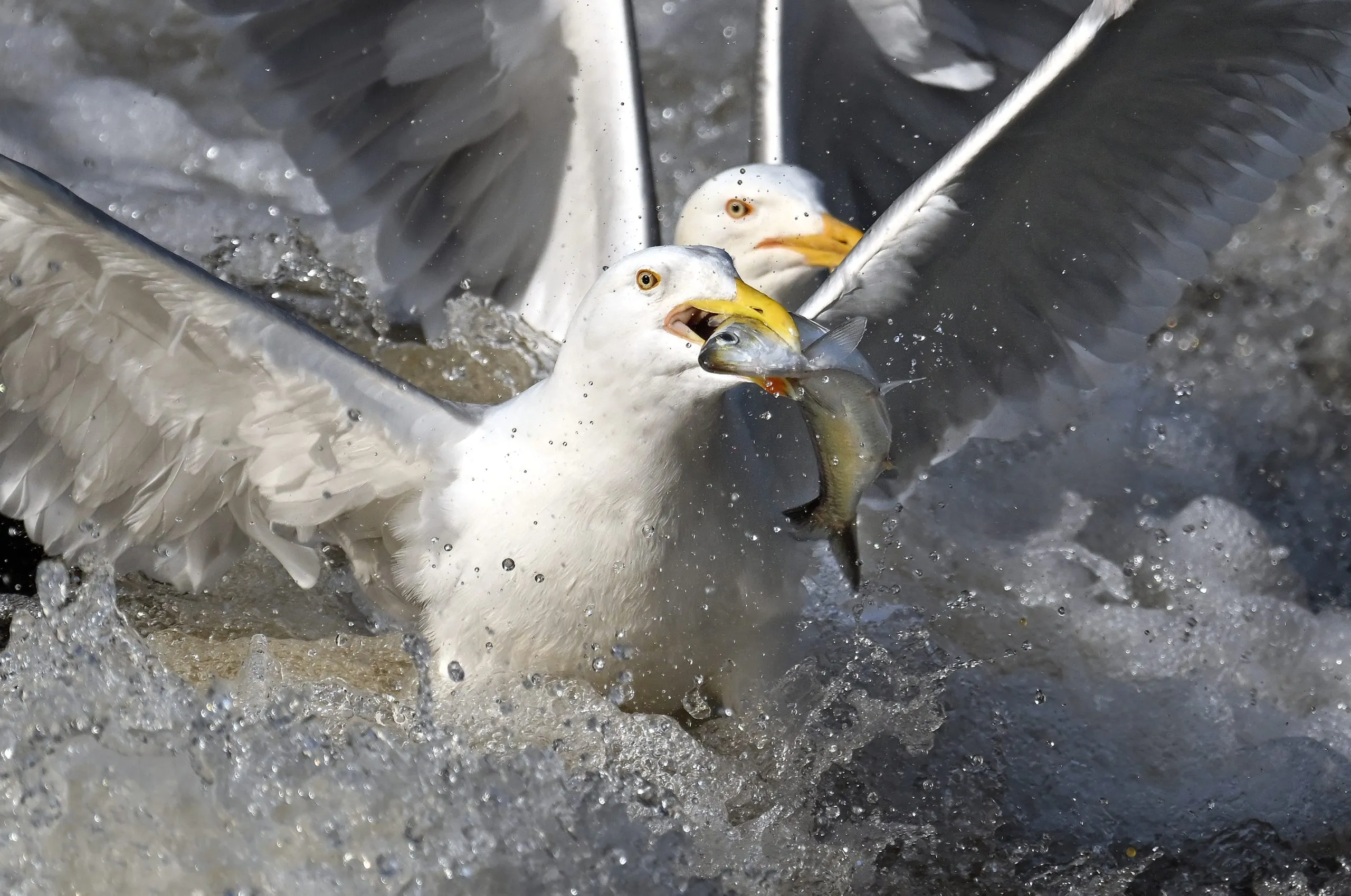
From Boston’s Museum of Science to the Watertown Dam, the Charles River this spring was rife with river herring swirling in the water like scores of baby sharks. Near the dam, dozens of the aptly named herring gulls perched on rocks and plunged for the fish, while great blue herons waded out into the shallows to spear the swimmers.
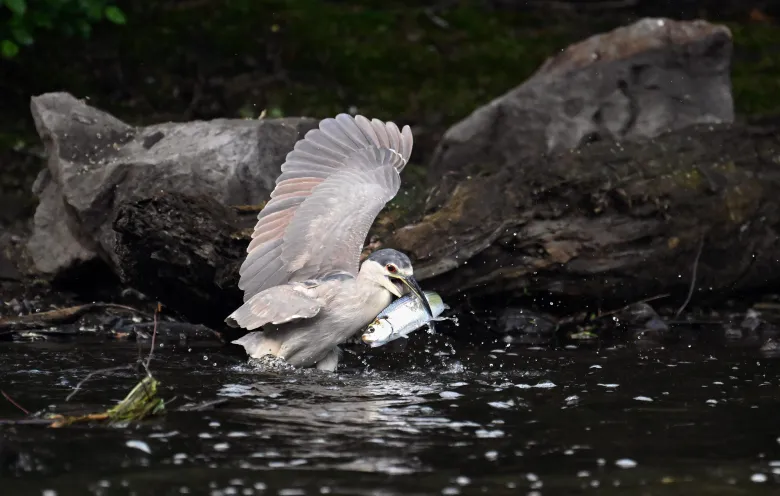
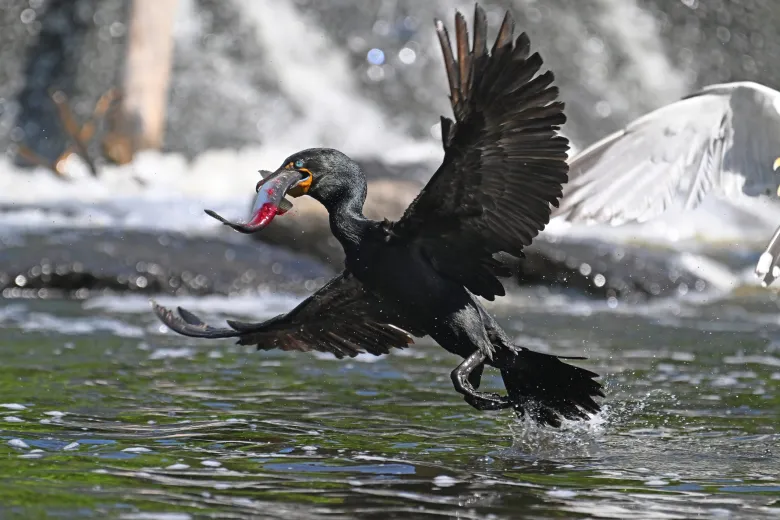
But they weren’t the only ones. Secretive black-crowned night herons used the cover of brush to look for their share. Double-crested cormorants dove into the middle of the river, popping up with the fish already halfway down the gullet.
The seeming abundance of these fish represents only a fraction of what was here centuries ago.
River herring, generally consisting of the alewife and blueback varieties, once migrated up coastal rivers by the hundreds of millions, according to the U.S. Fish & Wildlife Service (FWS). Up on the St. Croix River in Maine, the fish was such a “keystone” species for human consumption and the entire ecosystem the St. Croix River—from bacteria to eagles—that the Passamaquoddy People call it “the fish that feeds all.” They say they “would not have survived” without the herring run.
The European colonists who forced out Indigenous tribes brought on nearly four centuries of river use and abuse that brought the survival of herring into question. The first of scores of dams on the Charles was built in Watertown in 1634 for a grist mill. According to the Environmental Protection Agency, the dams quickly became “repositories of industrial waste.” With human sewage and animal sewage from butchers, the Charles became Greater Boston’s toilet.
By 1920, a state wildlife report found that the alewife fisheries in most of the state’s biggest rivers, including the Charles, had “disappeared.” The Charles was in such an “impoverished” condition that its chances for recovery were considered “poor.”
A century later, the federally-enforced cleanup of the Charles of the last three decades is a testament to what can happen when we stop treating a river as a toilet. We may never fully restore herring back to its historic populations, but enough are coming back to trigger a feeding frenzy that rivals what one might see in a national wildlife refuge.
Last year, Massachusetts fisheries officials, relying on fish counts from volunteers for the Charles River Watershed Association (CRWA), estimated a herring run of nearly 300,000 fish. Though historical data is scant, it was the highest fish count of its kind in recent memory.
Ryan Smith, the volunteer and outreach manager for the CRWA, said before he took his job two and a half years ago, he had never seen, nor heard of the herring run. “When I saw my first wave, I couldn’t keep up counting them,” Smith said. “My head and eyes couldn’t stop moving from one thing to the next,” he said, likening the sight to “a super busy traffic intersection,” where everyone’s rushing to get across once the light turns green.
Smith said this year may not be as prolific. The herring run was noticeably delayed by a couple weeks. It normally peaks in mid-May, but this year, the congregations of herons on the hunt were most visible in the first half of June. That delay could perhaps be because of the very cold winter or perhaps because of dam management.
Visually, it was hard to tell the difference. In one particularly spectacular moment, a great blue heron along the banks plunged its head into the water. It popped its head back up, having harpooned two herring with one stab. It had to drop one of them back into the water to eat the other. It was jaw dropping to see the river this thick with fish, in a river where recovery was once thought to be so poor.
It is no secret that much more could be done. Once given a D grade in 1995 for boating and swimming by the Environmental Protection Agency, the Charles has been at a B or B-minus the last several years. There are dams that no longer have an industrial use, such as the one in Watertown, that need to be torn down, to allow many more herring to get further upstream. There are ongoing debates between environmental groups, the state and some of the towns on how much to invest to further control storm sewage.
The debate should include the sight of the heron with the two herring. If one can see that on a B river, what would we see on a Charles that is truly A class?
Derrick Z. Jackson is a Cambridge-based writer and photographer. Visit his photography website here.
About This Story
Perhaps you noticed: This story, like all the news we publish, is free to read. That’s because Inside Climate News is a 501c3 nonprofit organization. We do not charge a subscription fee, lock our news behind a paywall, or clutter our website with ads. We make our news on climate and the environment freely available to you and anyone who wants it.
That’s not all. We also share our news for free with scores of other media organizations around the country. Many of them can’t afford to do environmental journalism of their own. We’ve built bureaus from coast to coast to report local stories, collaborate with local newsrooms and co-publish articles so that this vital work is shared as widely as possible.
Two of us launched ICN in 2007. Six years later we earned a Pulitzer Prize for National Reporting, and now we run the oldest and largest dedicated climate newsroom in the nation. We tell the story in all its complexity. We hold polluters accountable. We expose environmental injustice. We debunk misinformation. We scrutinize solutions and inspire action.
Donations from readers like you fund every aspect of what we do. If you don’t already, will you support our ongoing work, our reporting on the biggest crisis facing our planet, and help us reach even more readers in more places?
Please take a moment to make a tax-deductible donation. Every one of them makes a difference.
Thank you,