

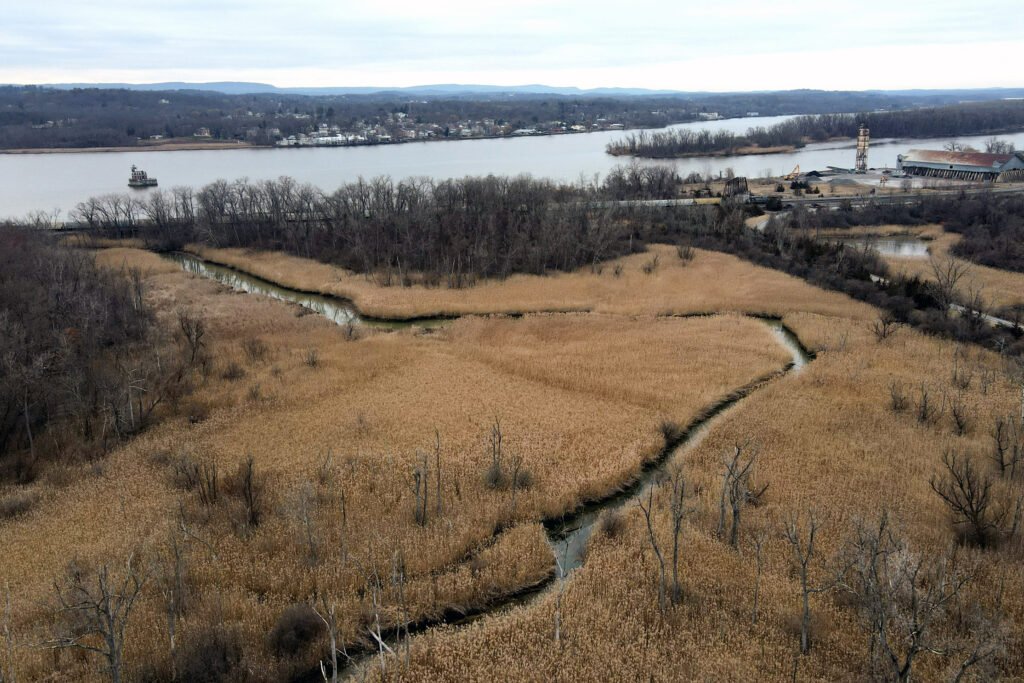
Four years ago, the New York State Legislature made a major move to better protect wetlands. Now some of those safeguards are delayed for potentially several more years.
The 2022 amendment to the 1975 Freshwater Wetlands Act brought more than 1 million additional acres of wetlands under the purview of the state Department of Environmental Conservation (DEC). Instead of regulating only previously mapped wetlands—records that had “substantial inadequacies and inaccuracies,” according to the DEC—the agency would protect all wetlands greater than 12.4 acres or of “unusual importance.”
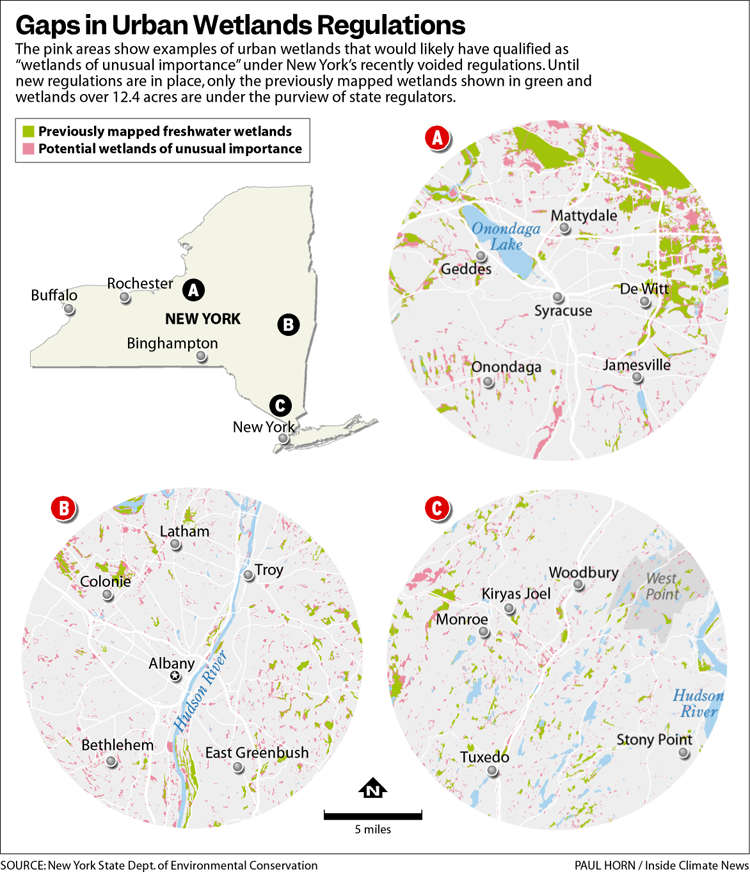
These special wetlands include those that are important for protecting water quality as well as wetlands located in flood zones and urban areas, where they act as a buffer against increasingly extreme rainfall caused by climate change. The unusual importance designation also applies to vernal pools that play a crucial role in amphibian breeding and wetlands that host rare plants or animals. Most importantly, the amendment protected wetlands that meet these criteria regardless of size.
That is, until April. Nearly four years to the day after the legislature passed the amendment, a New York judge struck down the DEC’s regulations implementing the law, leaving many wetlands in legal limbo.
While the 2022 law is still on the books, the DEC has no means of enforcing legal protections for wetlands of unusual importance until new regulations are in place—a process that could take years to complete.
Until then, many wetlands of unusual importance are now outside DEC’s jurisdiction, giving developers an opportunity to secure permits for construction without addressing the impact on those wetlands. The situation has left environmental advocates in the state concerned about the future of these small but crucial habitats, especially as the Trump administration seeks to further weaken federal wetland regulations.
“We were very disappointed by the decision,” said Erin McGrath, New York policy director for the National Audubon Society, part of a coalition that filed a brief supporting the wetland regulations during the lawsuit. “We would like to see the lapse in permitting be as tight as can be, but this is also a long process.”
The DEC’s regulations went into effect Jan. 1, 2025, but were challenged in the New York Supreme Court by developers and business groups several months later. Multiple lawsuits, consolidated into one case, alleged that the 2022 amendment and accompanying regulations would interfere with property rights, impose additional costs through the permitting process and hinder development, especially for housing in urban areas.
“We thought the rule captured way too much property, and it gave high protection to what we think would be ecologically insignificant wetlands, which makes the property around them not developable,” said Ken Pokalsky, vice president of The Business Council of New York State.
While the judge ultimately rejected challenges to the law itself, the decision annulled the DEC’s regulations for failing to comply with the state Environmental Quality Review Act’s mandate to “identify the relevant areas of environmental concern.”
The DEC had reasoned that bringing more wetlands under the jurisdiction of state regulators would not generate significant environmental damage, since this would require more projects to avoid or minimize the impact on wetlands. But the court found that the DEC did not take a “hard look” at other potential environmental effects beyond wetlands, such as changing development patterns that could drive urban sprawl, falling short of the necessary environmental review.
The DEC opted not to appeal the ruling, focusing instead on developing a new set of compliant regulations. “This kind of threw a monkey wrench in the works,” Krista Spohr, environmental program specialist at the DEC, said during a recent webinar on updated wetland regulations. “We’re taking it one step at a time.”
Experts say this will likely be a challenging, years-long process. “This is very complicated and will be under scrutiny the entire time,” said Laura M. Smith, a real estate lawyer at Nixon Peabody who often represents both municipalities and developers in permitting and environmental issues. She said that assessing the breadth of adverse environmental impacts stemming from the regulations will be difficult because these effects are “hard to quantify.”
In the meantime, the DEC only has jurisdiction over previously mapped wetlands and those meeting the 12.4-acre size requirement.
Prior to the decision, the DEC had evaluated approximately 11,000 wetlands across the state under the new regulations, including smaller wetlands of unusual importance. Property owners can now have those determinations re-evaluated. People with wetlands that are no longer under DEC’s jurisdiction will receive a regulatory waiver for the next five years.
The regulations were “certainly a wake-up call for people to understand the DEC is regulating a million acres of new wetlands,” said Greg Fleischer, an environmental scientist and wetlands expert with Capital Environmental Consultants who often works with developers. He said the court decision allows owners “to develop on properties that would otherwise have been protected per the 2025 regulations, and likely will be in the future.”
Wetlands “Under Attack”
Wetlands of unusual importance play many key roles in the surrounding environment.
“Urban wetlands are very important, and they’ve become even more important as we’re seeing the growing impacts of climate change,” Audubon’s McGrath said. A single acre of wetland can hold approximately 1 million gallons of water. During heavy rains, she said, “even small urban wetlands can help to absorb a lot of that excess.”
This story is funded by readers like you.
Our nonprofit newsroom provides award-winning climate coverage free of charge and advertising. We rely on donations from readers like you to keep going. Please donate now to support our work.
She also noted that vernal pools are critical for the biodiversity of the state, but are “very difficult to protect” because they often dry out for part of the year.
The state has already lost 60 percent of its historical wetlands, according to the DEC. Once wetlands are degraded or destroyed, advocates note, they are difficult to restore or replace.
Complicating matters further, fewer wetlands now receive federal protections under the Clean Water Act after the U.S. Supreme Court’s decision in Sackett v. Environmental Protection Agency rewrote the definition of protected waters. Last fall, the Trump administration proposed a new rule that could strip protections for all but 14 percent of freshwater wetlands nationwide, according to an analysis from the Natural Resources Defense Council.
“Wetlands are under attack from the Trump administration, and New York needs to step up to preserve these really critical natural resources that do so much to prevent extreme flooding and to filter our drinking water,” said Rob Hayes, senior director of clean water at Environmental Advocates NY.
While the 2022 amendment to New York’s wetland regulations addressed known issues with the mapping records, experts said it was also intended to help fill regulatory gaps at the federal level.
“There was some concern at the state level that federal protections were going to disappear,” said Adam Stolorow, an environmental and land use attorney at Sive, Paget & Riesel whose clients have included developers and government agencies. The changes were “intended specifically to try to make up for some of the losses of federal jurisdiction.”
Now, until new state regulations are in place, Hayes said New Yorkers should press their local officials to hold development to the strictest environmental standards and stand up for wetlands, especially in urban areas.
“We should be watchdogging as an environmental community to make sure that these critical natural resources are not lost as we’re in this interim period,” he said.
About This Story
Perhaps you noticed: This story, like all the news we publish, is free to read. That’s because Inside Climate News is a 501c3 nonprofit organization. We do not charge a subscription fee, lock our news behind a paywall, or clutter our website with ads. We make our news on climate and the environment freely available to you and anyone who wants it.
That’s not all. We also share our news for free with scores of other media organizations around the country. Many of them can’t afford to do environmental journalism of their own. We’ve built bureaus from coast to coast to report local stories, collaborate with local newsrooms and co-publish articles so that this vital work is shared as widely as possible.
Two of us launched ICN in 2007. Six years later we earned a Pulitzer Prize for National Reporting, and now we run the oldest and largest dedicated climate newsroom in the nation. We tell the story in all its complexity. We hold polluters accountable. We expose environmental injustice. We debunk misinformation. We scrutinize solutions and inspire action.
Donations from readers like you fund every aspect of what we do. If you don’t already, will you support our ongoing work, our reporting on the biggest crisis facing our planet, and help us reach even more readers in more places?
Please take a moment to make a tax-deductible donation. Every one of them makes a difference.
Thank you,

Fellow
Madeline Shaw is an Outrider fellow at Inside Climate News and a journalist in NYU’s Science, Health and Environmental Reporting Program. She has reported on issues involving conservation, poaching and biodiversity. Her work has been published in The New York Times and Scienceline.