

What if companies affected by government efforts to protect the environment could get international arbitrators to award them billion-dollar payouts?
That’s exactly what has been happening because of an obscure system called investor-state dispute settlement. Tucked into thousands of international investment agreements and contracts, ISDS gives foreign businesses formidable rights.
Inside Climate News’ “Cashing Out” investigation revealed how that works.

ISDS allows foreign companies to file claims against national governments if their investments have been affected by new policies, including those aimed at protecting the environment and public health. Though the system was set up to deal with the most egregious types of government actions such as expropriations, arbitration panels have ruled against nations simply for enacting regulations that hurt companies’ profits.
The arbitrations are largely conducted behind closed doors despite their substantial public consequences, and they have few checks and balances, Inside Climate News found. With rare exceptions, there’s no right to appeal. The system is a one-way street: Governments can’t launch ISDS cases against foreign investors. And arbitrators in one case can represent companies in another, a conflict of interest that would never fly for judges in most courts.
Key takeaways from our investigation:
Huge Taxpayer-Funded Payouts
Awards can run into the hundreds of millions or even billions of dollars because companies are allowed to seek speculative “lost future profits.” Claims filed against Honduras, for example, collectively demand far more than its annual public expenditures.
Ecuador, which has struggled with high external debt loads, has been forced to pay billions of dollars to American and European oil and gas companies. The awards created a perverse incentive in the country: The only way the government could pay, said Ecuadorian analyst Alberto Acosta-Burneo, was deepening its reliance on oil revenues or taking out more debt.
Researchers looking at publicly available ISDS case data have found that fossil fuel companies have won at least $82.8 billion in awards from governments in the system—a number they consider a significant underestimate because the details of many cases have not been disclosed.
Flipping the Script on Climate Litigation
Oil, gas and mining companies have already extracted more in ISDS awards from governments than any other industry, but climate cases represent the new frontier. The U.S. narrowly avoided a $15 billion claim over a shuttered oil pipeline.
At least one law firm has specifically advised fossil-fuel clients to take advantage of ISDS: “Climate change litigation is often viewed by companies as a risk. However, it is also an opportunity.”

While most climate-related claims have been filed against wealthy countries so far, a major threat looms over lower-income nations, such as in Southeast Asia, where coal power plants are relatively young. Forced early shutdowns could prompt the plants’ corporate owners to seek staggering amounts in future lost profits.
A study from Queen’s University in Canada and Boston College found that Guyana and Mozambique could face up to $21 billion and $31 billion in potential claims, respectively—both countries are home to multi-billion-dollar investments from ExxonMobil and other multinational oil companies.
Deterring Public Protections
The system operates as a deterrent to regulations meant to protect public interests and works to lock in weaker rules created by corporate lobbying, we found.
In Greenland, a company seeking to mine rare earth minerals intermixed with uranium successfully lobbied the government to repeal its prohibition on such projects—including bringing a former prime minister of Greenland on the company’s board. Years later, when a popular “Uranium? No” movement driven by public health concerns helped elect a government that reinstituted the ban, the company turned to ISDS with a claim seeking up to $11.5 billion.
This story is funded by readers like you.
Our nonprofit newsroom provides award-winning climate coverage free of charge and advertising. We rely on donations from readers like you to keep going. Please donate now to support our work.
In other countries, ISDS has increased the cost of closing coal power plants, prevented governments from canceling oil and gas licenses or stymied efforts to reduce fossil fuel use, government ministers and researchers say.
ISDS “can be very effective to, let’s just say, create the right incentives for good behavior,” a claimant in Honduras said in a podcast.
Merely the threat of an expensive ISDS suit can stop governments from acting in the public interest. When James Shaw was climate change minister of New Zealand, the country pushed progressive climate policies that included ending new offshore oil and gas exploration. The government stopped short of limiting development of fields where oil had already been discovered, however, because doing so would have exposed it to ISDS claims, Shaw told Inside Climate News.
Polluting, Then Getting Paid
Companies have won awards even after they flouted national laws, polluted the environment or were accused of violating human rights.
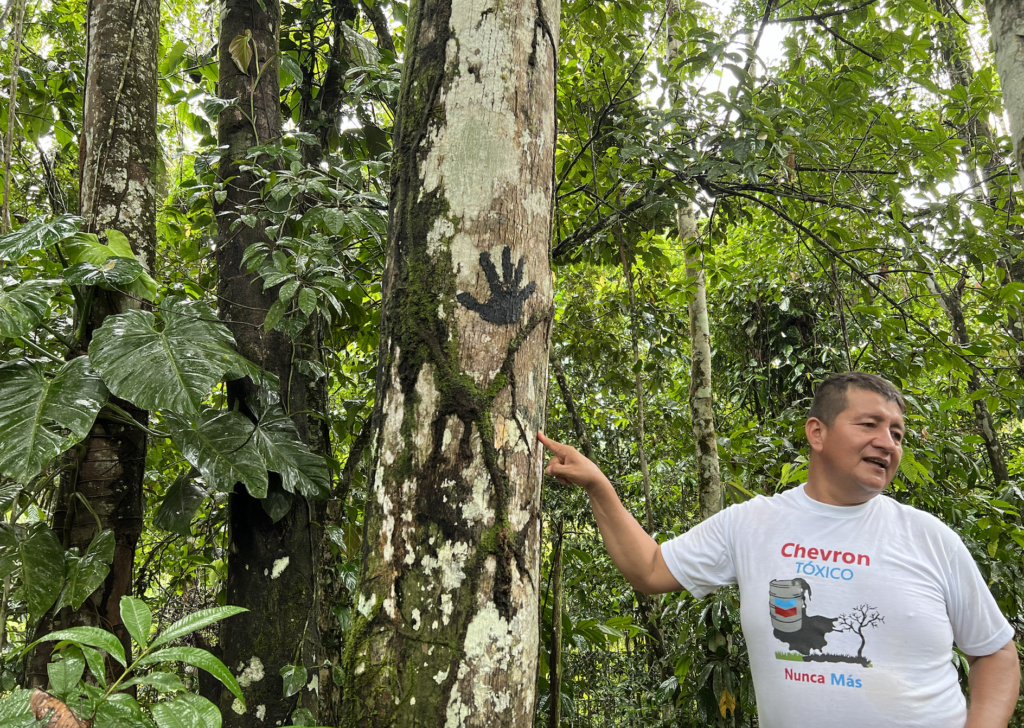
In Ecuador, the French oil company Perenco polluted the Amazon rainforest for years and regularly interfered with government environmental audits. Arbitrators acknowledged the destruction and still awarded the company and its partner more than $800 million after the government enacted a windfall tax on foreign oil companies. In a separate case, oil giant Chevron won a $220 million award, even after admitting that its predecessor, Texaco, had dumped millions of gallons of toxic waste into the Ecuadorian Amazon.
“They can contaminate, they can disrespect the rights of workers, they can fail to pay taxes to the countries where they make their investments,” Christian Pino, an Ecuadorian lawyer, told us. “Because if at any given moment that country decides to take legal action to avoid this type of inappropriate behavior, the multinational company can use the system to protect itself.”
Meanwhile, communities impacted by companies typically cannot participate in ISDS proceedings. When a mining firm sued Peru, there was evidence that the company ignored international standards for consulting Indigenous peoples and mishandled relations with Aymara communities, helping trigger a conflict that doomed the mine. Even so, those communities were barred from participating and the tribunal awarded the company $18 million.
Wall Street Is Buying In
Wall Street firms that invest in litigation are funding some companies’ ISDS cases for a share of the awards, not only profiting off a system weighted in favor of corporations but—our reporting suggests—also increasing the number of claims.
One academic, Lisa Sachs of the Columbia Center on Sustainable Investment, called this “pouring kerosene into a fire.” Another, Frank Garcia at Boston College Law School, said it represents a “wealth extraction mechanism,” with the vast majority of claims brought by companies from wealthy nations against developing ones.
Because case details are often shrouded from public view, much of this funding is secret.
About This Story
Perhaps you noticed: This story, like all the news we publish, is free to read. That’s because Inside Climate News is a 501c3 nonprofit organization. We do not charge a subscription fee, lock our news behind a paywall, or clutter our website with ads. We make our news on climate and the environment freely available to you and anyone who wants it.
That’s not all. We also share our news for free with scores of other media organizations around the country. Many of them can’t afford to do environmental journalism of their own. We’ve built bureaus from coast to coast to report local stories, collaborate with local newsrooms and co-publish articles so that this vital work is shared as widely as possible.
Two of us launched ICN in 2007. Six years later we earned a Pulitzer Prize for National Reporting, and now we run the oldest and largest dedicated climate newsroom in the nation. We tell the story in all its complexity. We hold polluters accountable. We expose environmental injustice. We debunk misinformation. We scrutinize solutions and inspire action.
Donations from readers like you fund every aspect of what we do. If you don’t already, will you support our ongoing work, our reporting on the biggest crisis facing our planet, and help us reach even more readers in more places?
Please take a moment to make a tax-deductible donation. Every one of them makes a difference.
Thank you,


Reporter, New York