

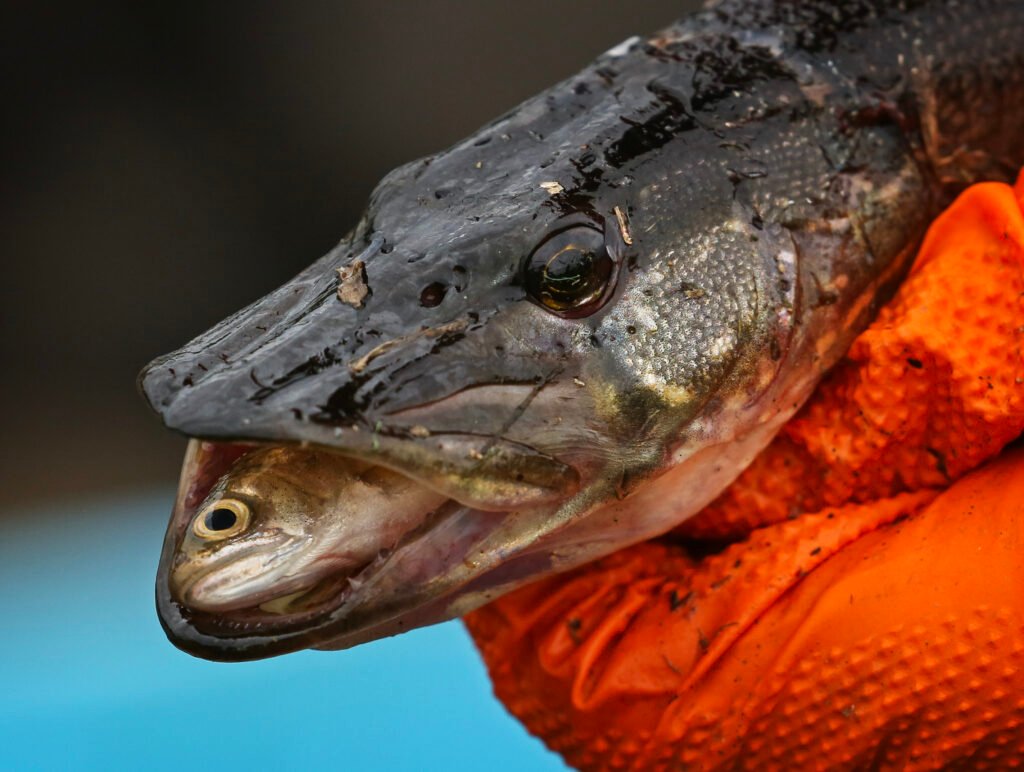
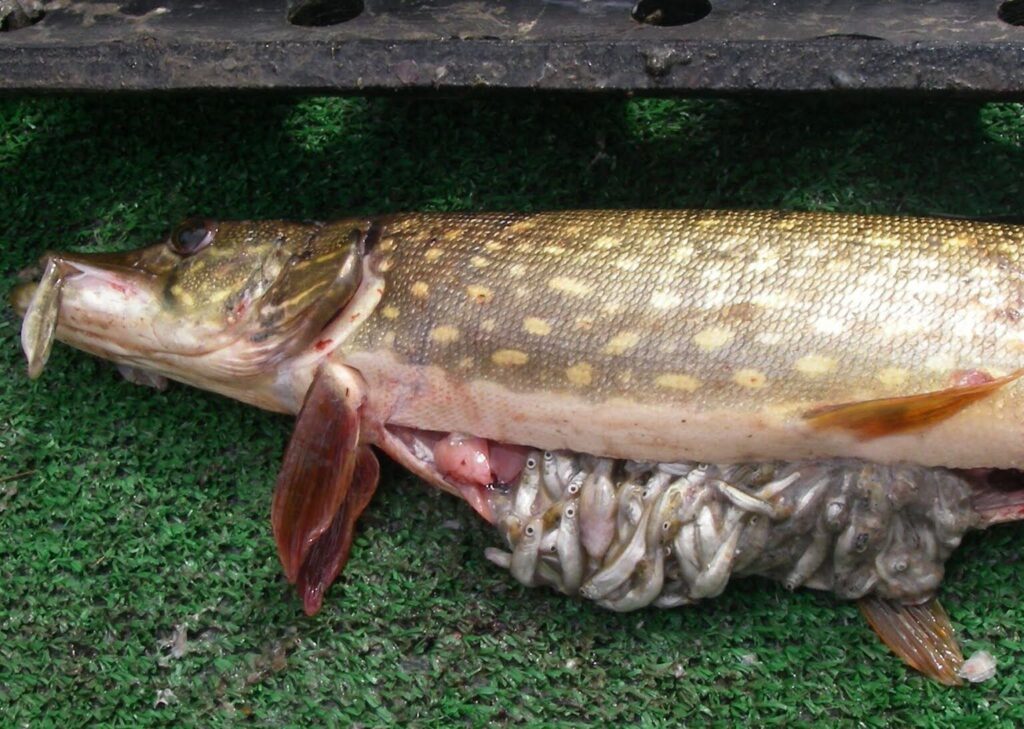
WILLOW, Alaska—Corey Ercolani pulled a northern pike from a gillnet and slit its belly with a knife. Inside its guts lay fresh evidence of a growing biological crime: a dead juvenile salmon. A coho, or silver salmon, to be exact.
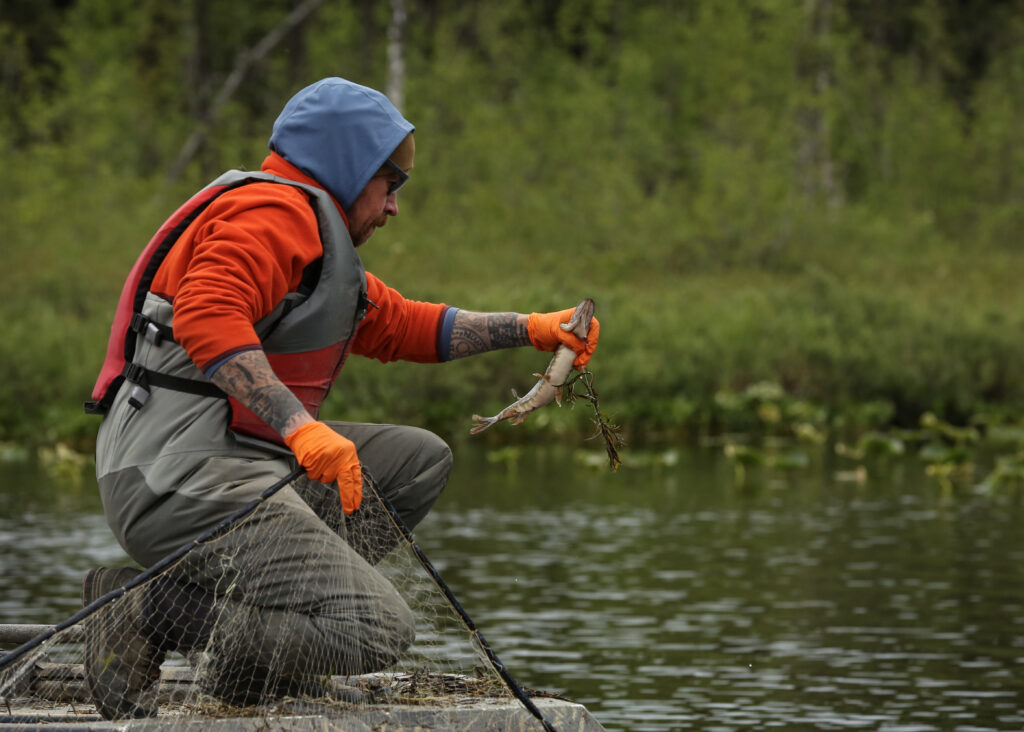
A technician with the Alaska Department of Fish and Game, Ercolani had set the net a few hours earlier on a recent June morning. He stretched it across Lake Creek, a lily-padded outflow from Nancy Lake, a popular sportfishing and recreational area near Willow, Alaska.
Ercolani and his fellow fish techs spend summer days motoring skiffs through slow-moving, weedy creeks and lakes of the Matanuska-Susitna region of Southcentral Alaska, an hour or so north of Anchorage by car. Their mission is to kill as many northern pike as possible, after documenting their size, age, location and what they’re eating. Increasingly, their menu includes baby salmon and rainbow trout, iconic species prized by Alaskans and anglers from around the state, the Lower 48 and beyond.
The Department of Fish and Game is aggressively trying to control the proliferation of northern pike here. While endemic to much of western and northern Alaska, pike are an invasive species south of the Alaska Range, a 600-mile expanse of mountains stretching from the Canadian border to the Aleutian Island chain. Pike were likely introduced illegally in the 1950s and have since spread throughout much of Southcentral Alaska.
Through sustained efforts, Fish and Game has successfully eradicated them on the Kenai Peninsula south of Anchorage. But the sharp-toothed apex predators have invaded more than 150 waterways around Anchorage and farther north in the Mat-Su, decimating native fish species as well as local sportfishing lodges and hurting air charter businesses that fly anglers to remote waterways.
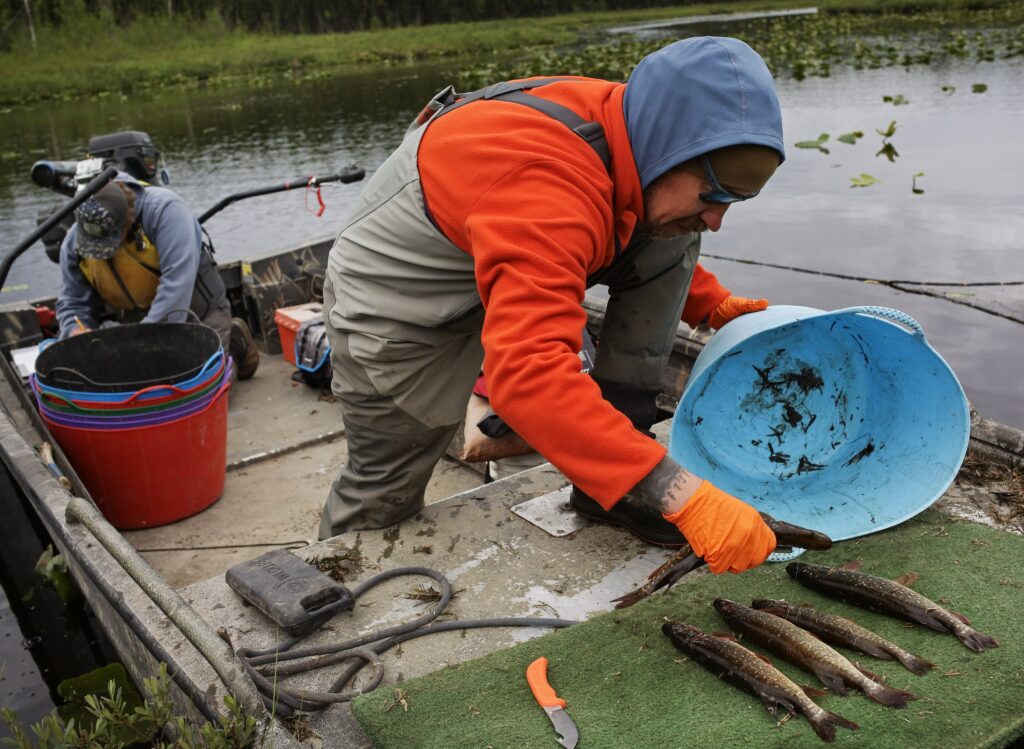
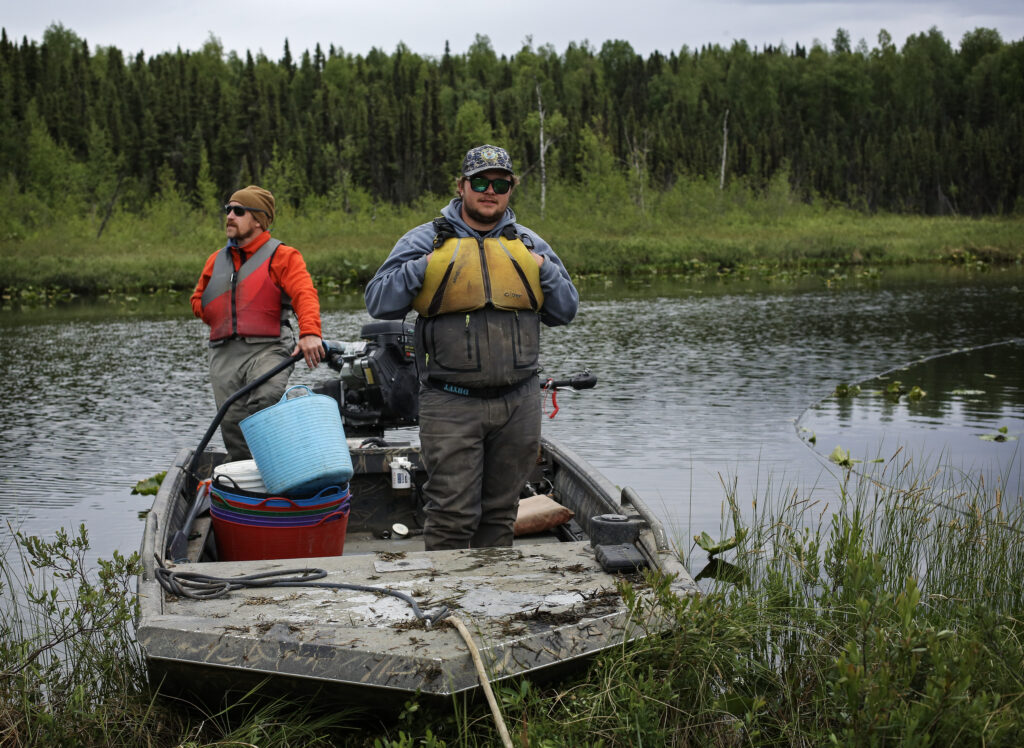
Corey Ercolani counts, weighs and measures pike that he and Thomas Sitz, caught in their net near Nancy Lake in Willow, Alaska on Monday, June 22, 2026, before taking their boat to check other nets for the invasive fish. The pair work as fish and wildlife technicians for the Alaska Department of Fish and Game and are spending the summer trying to eradicate the pike from this stream in order to bring back other species here, like salmon. Credit: Emily Mesner/Inside Climate News
Scary Studies
Economic studies commissioned by the Mat-Su Borough show that as native fish populations have shrunk, direct spending on sportfishing in Mat-Su has also contracted, falling by 47 percent between 2007 and 2017, a drop from $141 million to $57 million.
Recent scientific studies say the pike problem is likely to get much worse.
One peer-reviewed paper, published in the journal Biological Invasions last February, found that as water temperatures warm due to climate change, pike in Southcentral Alaska are becoming hungrier and more aggressive as their metabolisms ramp up. Led by researchers at the University of Alaska Fairbanks, the study contrasted the stomach contents of pike found in the Deshka River during the summers of 2021 and 2022 compared to similar samples taken a decade earlier.
Year-old pike were found to have eaten 63 percent more compared to pike in the earlier sampling. Pike of every age were found to have increased consumption rates.
Mean air temperatures have warmed by about 3 degrees Fahrenheit in the study area since 1919, including a rise of 0.8 degrees in the past decade. Overall, Alaska is by far the fastest warming state in the nation, warming 4.3 degrees F since 1970. The 49th state is also heating up two to three times faster than the global average.
Given that trajectory, scientific models included in the study forecast a 6 percent to 12 percent increase in pikes’ appetites by 2100.
“Their ability to capture prey goes up when it’s warm and then their consumption demands go up,” said Peter Westley, a UAF fisheries professor and study co-author, in an interview with Inside Climate News.
Westley describes the Mat-Su’s warming lakes and streams as “a sweet spot for pike.”
Swimming Through Saltwater
If more aggressive and hungrier pike weren’t alarming enough, another recent study revealed for the first time a different startling discovery: the invasive pike, a freshwater fish, can navigate through saltwater, opening vast new regions for them to colonize.
Researchers from the University of Alaska Fairbanks and the state Fish and Game Department reached that conclusion by studying the chemical signatures of pike ear bones, called otoliths.
Scientists previously thought that pike in Southcentral Alaska only swam through freshwater, not marine corridors like estuaries, limiting their range. But after studying the calcium carbonate ear bones of pike caught near Anchorage and on the Kenai Peninsula, the research team concluded that the predatory fish swam through Cook Inlet. The inlet is a 180-mile estuary with extreme tides that connects the Gulf of Alaska with Anchorage and major river systems including the Susitna, the Matanuska and the Kenai.
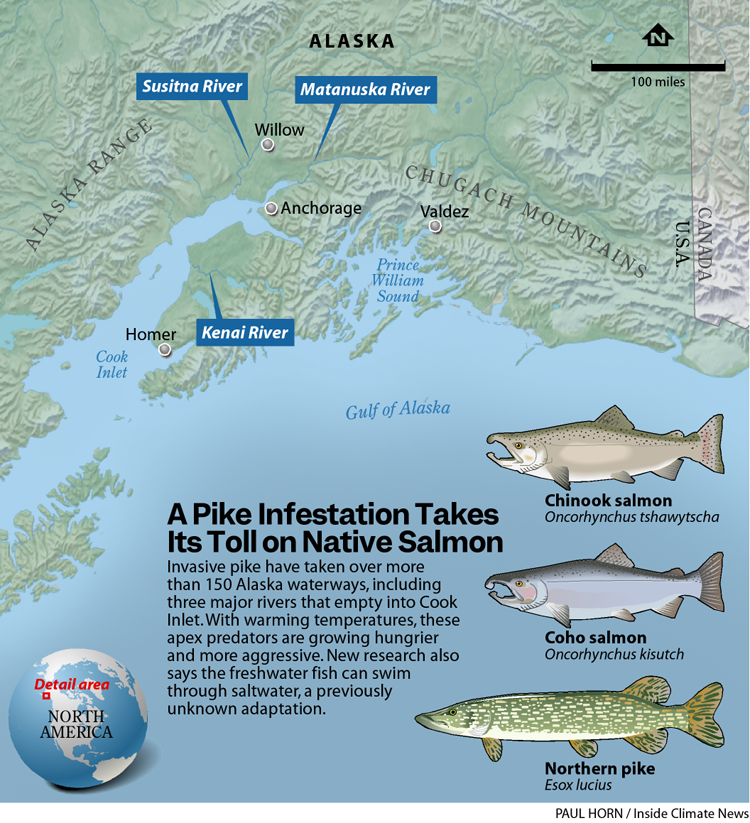
The implications of this discovery for salmon, trout and other species—adult pike are known to eat ducklings, eagle chicks, voles, shrews and even juvenile pike—may be profound. The researchers said their findings underscore the need for urgency in monitoring freshwater systems most vulnerable to pike invasion.
The Deshka River is one of them. An easy drive from Anchorage, the 71-mile river used to be among Alaska’s most premier sportfishing destinations, particularly for Chinook or king salmon. But under a state emergency order, the Deshka and the Susitna River drainage are closed to sport fishing for king salmon this summer due to low productivity.
The number of kings returning to the Deshka to spawn failed to meet minimum standards from 2022 to 2025. In fact, the number of king salmon swimming past a state-operated weir in 2025 was the lowest on record, according to Fish and Game.
Biologists blame myriad factors for causing the decline, including ocean bycatch, competition for food by hatchery salmon, orcas’ dietary fondness for kings and other variables. But warming temperatures, heat stress and pike predation are also high on the list.
Devastation for Lodges
Mike Williams has firsthand experience with the pike problem. A retired Army veteran, Williams and his wife, Paula, used to operate a remote sport fishing lodge nearly 50 miles from the nearest road at the base of Mount Susitna. Like other lodge owners in the area, the Williams family relied on salmon and trout from Alexander Creek, a tributary to the Susitna River, as their bread and butter.
But a steep drop in king and silver salmon due to pike predation, and other factors including warming waters, drove most of the lodges to close their doors in the early 2000s. The Williams family decided to stay, and they now operate a peony farm. But mention northern pike, and Mike Williams has a lot to say.
“We lost our salmon runs due to the invasion of northern pike to the point where the fishery was completely shut down by Fish and Game,” Williams said in an animated voice over the phone.

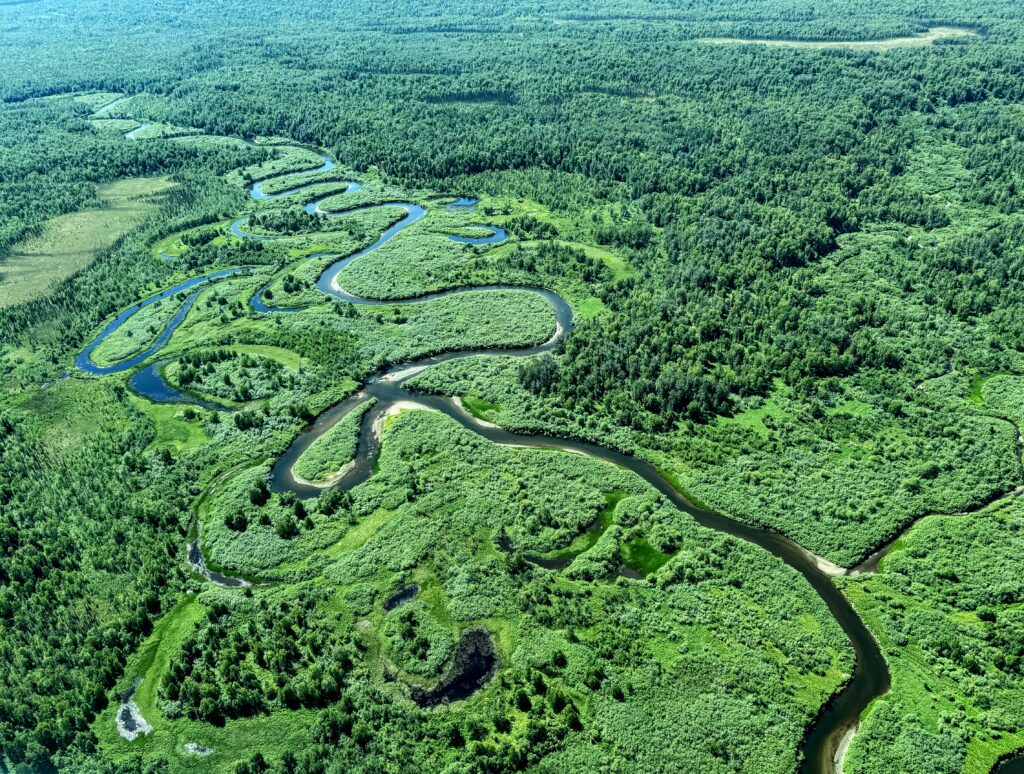
Two dozen or more fishing lodges used to operate up and down the Alexander Creek drainage, he recalled. By 2009, the Williams’ EagleSong lodge was the last one left.
“Everybody shut down and boarded up and left to find work,” Williams said. “It’s not easy to find work in Bush Alaska.”
Bears and wolves that used to fish for salmon in Alexander Creek also have largely left the area, and the duck population is also down, Williams said.
Andy Couch, a longtime guide, fishing columnist and a member of the Mat-Su Borough Fish and Wildlife Commission, commiserates with Williams. He used to start bringing clients out to fish for kings in May. But the explosion of pike and other factors causing the salmon decline have dwindled his business.
Couch used to tell clients they would each have an 80 percent chance of catching a king on multiple rivers he could take them to in Mat-Su. Now the Knik River is the only king salmon river left in the region, he said, and the likelihood of catching one is hit or miss.
“If they’re lucky, they catch one for the boat no matter how many people are on the boat. You know you might get two or three strikes during a trip,” Couch said.
Couch said he’s planning to retire soon. The timing couldn’t be better to close his guiding business.
Adaptation and Coexistence?
Dave Atcheson, a fly-fishing instructor and author, loves to catch pike in their native habitat because they’re feisty and put up a fight when hooked. The Kenai-based angler is heading to Canada’s Yukon Territory soon to catch some because they’re endemic there.
But he worries that fishers new to Southcentral Alaska without a close connection to or personal history with salmon may embrace pike fishing and not understand how devastating the invaders are to native fish and therefore not support suppression efforts.
“I’ve actually heard people say, ‘Oh well, we want to target pike because, you know, they’re fun,” Atcheson said. “I think a lot of newcomers could kind of feel that way.”
This story is funded by readers like you.
Our nonprofit newsroom provides award-winning climate coverage free of charge and advertising. We rely on donations from readers like you to keep going. Please donate now to support our work.
But Atcheson takes the long view. In western and northern Alaska and in the Interior, pike and salmon have evolved to inhabit the same waterways. Maybe in a few thousand years, the same could happen in Anchorage, Mat-Su and other parts of the Cook Inlet drainage, he said.
“North of the Alaska Range, they’ve adapted over the years,” Atcheson said. “They coexist with other species.”
A “Growing Dumpster Fire”
Parker Bradley isn’t waiting around for that to happen. As the regional invasive species coordinator for Fish and Game, and co-author of the recent pike study on saltwater navigation, Bradley is overseeing efforts to suppress pike in Mat-Su, a program that started on Alexander Creek in 2011.
Wiping out the invasive fish entirely in Mat-Su is nearly impossible because they’ve colonized so much territory. So rather than viewing it as an eradication effort, biologists use the term “suppression.” By prioritizing key waterways with efforts like gillnetting and the selective use of a plant-based pesticide called rotenone that kills fish, there’s hope that pike can be contained in places important for sportfishing and related businesses.
When rotenone is applied, biologists and fish techs attempt to trap and relocate salmon and trout, often by helicopter, to other waterbodies outside the treatment zone, Bradley said.

On the recent morning when Ercolani and Thomas Spitz, another fish tech, were trapping and measuring pike, Bradley observed and helped with data collection from the banks of Lake Creek, a languid waterway dotted with yellow pond lilies and other aquatic plants.
The wader-clad biologist candidly described the Mat-Su region as a “growing dumpster fire” for pike predation. But while the situation is alarming, and the science indicates it might get worse, there’s some cause for hope.
Bradley praised the efforts of his crew and touted the pike suppression work of local tribes and partner organizations including Tyonek Tribal Conservation District, Cook Inlet Aquaculture Association, Trout Unlimited and the Big Lake Chamber of Commerce.
“These guys are good at keeping it before it gets out of control or at least knocking it back, hopefully,” Bradley said. “We’re seeing some positive indicators. It’s helping the ecosystem and the salmon.”
About This Story
Perhaps you noticed: This story, like all the news we publish, is free to read. That’s because Inside Climate News is a 501c3 nonprofit organization. We do not charge a subscription fee, lock our news behind a paywall, or clutter our website with ads. We make our news on climate and the environment freely available to you and anyone who wants it.
That’s not all. We also share our news for free with scores of other media organizations around the country. Many of them can’t afford to do environmental journalism of their own. We’ve built bureaus from coast to coast to report local stories, collaborate with local newsrooms and co-publish articles so that this vital work is shared as widely as possible.
Two of us launched ICN in 2007. Six years later we earned a Pulitzer Prize for National Reporting, and now we run the oldest and largest dedicated climate newsroom in the nation. We tell the story in all its complexity. We hold polluters accountable. We expose environmental injustice. We debunk misinformation. We scrutinize solutions and inspire action.
Donations from readers like you fund every aspect of what we do. If you don’t already, will you support our ongoing work, our reporting on the biggest crisis facing our planet, and help us reach even more readers in more places?
Please take a moment to make a tax-deductible donation. Every one of them makes a difference.
Thank you,