

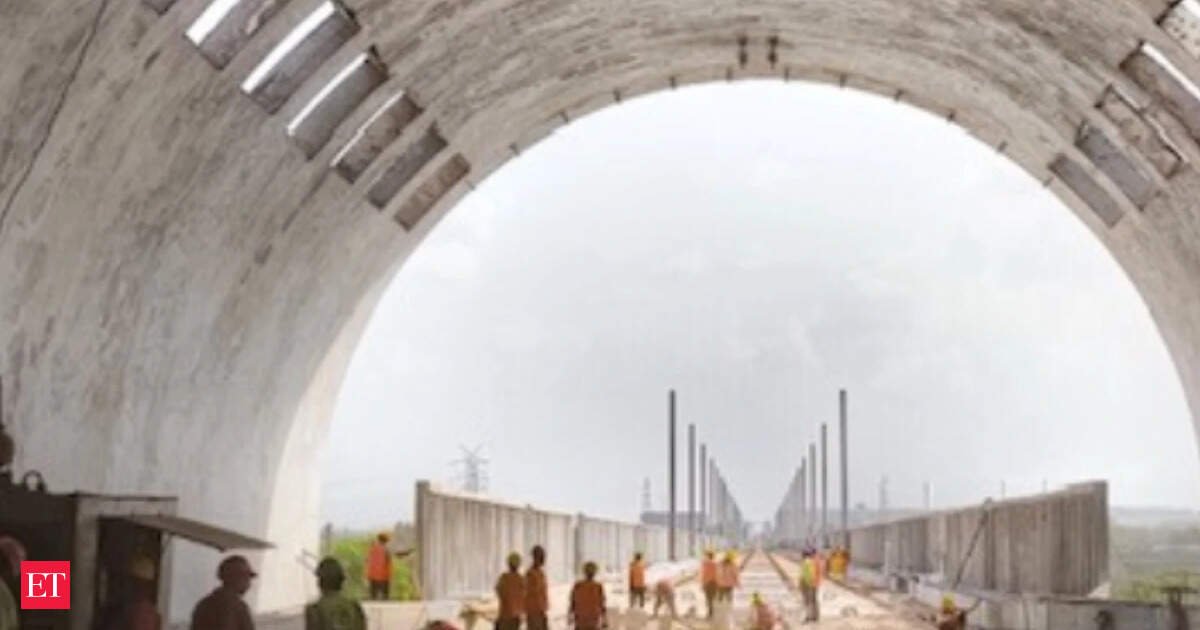
The implementing agency, National High Speed Rail Corporation Limited (NHSRCL), said in a release that the TBM began its drive from Sawli (Ghansoli) towards Vikhroli. Out of this 10-kilometre underground stretch, a “critical 7-km portion will be built under the seabed at Thane Creek, making it the country’s first undersea tunnel for any rail corridor”, it said.
The undersea section forms part of a 21-km underground network for the high-speed rail corridor, out of which 16 km between Sawli and the Bandra Kurla Complex (BKC) in Mumbai is being executed using TBMs, it said.
The remaining 5-km section has already been completed using the New Austrian Tunnelling Method. The first TBM previously commenced its 6-km drive from Vikhroli towards BKC on July 5.
“This TBM is among the largest ever deployed for rail tunnel construction in India,” said the NHSRCL release.

The machine features a cutterhead with a diameter of 13.6 metres, equivalent to the height of a four-storey building, and weighs 3,200 tonnes, “comparable to the weight of 500 Asian elephants”. The entire machine spans a length of 96 metres, it said.
The machine utilises a “pressurised liquid bentonite slurry circuit to actively stabilise the tunnel face during excavation”, it said, adding that this technology was chosen to minimise surface disruption in the urban Mumbai suburban sector.The project executing agency has incorporated multi-tiered safety systems for the underground operation, it said.
Besides an active water sprinkler network along the designated escape routes, the TBM is also fitted with a real-time multi-gas monitoring system to track the levels of methane, oxygen, carbon monoxide, and carbon dioxide, the release said.
“The surface shaft area has been equipped with a comprehensive support ecosystem including water and slurry treatment plants, bentonite storage tanks, a dedicated power substation with backup generators, and a ready-mix concrete plant for grouting,” it said.
To protect nearby urban structures and ensure long-term structural durability, a real-time monitoring network featuring surface settlement points, optical displacement sensors, strain gauges, and seismographs has been deployed, the NHSRCL said.
The 508-kilometre Mumbai-Ahmedabad bullet train corridor is being constructed at an estimated Rs 1.08 lakh crore. As per the shareholding pattern, the Government of India is to pay Rs 10,000 crore to the NHSRCL, while the two states involved, Gujarat and Maharashtra, are to pay Rs 5,000 crore each. The rest is to be paid by Japan through a long-term loan at 0.1 per cent interest.