

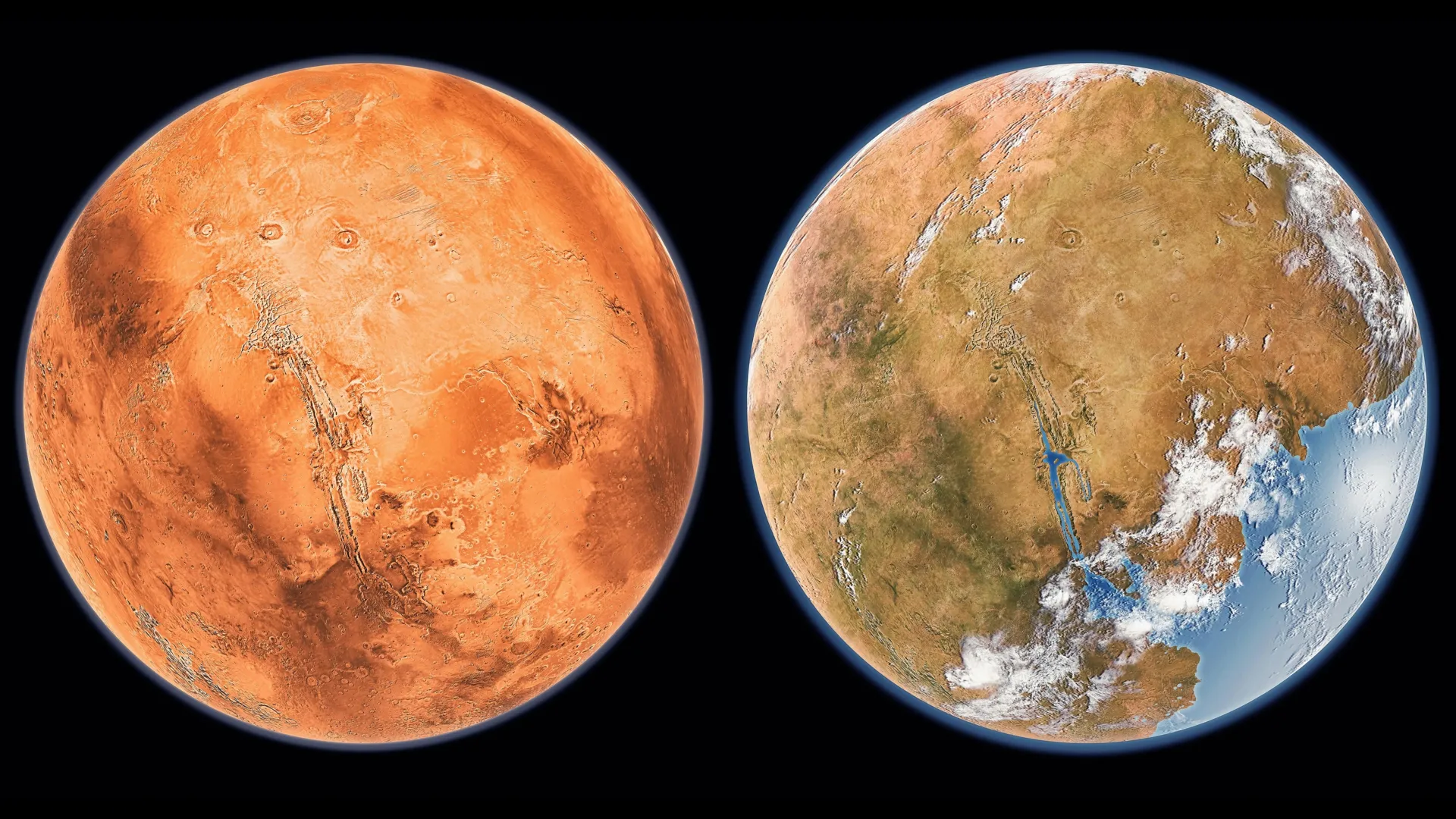
Terraforming is the process of reshaping a planet or moon so it can support humans and other Earth-like life. In theory, that means changing an alien world’s atmosphere, climate, and surface to more closely resemble Earth’s by adding oxygen, creating stable bodies of liquid water, and producing temperatures suitable for life. Mars has long been considered the leading candidate, with proposals ranging from releasing greenhouse gases to warm the planet to using microorganisms that could slowly generate oxygen over many centuries.
For decades, the concept of terraforming Mars has lived mostly in the realm of science fiction. Although the vision of turning the cold, dusty planet into a living world has inspired generations, most scientists viewed it as far beyond our technological reach. A new workshop summary, however, argues that recent advances mean terraforming should now be treated as a legitimate area of scientific research, even if any real attempt remains far in the future.
Dr. Erika DeBenedictis, CEO of Pioneer Labs, authored the summary prepared for the 2025 Green Mars Workshop. She argues that while terraforming Mars was effectively impossible just a few decades ago, major technological progress has changed that assessment. Potentially dramatic reductions in launch costs from SpaceX’s Starship, along with breakthroughs in synthetic biology and climate modeling, have shifted the discussion. Rather than asking whether terraforming violates the laws of physics, researchers believe the more important questions are whether humanity should pursue it and what the safest path would look like.
A Roadmap for Terraforming Mars
Instead of beginning with today’s technology, the workshop summary starts by imagining what a habitable Mars might eventually look like and then works backward to identify the steps needed to get there.
The first stage would focus on warming the planet. Researchers envision increasing Mars’s average temperature by several tens of degrees over a few decades using engineered aerosols or greenhouse gases. Studies suggest Mars contains enough frozen water to eventually produce an ocean covering nearly four million square kilometers with an average depth of about 300 meters. Raising temperatures by roughly 30 degrees Celsius could begin melting those ice reserves, allowing stable liquid water to appear on the surface.
Engineered Microbes Could Play a Key Role
Once conditions become less hostile, the next step would involve introducing microbial life.
Researchers propose engineering extremophiles, microbes that naturally survive harsh environments, by combining characteristics such as resistance to extreme temperatures, radiation, and low atmospheric pressure. These specially designed organisms could potentially spread across Mars in algae-like layers within decades. Through photosynthesis, they would begin the extremely slow process of altering the planet’s atmosphere.
Building a Breathable Atmosphere
Creating an oxygen-rich atmosphere capable of supporting complex life would require centuries, and likely much longer.
The researchers envision beginning inside enormous domed habitats about 100 meters tall. Within these enclosed environments, breathable oxygen could be produced through photosynthesis or water electrolysis. Over time, vegetation spreading beyond the domes could gradually add oxygen to the wider atmosphere, although the team estimates that natural oxygen production alone would require roughly a thousand years. If successful, future explorers might eventually live on Mars without relying on protective domes.
Major Scientific Unknowns Remain
The proposal also highlights fundamental questions that must be answered before any large-scale effort could even be considered.
Scientists still do not know what lies beneath Mars’s vast ice sheets. They also need a better understanding of how dust storms might change if the planet became warmer and wetter. Another important question is whether Mars contains enough of the materials required for large-scale water electrolysis or whether those resources would have to be transported from Earth at enormous expense.
Ethical Questions About Changing Mars
The scientific obstacles are only part of the challenge. Terraforming Mars would also raise profound ethical questions.
Any large-scale transformation of the planet could permanently erase parts of its natural history, limiting future opportunities to study Mars in its original state. If indigenous Martian life exists, even as microscopic organisms, introducing Earth-based life could destroy it before it is ever fully understood.
At the same time, the researchers argue that studying terraforming could produce important benefits closer to home. Technologies developed for sustaining life on Mars, including desiccation-resistant crops and efficient closed-loop life support systems, could improve sustainability on Earth. Advances in environmentally friendly technologies designed for space exploration may also find valuable applications here on our own planet.
As a not-so-closet space enthusiast, I find the shift in thinking especially interesting. The workshop summary is not proposing that humanity begin terraforming Mars tomorrow. Instead, it calls for careful laboratory research, more sophisticated climate modeling, and perhaps small-scale experiments on future Mars missions to explore localized warming techniques.
Before attempting to reshape an entire planet, we first need a much deeper understanding of Mars itself, along with the scientific, environmental, and ethical consequences of altering it. The conversation is gradually shifting away from asking “could we?” and toward asking “should we, and if so, how?” That may be the most meaningful step forward so far.