

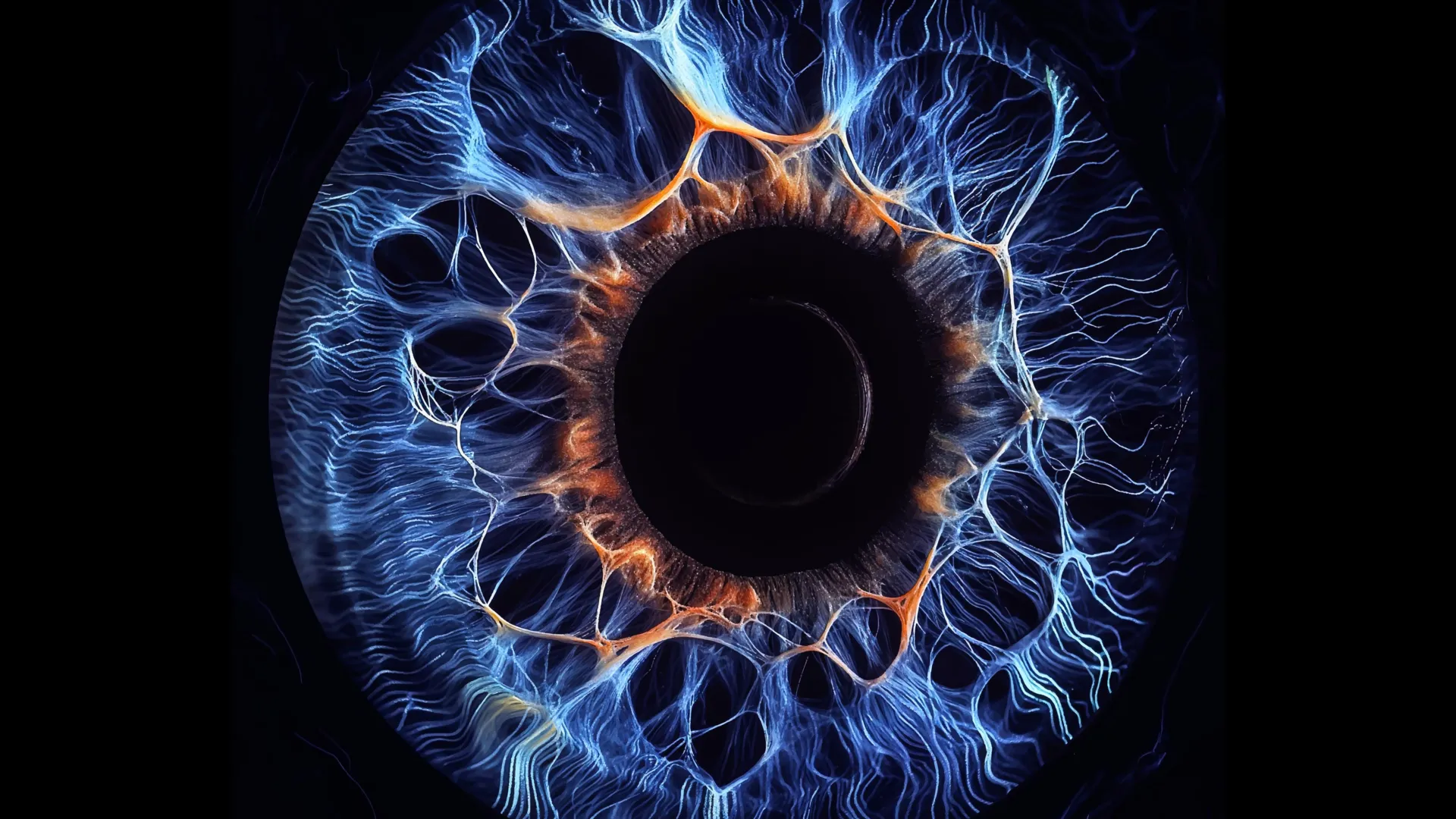
A new study from Yale School of Medicine (YSM) suggests that the eye processes visual information in a far more connected way than scientists had believed. The findings challenge a long standing view of how visual signals travel through the retina and may help explain how we detect faint objects or see in low light.
Our visual system rapidly analyzes many different features of a scene, including color, contrast, motion, and shape. This process, known as parallel visual processing, allows the brain to interpret complex images almost instantly by sending different types of information along separate pathways.
Researchers have long believed these pathways remained largely independent as visual signals moved through the retina and into the brain. However, the new study, published in Neuron, found that these channels are closely linked through hidden electrical connections. According to the research team, this cooperation may strengthen weak visual signals before they move deeper into the visual system.
“We found that while different channels can deliver their own features, they’re also interconnected by underlying electrical circuitry,” says Yao Xue, PhD, a postdoctoral fellow in the Department of Ophthalmology and Visual Science at YSM and the study’s first author.
Bipolar Cells Form an Unexpected Communication Network
Vision begins when rods and cones in the retina detect light. These specialized cells pass information to neurons known as bipolar cells. At this stage, visual information is sorted into more than a dozen parallel channels that process features such as daylight, nighttime vision, color, contrast, and shape.
When the researchers closely examined the synapses, the tiny junctions where bipolar cells communicate, they found something unexpected. Instead of remaining isolated, the supposedly separate channels were sharing information with one another.
Neurons communicate through two main types of synapses: chemical and electrical. Chemical synapses use neurotransmitters to pass messages between cells, while electrical synapses, also called gap junctions, transmit signals through direct electrical currents. Bipolar cells were generally thought to rely mainly on chemical communication.
The new study found that in both mouse and human retinas, electrical synapses were connecting most of these separate information channels. When the team electrically stimulated a single bipolar cell, the response spread well beyond that one pathway. Rather than seeing neurotransmitter release confined to one channel, they observed broad, cloud like patterns of activity, revealing extensive communication between different bipolar cell types.
“When we stimulated one bipolar cell, many bipolar cells released neurotransmitters,” says Z. Jimmy Zhou, PhD, Marvin L. Sears Professor of Ophthalmology and Visual Science and principal investigator.
The researchers also identified one bipolar cell type, known as BC6, that appeared to play a leading role in coordinating this network. Signals originating from BC6 spread through multiple visual pathways in an organized, hierarchical pattern.
“People had assumed that the different types of bipolar cells were more or less autonomous,” Zhou says. “But we found a driver among all these cell types that creates this network with a hierarchy.”
The scientists say this combination of specialized pathways and electrical communication offers the retina the best of both approaches. Separate channels can focus on specific visual features, while their connections allow information to be shared when signals are especially weak.
“If the signal is already very weak and is divided into several channels, there isn’t much left for each channel to process,” says Seunghoon Lee, PhD, a research scientist in the Department of Ophthalmology and Visual Science at YSM and co-corresponding author of the study. “The integration is particularly useful for detecting low contrast signals or signals from very small objects.”
“And the cells aren’t cooperating in a random way,” adds Xue. “There’s a commander within them — BC6 — that leads them in relaying signals to the downstream target.”
Recording Signals in Intact Retinas
To map these communication networks, the team combined several experimental techniques. They used advanced imaging to monitor how bipolar cells released and responded to neurotransmitters, while also stimulating individual cells and recording the responses of neighboring cells.
Studying bipolar cells has long been difficult because they sit deep within the retina. Earlier experiments often required cutting the retina into slices to reach them, a process that could disrupt the natural circuitry researchers wanted to examine.
For this study, the Yale team successfully used a dual patch clamp technique on fully intact mouse retinas. Using electrodes, they stimulated specific bipolar cell types while simultaneously recording how neighboring cells responded.
“No other lab in the world has been able to pull off these kinds of recordings systematically,” says Zhou. “It is a tour de force of Yao Xue’s PhD thesis work, pairing an innovative approach with exceptional electrophysiological skill.”
The researchers then repeated the experiments using intact human retinas obtained through the Department of Pathology’s Legacy Tissue Donation Program. According to the team, these are the first experiments of this kind ever performed in an intact human retina.
What the Discovery Could Mean
Because the retina is part of the central nervous system, the researchers say these findings may have implications beyond vision. Understanding how retinal circuits process information could provide new insights into how other neural networks in the brain function.
The work could also improve scientists’ understanding of diseases that damage the retina, including macular degeneration, glaucoma, and congenital night blindness.
The researchers also say the study highlights the value of curiosity driven science. Rather than testing a single predefined idea, the experiments uncovered a previously unknown mechanism that changes how scientists think about visual processing.
“Our experiments didn’t begin with a specific hypothesis but revealed a fundamental processing mechanism in the visual system,” says Lee. “It’s an important reminder of how essential curiosity-driven research is to discovery.”