

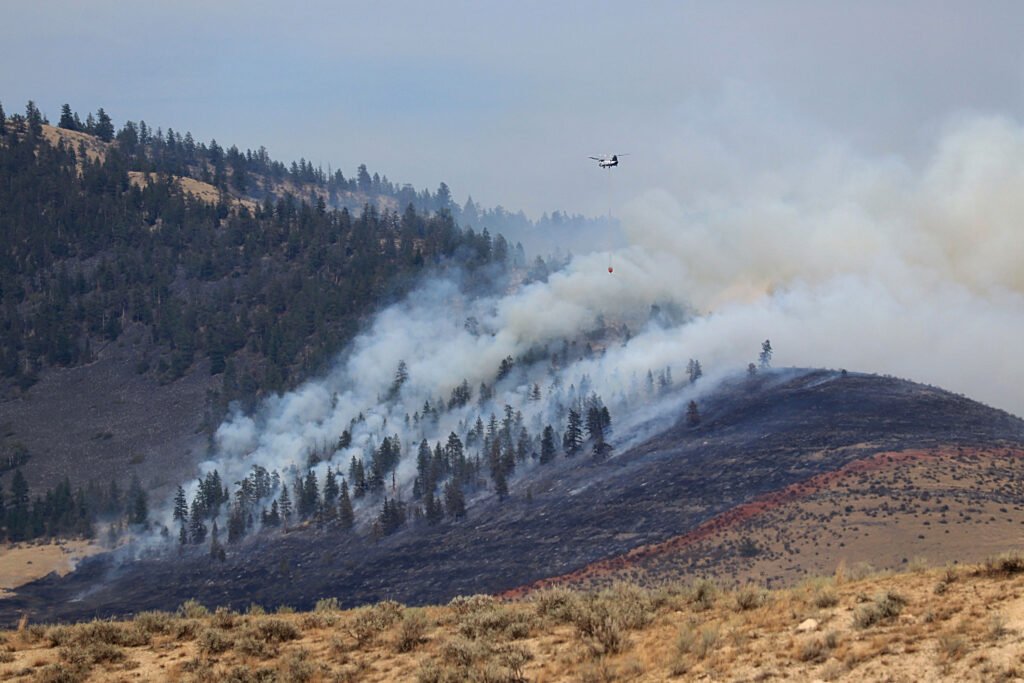
Montana officials are warning that the 2026 wildfire season could bring above-normal fire risk to parts of the state, driven by a mix of drought conditions, wind events and warmer-than-average winter temperatures.
At a statewide wildfire outlook briefing on Tuesday, Gov. Greg Gianforte joined state, local and federal officials to discuss preparedness for the upcoming fire season, including expected weather patterns, firefighter staffing levels, funding availability and new technologies being deployed to detect and respond to fires more quickly.
“As we look ahead to the season, our goal is straightforward: be prepared,” Gianforte said. “Work together to protect Montana families, homes, communities and the natural resources that support our incredible way of life.”
Firefighter and public safety will remain the top priority, he said, adding that the state is committed to aggressively containing fires while they are still small.
The Montana Department of Natural Resources and Conservation said it is fully staffed and ready for the fire season. However, officials stressed that wildfire response depends on coordination across state, local, federal and tribal agencies. And the initial attacks on small fires are usually done by local resources, many of them volunteer departments that have faced recruitment challenges, despite their critical role.
“Are our local fire services totally prepared? We’d like to say yes, but we are challenged,” said Rich Cowger, president emeritus of the Montana State Fire Chiefs, who noted that more than 300 local fire departments protect over 45 million acres across the state. “Our volunteer systems are stretched. Volunteerism today isn’t what it was in years past,” he said.
That challenge comes as fire departments across Montana are facing growing demand for emergency response services. In 2000, when Karl Weeks, the fire chief of the Columbia Falls Fire Department, started volunteering, the department responded to about 170 calls each year. But over the last two decades, that’s increased, especially in the last two years. In 2020, the department responded to 305 calls; in 2022, it responded to 357— a 17 percent increase. (The fire department doesn’t do medical calls unless the local ambulance service, Three Rivers EMS, isn’t available.)
Federal firefighting operations within the U.S. Department of the Interior, where firefighters from several agencies were combined into the new U.S. Wildland Fire Service, and in the U.S. Forest Service, which holds the largest number of federal wildland firefighters, are also undergoing restructuring this year, though officials said personnel with firefighting duties are expected to remain available when needed. In 2025, about 1400 of the 4200 people who took deferred resignations from the USFS as part of the Department of Government Efficiency’s effort to reduce the federal workforce were credentialled to fight wildfires but held other jobs and only responded to fires when needed. The Forest Service asked many of those employees to return to work during last summer’s fire season, but not all of them did.
Meteorologists with the U.S. Wildland Fire Service said Montana experienced a complex winter shaped by ongoing drought in some regions, major wind events and unusually warm winter temperatures. While recent precipitation has helped in parts of the state, the outlook remains uneven. Predictive meteorologist Dan Borsum, with the USWFS’s Northern Rockies Coordination Center, warned that eastern Montana could see above-normal fire potential through July, with risks shifting to southwest Montana later in the summer and expanding into the Bitterroot region in August.
This story is funded by readers like you.
Our nonprofit newsroom provides award-winning climate coverage free of charge and advertising. We rely on donations from readers like you to keep going. Please donate now to support our work.
Of particular concern to fire managers is the threat of dry thunderstorms over Idaho and Montana that produce lightning strikes but no rain, which have historically been responsible for igniting some of the most damaging fires in the Pacific Northwest. Dry lightning from a single thunderstorm cell can ignite dozens of fires simultaneously, overwhelming initial attack resources. The long-term weather forecast from the National Interagency Fire Center in Boise noted there is “higher potential for thunderstorms further north and east across the mountains of Idaho and most of Montana.”
Recent Montana fire seasons have been relatively less severe. In 2025, about 76,000 acres burned statewide—the fourth-lowest total in the past 15 years. However, officials noted that even relatively quiet fire years can still be extremely costly. The Windy Rock Fire in Powell County, for example, cost roughly $56 million to suppress, ranking among the most expensive firefighting efforts in state history.
Despite the anticipation of a more active fire season, Gov. Gianforte was confident the state had adequate funding to confront it.
“The legislature has been very good in giving us resources,” he said. “The fire fund refills itself on August 15, and we have ways to get to August 15, so we’re in good shape.”
State officials also highlighted significant investments in wildfire suppression technology. One key development includes aircraft equipped with infrared sensors mounted on wing tips that can fly over areas after thunderstorms from which lightning might have ignited fires and detect heat signatures on the ground long before smoke is visible, allowing firefighters to respond quickly before small fires grow into major incidents.
Officials at Tuesday’s briefing also stressed that public behavior plays a major role in wildfire risk, noting that about three-quarters of wildfires in Montana are human-caused. They urged residents to remain cautious, stay prepared and have evacuation plans in place, as every community in the state could be affected during wildfire season.
Early-season wildfires have already sent crews scrambling across the Greater Yellowstone region and beyond, and with the revamping of the federal firefighting systems in charge of protecting public lands still underway, there are many open questions about how the response to wildfires on federal lands will come together during the coming season.
About This Story
Perhaps you noticed: This story, like all the news we publish, is free to read. That’s because Inside Climate News is a 501c3 nonprofit organization. We do not charge a subscription fee, lock our news behind a paywall, or clutter our website with ads. We make our news on climate and the environment freely available to you and anyone who wants it.
That’s not all. We also share our news for free with scores of other media organizations around the country. Many of them can’t afford to do environmental journalism of their own. We’ve built bureaus from coast to coast to report local stories, collaborate with local newsrooms and co-publish articles so that this vital work is shared as widely as possible.
Two of us launched ICN in 2007. Six years later we earned a Pulitzer Prize for National Reporting, and now we run the oldest and largest dedicated climate newsroom in the nation. We tell the story in all its complexity. We hold polluters accountable. We expose environmental injustice. We debunk misinformation. We scrutinize solutions and inspire action.
Donations from readers like you fund every aspect of what we do. If you don’t already, will you support our ongoing work, our reporting on the biggest crisis facing our planet, and help us reach even more readers in more places?
Please take a moment to make a tax-deductible donation. Every one of them makes a difference.
Thank you,

Fellow
Mosabber Hossain is an award-winning climate and environmental investigative journalist from Bangladesh. His reporting focuses on climate change, biodiversity, environmental justice, adaptation and corruption. His work with Reuters and other international outlets has been republished globally, and some of his reporting contributed to discussions featured on the agenda of the World Economic Forum. Mosabber is a graduate student at the University of Montana studying environmental science and natural resource journalism. He received masterclass training from the Reuters Institute for the Study of Journalism Climate Journalism Network at the University of Oxford, with special focus on heat reporting projects.